A permutation is a (possible) rearrangement of objects.
For example,
there are 6 permutations of the letters a, b, c:
.
We know that we have them all listed above
—there are 3 choices for which letter we put first,
then 2 choices for which letter comes next,
which leaves only 1 choice for the last letter.
The multiplicative principle says we multiply .
A piece of notation is helpful here:
, read “ factorial”,
is the product of all positive integers less than or equal to
(for reasons of convenience, we also define 0! to be 1).
So the number of permutation of 6 letters,
as seen in the previous example is .
This generalizes:
Sometimes we do not want to permute all of the letters/numbers/elements we are given.
In general, we can ask how many permutations exist of objects choosing those objects from a larger collection of objects.
(In the example above, , and .)
We write this number and sometimes call it a
-permutation of elements.
From the example above,
we see that to compute we must apply the multiplicative principle to numbers,
starting with and counting backwards.
For example
.
Notice again that starts out looking like ,
but we stop after 7.
We can formally account for this “stopping”
by dividing away the part of the factorial we do not want:
.
Careful: The factorial in the denominator is not but rather .
Note that when , we have
(since we defined to be 1).
This makes sense
—we already know gives the number of permutations of all objects.
Here is another way to find the number of -permutations of elements:
first select which elements will be in the permutation,
then count how many ways there are to arrange them.
Once you have selected the objects,
we know there are ways to arrange (permute) them.
But how do you select objects from the ?
You have objects, and you need to
choose of them.
You can do that in ways.
Then for each choice of those elements,
we can permute them in ways.
Using the multiplicative principle,
we get another formula for :
.
Now since we have a closed formula for already,
we can substitute that in:
.
If we divide both sides by we get a closed formula for .
We say counts permutations,
and counts combinations.
The formulas for each are very similar,
there is just an extra in the denominator of .
That extra accounts for the fact that
does not distinguish between the different orders that the objects can appear in.
We are just selecting
(or choosing)
the objects, not arranging them.
Perhaps “combination” is a misleading label.
We don't mean it like a combination lock
(where the order would definitely matter).
Perhaps a better metaphor is a combination of flavors
— you just need to decide which flavors to combine,
not the order in which to combine them.
To further illustrate the connection between combinations and permutations,
we close with an example.
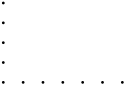
How many triangles are there with vertices from the points shown below?
Note, we are not allowing degenerate triangles - ones with all three vertices on the same
line,
but we do allow non-right triangles.
Explain why your answer is correct.
If you pick any three points, you can get a triangle, unless those three points are all on
the -axis or on the -axis. There are other ways to start this as well, and any
correct method should give the same answer.
120.
We have seen that the formula for is . Your task here is to
explain why this is the right formula.
Suppose you have 12 chips, each a different
color. How many different stacks of 5 chips can you make? Explain your answer and why it is
the same as using the formula for .
Using the scenario of the
12 chips again, what does count? What does count? Explain.
Explain why it makes sense to divide by when computing (in terms
of the chips).
Does your explanation work for numbers other than 12 and
5? Explain the formula using the variables and .
Discrete Mathematics: An Open Introduction, 3rd edition, by Oscar Levin (discrete.openmathbooks.org), licensed under CC BY-SA 4.0; this adaptation is distributed under the same license. License: CC-BY-SA-4.0.
These eBooks are a prerelease and are not yet certified conformant with WCAG 2.1 AA or ADA Title II. Every page is built against an automated accessibility gate, and the published editions will meet ADA Title II requirements when they release in late September 2026. If something is unusable, please tell us.