
4.2 The Pendulum and Its Energy
A pendulum — a mass on a rigid rod of length — obeys . For small swings , and this is Chapter 2's spring: oscillation at the natural frequency . But a pendulum is not a spring. Push it hard enough and it goes over the top, something no linear equation ever does, so this section keeps the sine. Measuring time in units of scrubs out the constants, leaving
or, as a system, , , where is the angle from straight down and the angular velocity.
The system rests wherever and : the points . At even multiples of the pendulum hangs straight down; at odd multiples it balances upside down. Near the bottom, gives the center — closed loops, dimensionless period . Near the top, setting gives : precisely the saddle in disguise from the last section, eigenvalues . So the portrait must alternate — center, saddle, center, saddle — forever along the -axis. What no linearization can say is how these local pictures knit together, and for that the pendulum volunteers a global gift. Multiply by and recognize both terms as derivatives: . The energy
The linearization of , at any point, computed from the system itself. The alternation is visible in one entry: is at the hanging equilibria and at the inverted ones — the sign flip that turns each center into a saddle and back.
At the Jacobian is , so is the polynomial shown — whose roots are the eigenvalues named above, one positive and one negative, which is exactly what a saddle is. ( stands for .)
— kinetic plus potential — is constant along every solution. That is a confession of imprisonment: each solution is confined for all time to a single level curve of . To draw the complete phase portrait of an unsolvable nonlinear equation, no solving is required. Draw the contour map of .
 Explore in 3D (opens in a new tab)
Explore
- Observe. Three families of curves, three kinds of motion. The nested ovals around and are back-and-forth swings; the open curves running the full width of the window are whirls, over the top in the same direction forever; and the cat's-eye curve crossing itself at — the separatrix — is the frontier between them.
- Predict. No arrows are drawn. Use : in the upper half-plane must increase. Which way do the ovals circulate, and which way do the upper whirl curves run? Decide, then check that the lower half-plane tells a consistent story.
- Verify. The separatrix carries the energy of the balanced-upright state, . Setting in gives : the cat's-eye should stand exactly grid units above and below the origin. Check it against the grid.
- Observe. The whirl curves undulate: farthest from the axis over and , closest over . A whirling pendulum is fastest through the bottom and slowest over the top — readable straight off the map.
- Predict, then verify. An oval reaching maximum angle has , so it crosses the -axis at height . For the oval reaching out near , predict the height of its top — about — then check.
The Lift
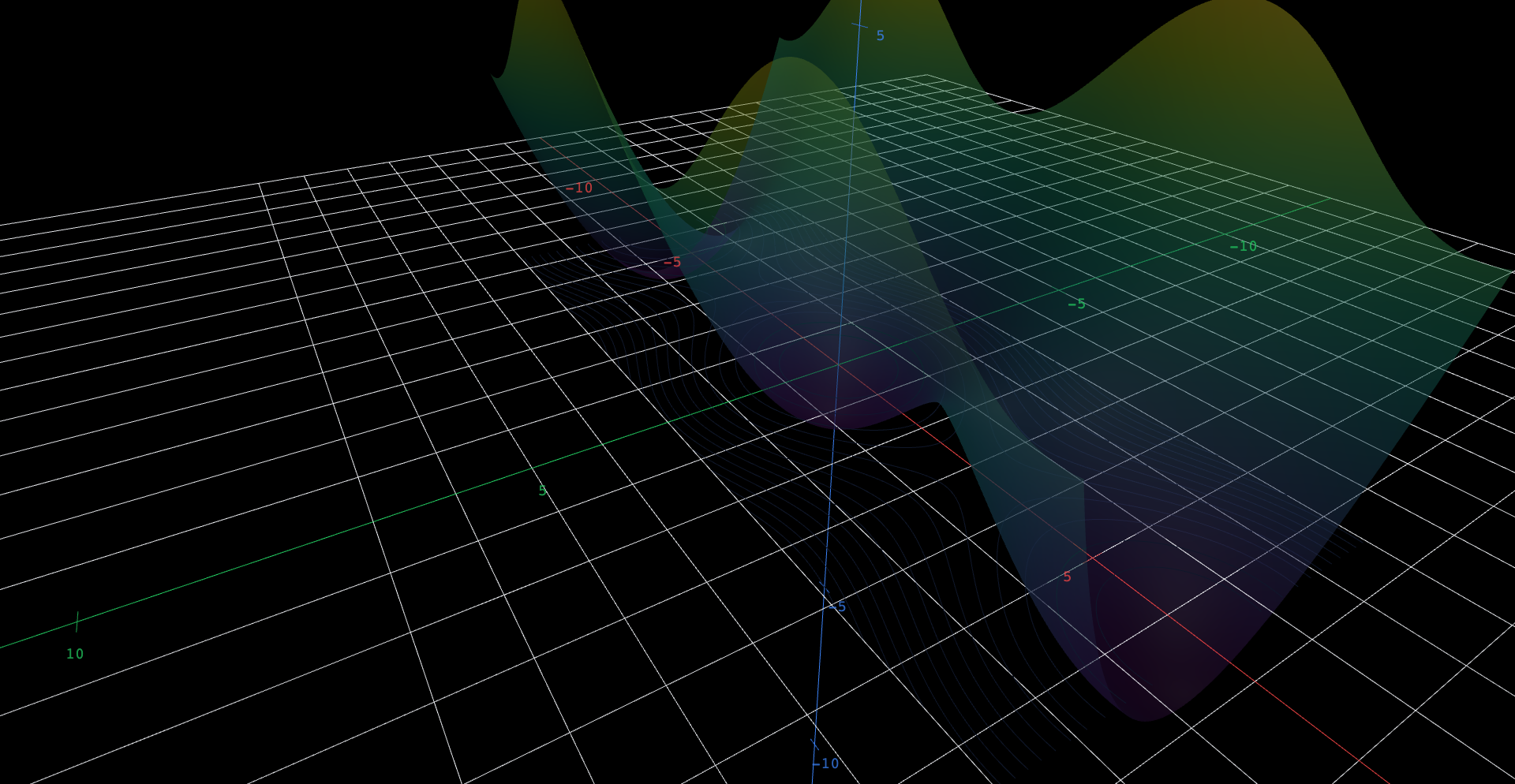
Why should the level curves of a function be the orbits of a system? The most convincing answer is to stop flattening. is a function of two variables, so it is a landscape — a surface standing over the phase plane — and a level curve is a horizontal slice of that landscape, dropped to the floor. The second figure performs the lift.
 Explore in 3D (opens in a new tab)
- Observe. The surface is an egg carton stretched along the -direction — bowls at the hanging equilibria, passes between them — with walls climbing like toward the front and back. Orbit the camera until you can see one floor curve and the surface slice directly above it at the same time.
- Predict, then verify. A horizontal slice below pass height () is trapped inside one bowl; dropped to the floor it is a closed ring around a well — a swing. A slice above every pass () clears the whole range and runs unbroken from end to end — a whirl. Match each family on the floor to its slice height on the surface.
- Observe. The slice at exactly pass height, , pinches onto the passes themselves: dropped down, it is the separatrix, crossing itself precisely at the saddle points. The frontier between swinging and whirling is the altitude of a mountain pass.
Connect
One picture now settles questions that formulas struggle with. The bottom equilibrium is the floor of a bowl, and nearby slices are small closed rings: a pendulum nudged from rest swings near rest forever — stable, though not attracting, since nothing here dissipates. The top equilibrium is a mountain pass, terrain falling away on two sides, the slice through it crossing itself: the saddle instability of the last section, now with a topographic reason. Even timing is visible: ovals deep in a bowl are traversed with period near , ovals near the separatrix take longer and longer, and the separatrix itself takes forever — released ever closer to upside down, the pendulum hangs ever longer near the top before committing.
The landscape also explains what conservation costs. Add a little friction, , and the energy obeys : the state can no longer hold its altitude and slides downhill across the level sets, every swing and every whirl eventually spiraling into some well. The contour map stops being the portrait, but the landscape still governs — now as terrain being descended. That is Chapter 2's inward spiral, seen from above.
Crossing the Threshold
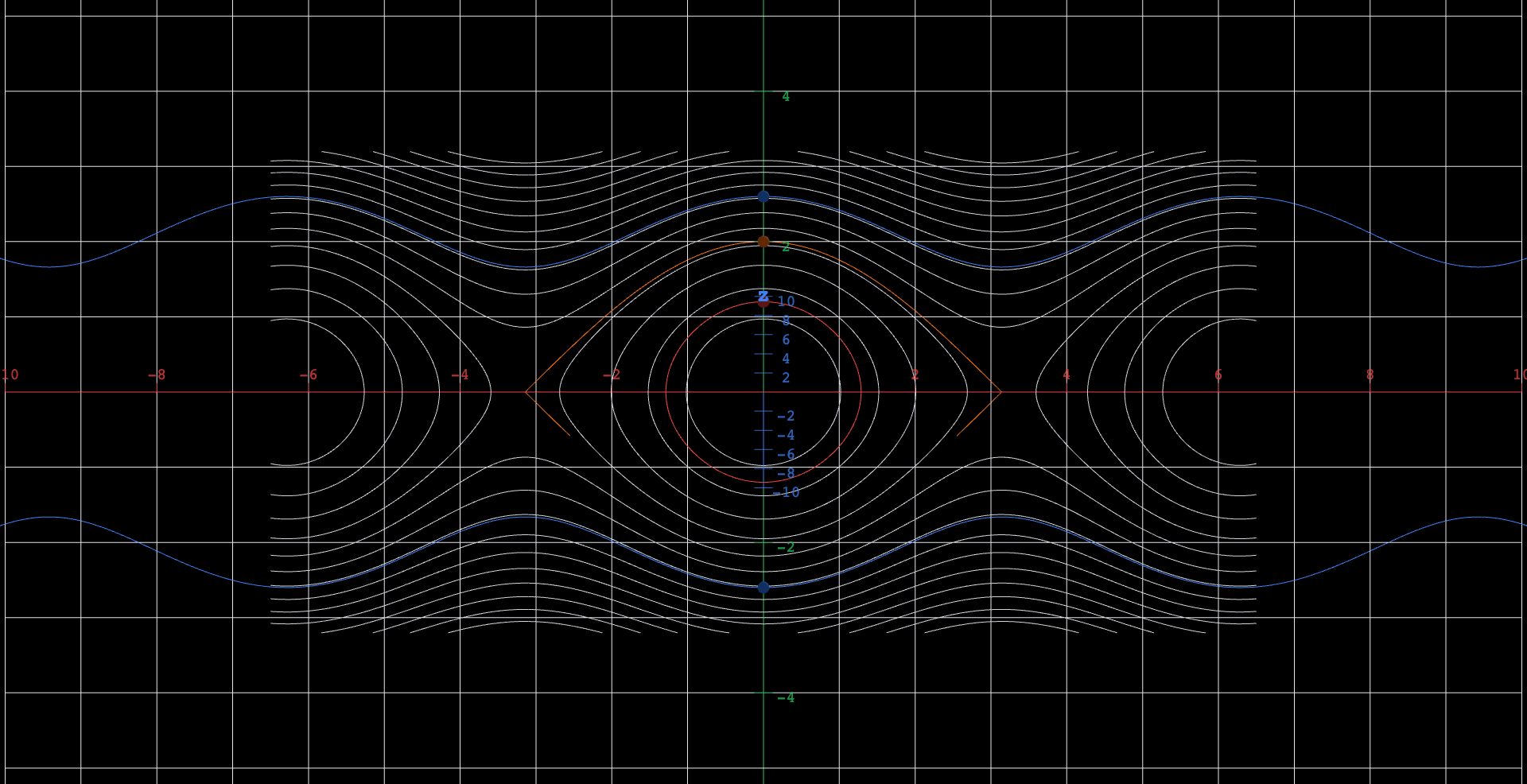
The contour map is an argument from conservation: orbits must lie on level curves, so drawing the levels draws the orbits. It is worth watching the same picture arrive by a completely different route — integrating the system forward in time, step by step, with no mention of energy at all. The figure below launches the pendulum from the bottom at three speeds, one either side of the threshold and one exactly on it, and integrates.
 Explore in 3D (opens in a new tab)
- Observe. Follow the red trajectory. It closes on itself — the pendulum returns to its starting state and repeats forever. Which family of the contour map does it belong to?
- Predict. The orange launch is exactly at the threshold energy. Before looking closely: does it reach the balance point at , and if it does, what happens next?
- Verify. Trace the orange curve toward . It flattens and slows without arriving, because arriving would mean sitting at an equilibrium — and a solution that reaches an equilibrium in finite time would have to leave it again, which no solution of an autonomous system does.
- Observe. The blue curve never returns to the axis: it runs off the right edge, having gone over the top. Its downward-launched twin runs off to the left. Compare their undulation with the map's whirl curves.
- Predict, then verify. Each computed curve should lie exactly on top of one faint contour line, because energy is conserved along solutions. Check one, and say what a visible drift off the contour would have told you about the integrator rather than about the pendulum.
An original work of XYZ Homework, built around interactive XYZ 3D figures, following the standard first-course sequence (first-order equations through systems and the phase plane). Distinct from the LibreTexts-sourced Differential Equations for Engineers (Lebl) edition, which has its own attribution. License: CC-BY-NC-SA-4.0.