
29.8 The Particle-Wave Duality Reviewed
Learning Objectives
By the end of this section, you will be able to:
- Explain the concept of particle-wave duality, and its scope.
Particle-wave duality—the fact that all particles have wave properties—is one of the cornerstones of quantum mechanics. We first came across it in the treatment of photons, those particles of EM radiation that exhibit both particle and wave properties, but not at the same time. Later it was noted that particles of matter have wave properties as well. The dual properties of particles and waves are found for all particles, whether massless like photons, or having a mass like electrons. (See Figure 29.24.)
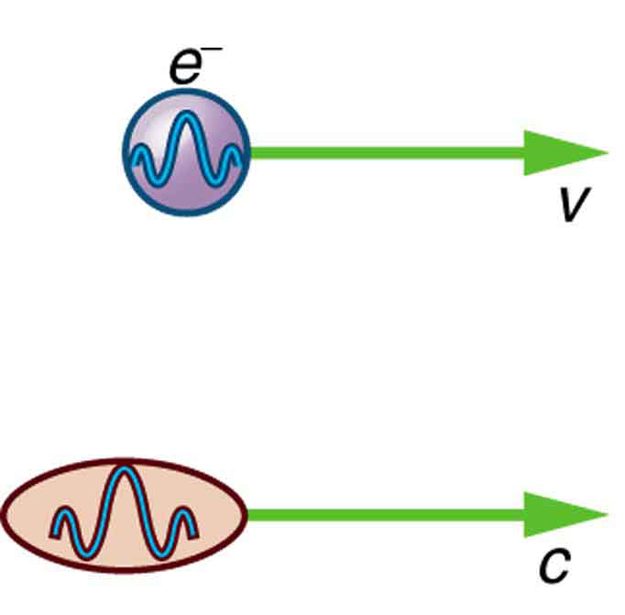
There are many submicroscopic particles in nature. Most have mass and are expected to act as particles, or the smallest units of matter. All these masses have wave properties, with wavelengths given by the de Broglie relationship . So, too, do combinations of these particles, such as nuclei, atoms, and molecules. As a combination of masses becomes large, particularly if it is large enough to be called macroscopic, its wave nature becomes difficult to observe. This is consistent with our common experience with matter.
Some particles in nature are massless. We have only treated the photon so far, but all massless entities travel at the speed of light, have a wavelength, and exhibit particle and wave behaviors. They have momentum given by a rearrangement of the de Broglie relationship, . In large combinations of these massless particles (such large combinations are common only for photons or EM waves), there is mostly wave behavior upon detection, and the particle nature becomes difficult to observe. This is also consistent with experience. (See Figure 29.25.)
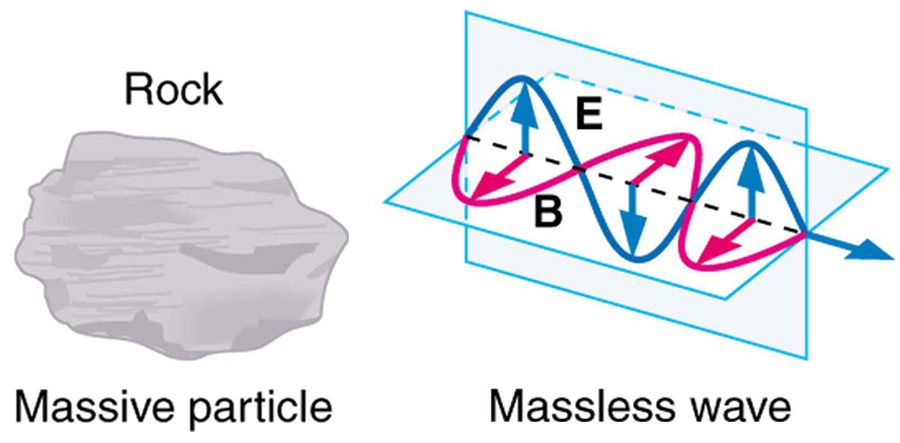
The particle-wave duality is a universal attribute. It is another connection between matter and energy. Not only has modern physics been able to describe nature for high speeds and small sizes, it has also discovered new connections and symmetries. There is greater unity and symmetry in nature than was known in the classical era—but they were dreamt of. A beautiful poem written by the English poet William Blake some two centuries ago contains the following four lines:
To see the World in a Grain of Sand
And a Heaven in a Wild Flower
Hold Infinity in the palm of your hand
And Eternity in an hour
Integrated Concepts
The problem set for this section involves concepts from this chapter and several others. Physics is most interesting when applied to general situations involving more than a narrow set of physical principles. For example, photons have momentum, hence the relevance of Linear Momentum and Collisions. The following topics are involved in some or all of the problems in this section:
- Dynamics: Newton’s Laws of Motion
- Work, Energy, and Energy Resources
- Linear Momentum and Collisions
- Heat and Heat Transfer Methods
- Electric Potential and Electric Field
- Electric Current, Resistance, and Ohm’s Law
- Wave Optics
- Special Relativity
Example 1 illustrates how these strategies are applied to an integrated-concept problem.
Test Prep for AP Courses
Which of the following describes one of the main features of wave-particle duality?
- As speed increases, the wave nature of matter becomes more evident.
- As momentum decreases, the particle nature of matter becomes more evident.
- As energy increases, the wave nature of matter becomes easier to observe.
- As mass increases, the wave nature of matter is less easy to observe.
(d)
Explain why Heisenberg’s uncertainty principle limits the precision with which either momentum or position of a subatomic particle can be known, but becomes less applicable for matter at the macroscopic level.
Section Summary
- The particle-wave duality refers to the fact that all particles—those with mass and those without mass—have wave characteristics.
- This is a further connection between mass and energy.
Conceptual Questions
In what ways are matter and energy related that were not known before the development of relativity and quantum mechanics?
Problems & Exercises
Integrated Concepts
The 54.0-eV electron in Example 1 in Section 29.6 has a 0.167-nm wavelength. If such electrons are passed through a double slit and have their first maximum at an angle of , what is the slit separation ?
0.395 nm
Integrated Concepts
An electron microscope produces electrons with a 2.00-pm wavelength. If these are passed through a 1.00-nm single slit, at what angle will the first diffraction minimum be found?
Integrated Concepts
A certain heat lamp emits 200 W of mostly IR radiation averaging 1500 nm in wavelength. (a) What is the average photon energy in joules? (b) How many of these photons are required to increase the temperature of a person’s shoulder by , assuming the affected mass is 4.0 kg with a specific heat of . Also assume no other significant heat transfer. (c) How long does this take?
(a)
(b)
(c)
Integrated Concepts
On its high power setting, a microwave oven produces 900 W of 2560 MHz microwaves. (a) How many photons per second is this? (b) How many photons are required to increase the temperature of a 0.500-kg mass of pasta by , assuming a specific heat of ? Neglect all other heat transfer. (c) How long must the microwave operator wait for their pasta to be ready?
Integrated Concepts
(a) Calculate the amount of microwave energy in joules needed to raise the temperature of 1.00 kg of soup from to . (b) What is the total momentum of all the microwave photons it takes to do this? (c) Calculate the velocity of a 1.00-kg mass with the same momentum. (d) What is the kinetic energy of this mass?
(a)
(b)
(c)
(d)
Integrated Concepts
(a) What is for an electron emerging from the Stanford Linear Accelerator with a total energy of 50.0 GeV? (b) Find its momentum. (c) What is the electron’s wavelength?
Integrated Concepts
(a) What is for a proton having an energy of 1.00 TeV, produced by the Fermilab accelerator? (b) Find its momentum. (c) What is the proton’s wavelength?
(a)
(b)
(c)
Integrated Concepts
An electron microscope passes 1.00-pm-wavelength electrons through a circular aperture in diameter. What is the angle between two just-resolvable point sources for this microscope?
Integrated Concepts
(a) Calculate the velocity of electrons that form the same pattern as 450-nm light when passed through a double slit. (b) Calculate the kinetic energy of each and compare them. (c) Would either be easier to generate than the other? Explain.
(a)
(b) for photon, for electron, photon energy is times greater
(c) The light is easier to make because 450-nm light is blue light and therefore easy to make. Creating electrons with of energy would not be difficult, but would require a vacuum.
Integrated Concepts
(a) What is the separation between double slits that produces a second-order minimum at for 650-nm light? (b) What slit separation is needed to produce the same pattern for 1.00-keV protons.
(a)
(b)
Integrated Concepts
A laser with a power output of 2.00 mW at a wavelength of 400 nm is projected onto calcium metal. (a) How many electrons per second are ejected? (b) What power is carried away by the electrons, given that the binding energy is 2.71 eV? (c) Calculate the current of ejected electrons. (d) If the photoelectric material is electrically insulated and acts like a 2.00-pF capacitor, how long will current flow before the capacitor voltage stops it?
Integrated Concepts
One problem with x rays is that they are not sensed. Calculate the temperature increase of a researcher exposed in a few seconds to a nearly fatal accidental dose of x rays under the following conditions. The energy of the x-ray photons is 200 keV, and of them are absorbed per kilogram of tissue, the specific heat of which is . (Note that medical diagnostic x-ray machines cannot produce an intensity this great.)
Integrated Concepts
A 1.00-fm photon has a wavelength short enough to detect some information about nuclei. (a) What is the photon momentum? (b) What is its energy in joules and MeV? (c) What is the (relativistic) velocity of an electron with the same momentum? (d) Calculate the electron’s kinetic energy.
Integrated Concepts
The momentum of light is exactly reversed when reflected straight back from a mirror, assuming negligible recoil of the mirror. Thus the change in momentum is twice the photon momentum. Suppose light of intensity reflects from a mirror of area . (a) Calculate the energy reflected in 1.00 s. (b) What is the momentum imparted to the mirror? (c) Using the most general form of Newton’s second law, what is the force on the mirror? (d) Does the assumption of no mirror recoil seem reasonable?
(a) 2.00 kJ
(b)
(c)
(d) yes
Integrated Concepts
Sunlight above the Earth’s atmosphere has an intensity of . If this is reflected straight back from a mirror that has only a small recoil, the light’s momentum is exactly reversed, giving the mirror twice the incident momentum. (a) Calculate the force per square meter of mirror. (b) Very low mass mirrors can be constructed in the near weightlessness of space, and attached to a spaceship to sail it. Once done, the average mass per square meter of the spaceship is 0.100 kg. Find the acceleration of the spaceship if all other forces are balanced. (c) How fast is it moving 24 hours later?
Critical Thinking A photon of light with a wavelength of 550.0 nm is involved in a collision with an electron. Use for Planck’s constant. (a) How much momentum does the photon have before the collision? (b) If the wavelength of the photon leaving the collision is 650.0 nm, how much momentum does the photon have? (c) Does the momentum have to be conserved in every direction? (d) Does a longer wavelength imply more or less momentum than a shorter wavelength?
(a)
(b)
(c) Yes, conservation of momentum applies.
(d) The photon with the longer wavelength has less momentum than the one with the shorter wavelength.
Adapted from College Physics 2e by OpenStax (openstax.org), licensed under CC BY-NC-SA 4.0. Changes were made. License: CC-BY-NC-SA-4.0.