
29.4 Photon Momentum
Learning Objectives
By the end of this section, you will be able to:
- Relate the linear momentum of a photon to its energy or wavelength, and apply linear momentum conservation to simple processes involving the emission, absorption, or reflection of photons.
- Account qualitatively for the increase of photon wavelength that is observed, and explain the significance of the Compton wavelength.
Measuring Photon Momentum
The quantum of EM radiation we call a photon has properties analogous to those of particles we can see, such as grains of sand. A photon interacts as a unit in collisions or when absorbed, rather than as an extensive wave. Massive quanta, like electrons, also act like macroscopic particles—something we expect, because they are the smallest units of matter. Particles carry momentum as well as energy. Despite photons having no mass, there has long been evidence that EM radiation carries momentum. (Maxwell and others who studied EM waves predicted that they would carry momentum.) It is now a well-established fact that photons do have momentum. In fact, photon momentum is suggested by the photoelectric effect, where photons knock electrons out of a substance. Figure 29.14 shows macroscopic evidence of photon momentum.
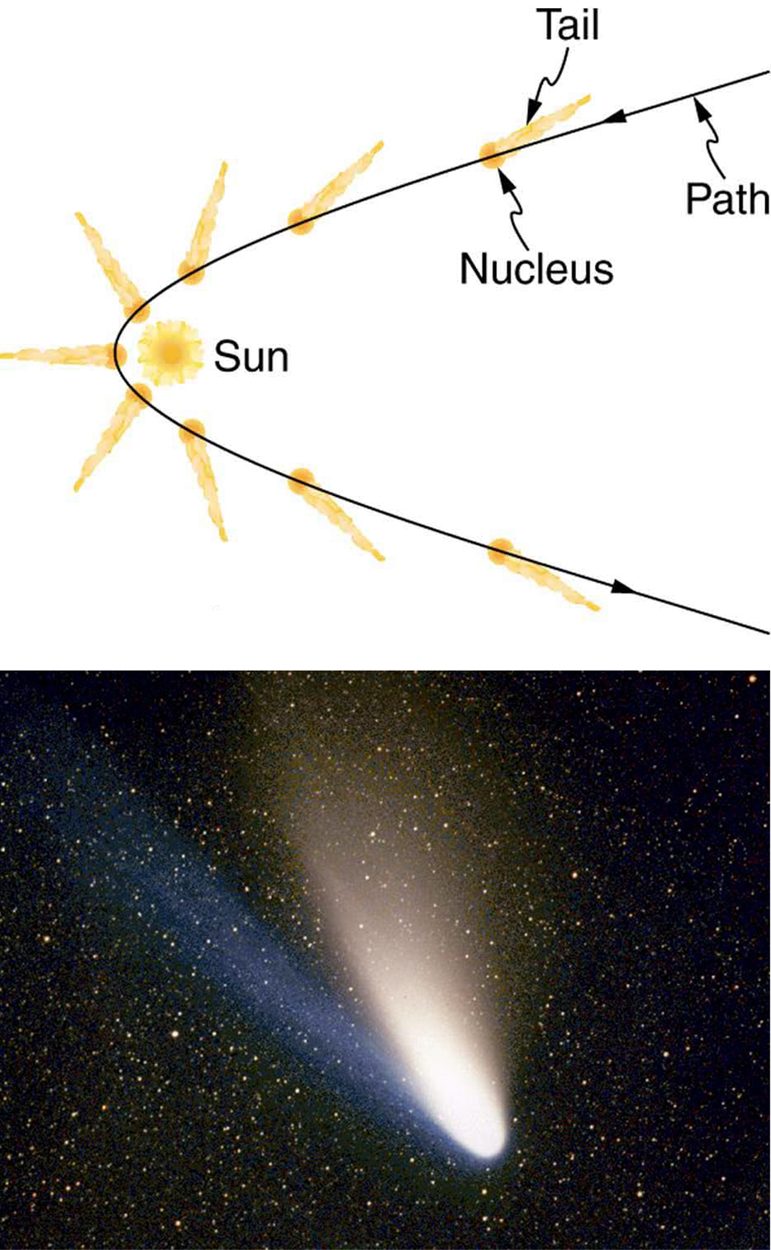
Figure 29.14 shows a comet with two prominent tails. What most people do not know about the tails is that they always point away from the Sun rather than trailing behind the comet (like the tail of Bo Peep’s sheep). Comet tails are composed of gases and dust evaporated from the body of the comet and ionized gas. The dust particles recoil away from the Sun when photons scatter from them. Evidently, photons carry momentum in the direction of their motion (away from the Sun), and some of this momentum is transferred to dust particles in collisions. Gas atoms and molecules in the blue tail are most affected by other particles of radiation, such as protons and electrons emanating from the Sun, rather than by the momentum of photons.
Momentum is conserved in quantum mechanics just as it is in relativity and classical physics. Some of the earliest direct experimental evidence of this came from scattering of x-ray photons by electrons in substances, named Compton scattering after the American physicist Arthur H. Compton (1892–1962). Around 1923, Compton observed that x rays scattered from materials had a decreased energy and correctly analyzed this as being due to the scattering of photons from electrons. This phenomenon could be handled as a collision between two particles—a photon and an electron at rest in the material. Energy and momentum are conserved in the collision. (See Figure 29.15) He won a Nobel Prize in 1929 for the discovery of this scattering, now called the Compton effect, because it helped prove that photon momentum is given by
where is Planck’s constant and is the photon wavelength. (Note that relativistic momentum given as is valid only for particles having mass.)
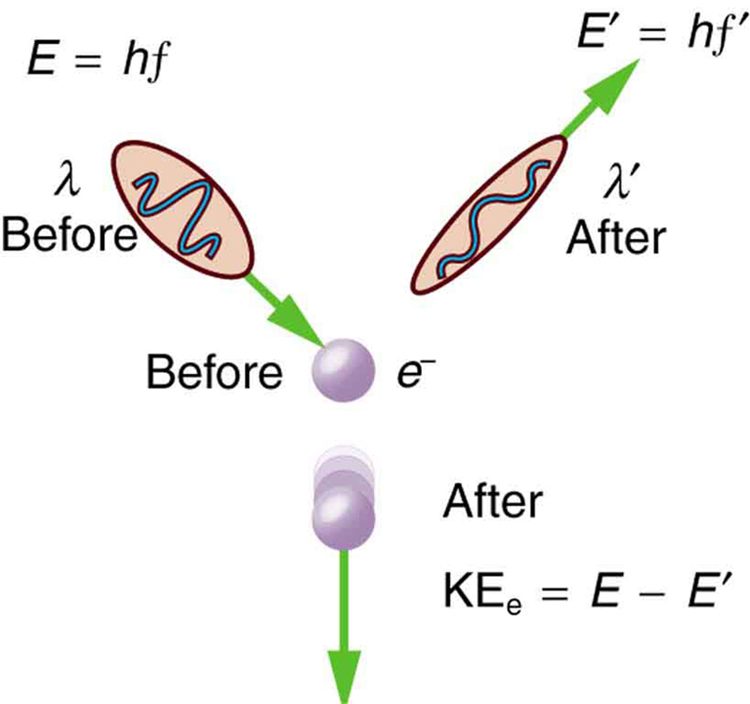
We can see that photon momentum is small, since and is very small. It is for this reason that we do not ordinarily observe photon momentum. Our mirrors do not recoil when light reflects from them (except perhaps in cartoons). Compton saw the effects of photon momentum because he was observing x rays, which have a small wavelength and a relatively large momentum, interacting with the lightest of particles, the electron.
Relativistic Photon Momentum
There is a relationship between photon momentum and photon energy that is consistent with the relation given previously for the relativistic total energy of a particle as . We know is zero for a photon, but is not, so that becomes
or
To check the validity of this relation, note that for a photon. Substituting this into yields
as determined experimentally and discussed above. Thus, is equivalent to Compton’s result . For a further verification of the relationship between photon energy and momentum, see Example 2.
Test Prep for AP Courses
The mass of a proton is 1.67 × 10⁻²⁷ kg. If a proton has the same momentum as a photon with a wavelength of 325 nm, what is its speed?
- 2.73 × 10⁻³ m/s
- 0.819 m/s
- 1.22 m/s
- 2.71 × 10⁴ m/s
(c)
A strip of metal foil with a mass of 5.00 × 10⁻⁷ kg is suspended in a vacuum and exposed to a pulse of light. The velocity of the foil changes from zero to 1.00 × 10⁻³ m/s in the same direction as the initial light pulse, and the light pulse is entirely reflected from the surface of the foil. Given that the wavelength of the light is 450 nm, and assuming that this wavelength is the same before and after the collision, how many photons in the pulse collide with the foil?
In an experiment in which the Compton effect is observed, a “gamma ray” photon with a wavelength of 5.00 × 10⁻¹³ m scatters from an electron. If the change in the electron energy is 1.60 × 10⁻¹⁵ J, what is the wavelength of the photon after the collision with the electron?
- 4.95 × 10⁻¹³ m
- 4.98 × 10⁻¹³ m
- 5.02 × 10⁻¹³ m
- 5.05 × 10⁻¹³ m
(c)
Consider two experiments involving a metal sphere with a radius of 2.00 μm that is suspended in a vacuum. In one experiment, a pulse of N photons reflects from the surface of the sphere, causing the sphere to acquire momentum. In a second experiment, an identical pulse of photons is completely absorbed by the sphere, so that the sphere acquires momentum. Identify each type of collision as either elastic or inelastic, and, assuming that the change in the photon wavelength can be ignored, use linear momentum conservation to derive the expression for the momentum of the sphere in each experiment.
Section Summary
- Photons have momentum, given by , where is the photon wavelength.
- Photon energy and momentum are related by , where for a photon.
Conceptual Questions
Which formula may be used for the momentum of all particles, with or without mass?
Is there any measurable difference between the momentum of a photon and the momentum of matter?
Why don’t we feel the momentum of sunlight when we are on the beach?
Problems & Exercises
(a) Find the momentum of a 4.00-cm-wavelength microwave photon. (b) Discuss why you expect the answer to (a) to be very small.
(a)
(b) The wavelength of microwave photons is large, so the momentum they carry is very small.
(a) What is the momentum of a 0.0100-nm-wavelength photon that could detect details of an atom? (b) What is its energy in MeV?
(a) What is the wavelength of a photon that has a momentum of ? (b) Find its energy in eV.
(a) 13.3 μm
(b) eV
(a) A -ray photon has a momentum of . What is its wavelength? (b) Calculate its energy in MeV.
(a) Calculate the momentum of a photon having a wavelength of . (b) Find the velocity of an electron having the same momentum. (c) What is the kinetic energy of the electron, and how does it compare with that of the photon?
(a)
(b) 291 m/s
(c) electron , photon , ratio
Repeat the previous problem for a 10.0-nm-wavelength photon.
(a) Calculate the wavelength of a photon that has the same momentum as a proton moving at 1.00% of the speed of light. (b) What is the energy of the photon in MeV? (c) What is the kinetic energy of the proton in MeV?
(a)
(b) 9.39 MeV
(c)
(a) Find the momentum of a 100-keV x-ray photon. (b) Find the equivalent velocity of a neutron with the same momentum. (c) What is the neutron’s kinetic energy in keV?
Take the ratio of relativistic rest energy, , to relativistic momentum, , and show that in the limit that mass approaches zero, you find .
and , so
As the mass of particle approaches zero, its velocity will approach , so that the ratio of energy to momentum in this limit is
which is consistent with the equation for photon energy.
Construct Your Own Problem
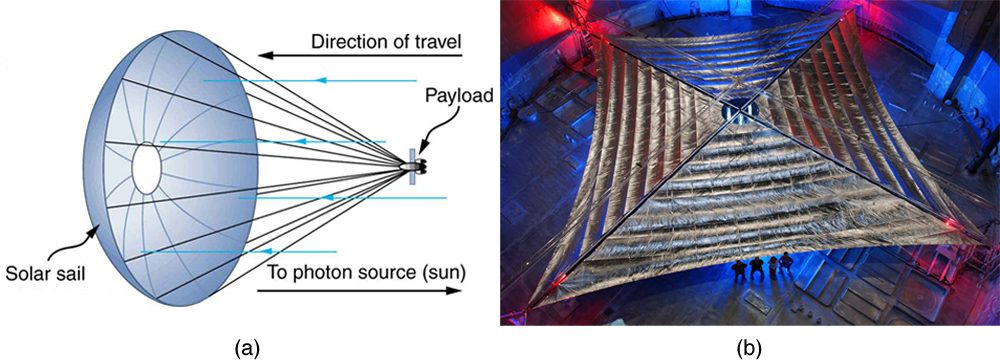
Consider a space sail such as mentioned in Example 1. Construct a problem in which you calculate the light pressure on the sail in produced by reflecting sunlight. Also calculate the force that could be produced and how much effect that would have on a spacecraft. Among the things to be considered are the intensity of sunlight, its average wavelength, the number of photons per square meter this implies, the area of the space sail, and the mass of the system being accelerated.
Unreasonable Results
A car feels a small force due to the light it sends out from its headlights, equal to the momentum of the light divided by the time in which it is emitted. (a) Calculate the power of each headlight, if they exert a total force of backward on the car. (b) What is unreasonable about this result? (c) Which assumptions are unreasonable or inconsistent?
(a)
(b) Headlights are way too bright.
(c) Force is too large.
Adapted from College Physics 2e by OpenStax (openstax.org), licensed under CC BY-NC-SA 4.0. Changes were made. License: CC-BY-NC-SA-4.0.