
19.6 Capacitors in Series and Parallel
Learning Objectives
By the end of this section, you will be able to:
- Derive expressions for total capacitance in series and in parallel.
- Identify series and parallel parts in the combination of connection of capacitors.
- Calculate the effective capacitance in series and parallel given individual capacitances.
Several capacitors may be connected together in a variety of applications. Multiple connections of capacitors act like a single equivalent capacitor. The total capacitance of this equivalent single capacitor depends both on the individual capacitors and how they are connected. There are two simple and common types of connections, called series and parallel, for which we can easily calculate the total capacitance. Certain more complicated connections can also be related to combinations of series and parallel.
Capacitance in Series
Figure 19.26(a) shows a series connection of three capacitors with a voltage applied. As for any capacitor, the capacitance of the combination is related to charge and voltage by .
Note in Figure 19.26 that opposite charges of magnitude flow to either side of the originally uncharged combination of capacitors when the voltage is applied. Conservation of charge requires that equal-magnitude charges be created on the plates of the individual capacitors, since charge is only being separated in these originally neutral devices. The end result is that the combination resembles a single capacitor with an effective plate separation greater than that of the individual capacitors alone. (See Figure 19.26(b).) Larger plate separation means smaller capacitance. It is a general feature of series connections of capacitors that the total capacitance is less than any of the individual capacitances.
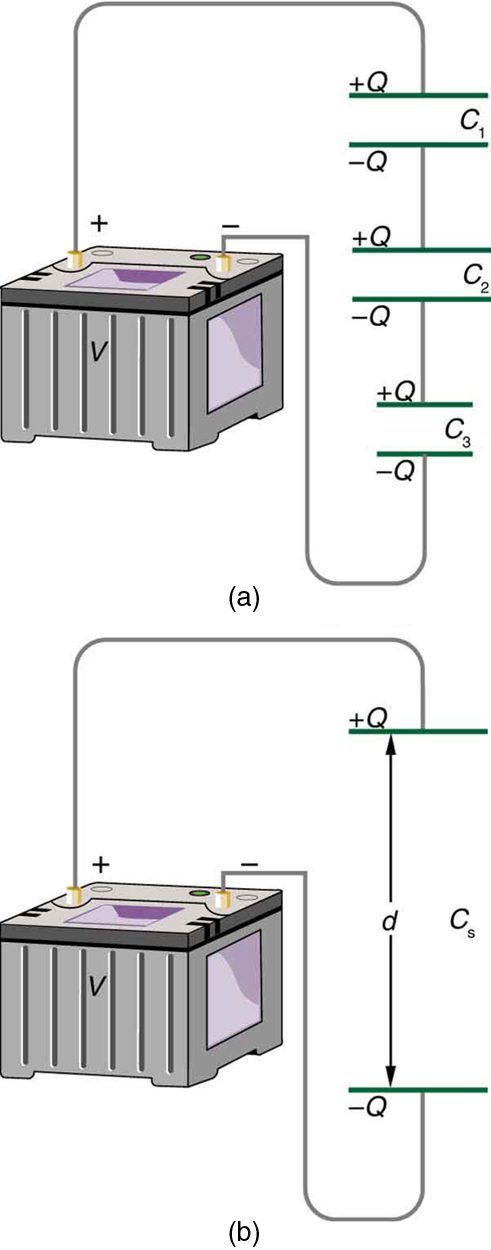
We can find an expression for the total capacitance by considering the voltage across the individual capacitors shown in Figure 19.26. Solving for gives . The voltages across the individual capacitors are thus , , and . The total voltage is the sum of the individual voltages:
Now, calling the total capacitance for series capacitance, consider that
Entering the expressions for , , and , we get
Canceling the s, we obtain the equation for the total capacitance in series to be
where “...” indicates that the expression is valid for any number of capacitors connected in series. An expression of this form always results in a total capacitance that is less than any of the individual capacitances , ,..., as the next example illustrates.
Capacitors in Parallel
Figure 19.27(a) shows a parallel connection of three capacitors with a voltage applied. Here the total capacitance is easier to find than in the series case. To find the equivalent total capacitance , we first note that the voltage across each capacitor is , the same as that of the source, since they are connected directly to it through a conductor. (Conductors are equipotentials, and so the voltage across the capacitors is the same as that across the voltage source.) Thus the capacitors have the same charges on them as they would have if connected individually to the voltage source. The total charge is the sum of the individual charges:
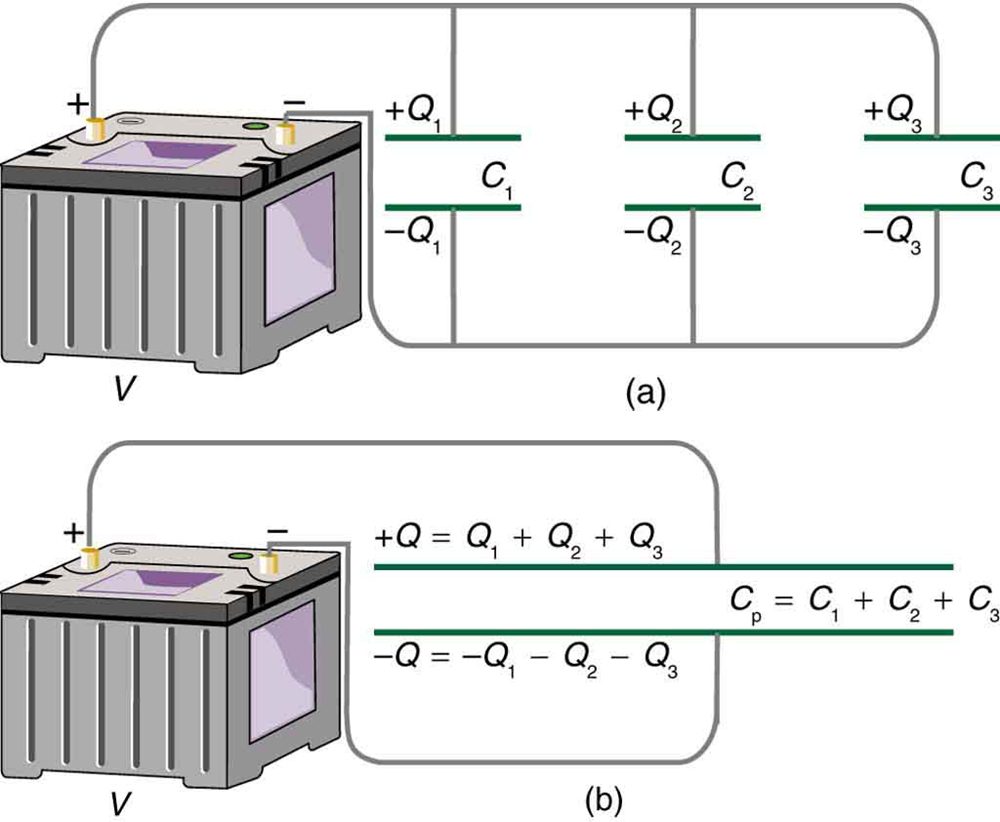
Using the relationship , we see that the total charge is , and the individual charges are , , and . Entering these into the previous equation gives
Canceling from the equation, we obtain the equation for the total capacitance in parallel :
Total capacitance in parallel is simply the sum of the individual capacitances. (Again the “...” indicates the expression is valid for any number of capacitors connected in parallel.) So, for example, if the capacitors in the example above were connected in parallel, their capacitance would be
The equivalent capacitor for a parallel connection has an effectively larger plate area and, thus, a larger capacitance, as illustrated in Figure 19.27(b).
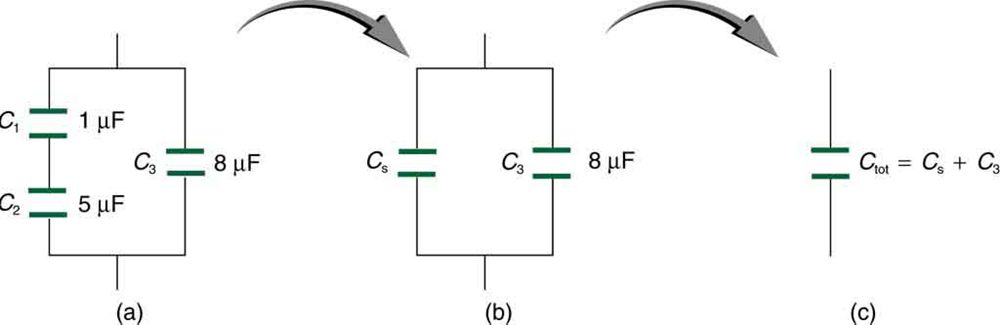
More complicated connections of capacitors can sometimes be combinations of series and parallel. (See Figure 19.28.) To find the total capacitance of such combinations, we identify series and parallel parts, compute their capacitances, and then find the total.
Section Summary
- Total capacitance in series
- Total capacitance in parallel
- If a circuit contains a combination of capacitors in series and parallel, identify series and parallel parts, compute their capacitances, and then find the total.
Conceptual Questions
If you wish to store a large amount of energy in a capacitor bank, would you connect capacitors in series or parallel? Explain.
Problems & Exercises
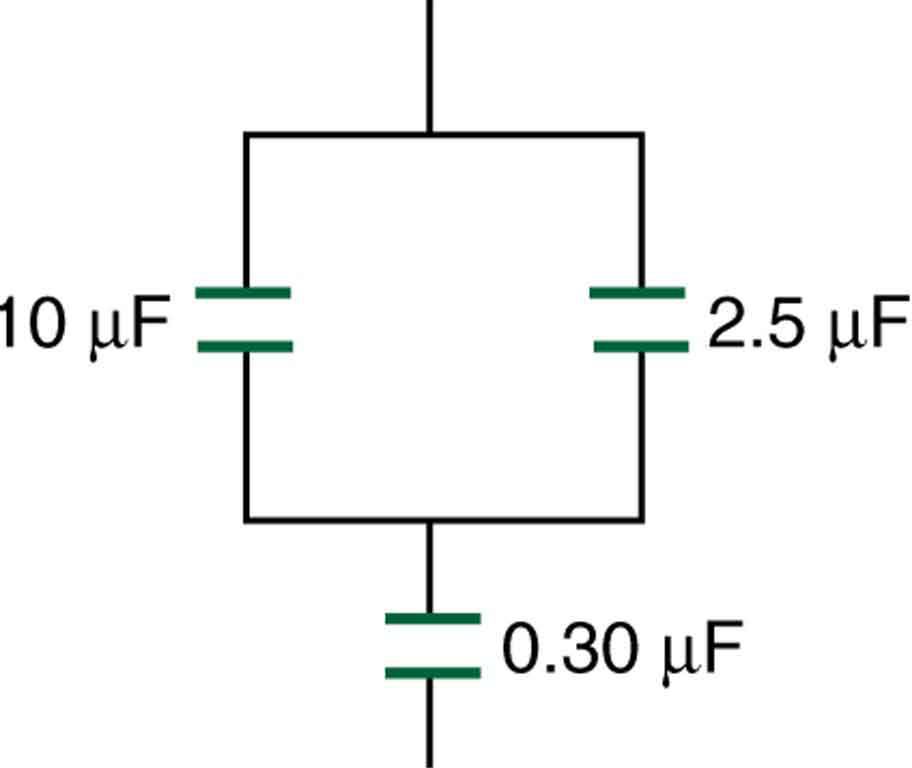
Find the total capacitance of the combination of capacitors in Figure 19.29.
Suppose you want a capacitor bank with a total capacitance of 0.750 F and you possess numerous 1.50 mF capacitors. What is the smallest number you could hook together to achieve your goal, and how would you connect them?
What total capacitances can you make by connecting a and an capacitor together?
in series combination, in parallel combination
Find the total capacitance of the combination of capacitors shown in Figure 19.30.
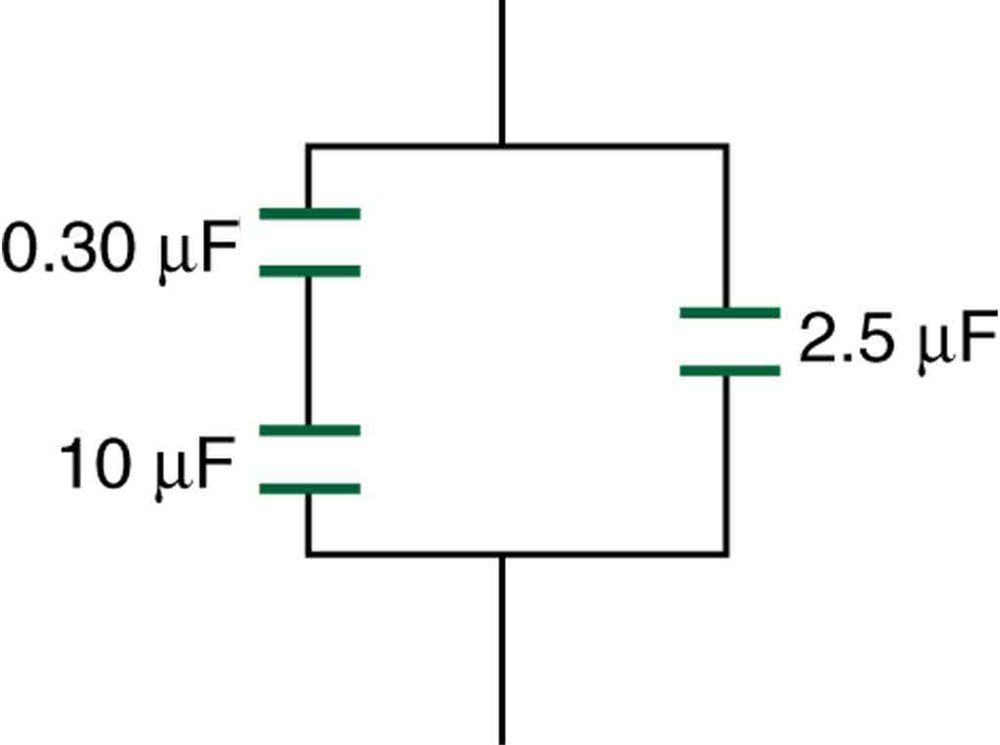
Find the total capacitance of the combination of capacitors shown in Figure 19.31.
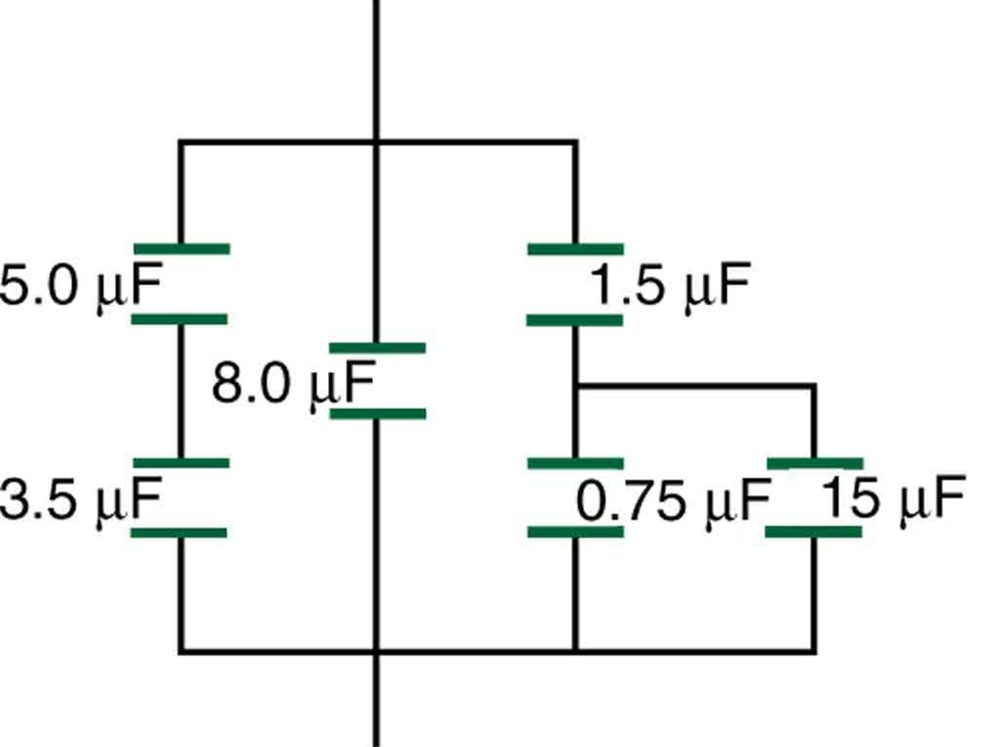
Unreasonable Results
(a) An capacitor is connected in parallel to another capacitor, producing a total capacitance of . What is the capacitance of the second capacitor? (b) What is unreasonable about this result? (c) Which assumptions are unreasonable or inconsistent?
(a)
(b) You cannot have a negative value of capacitance.
(c) The assumption that the capacitors were hooked up in parallel, rather than in series, was incorrect. A parallel connection always produces a greater capacitance, while here a smaller capacitance was assumed. This could happen only if the capacitors are connected in series.
Adapted from College Physics 2e by OpenStax (openstax.org), licensed under CC BY-NC-SA 4.0. Changes were made. License: CC-BY-NC-SA-4.0.