
19.2 Electric Potential in a Uniform Electric Field
Learning Objectives
By the end of this section, you will be able to:
- Describe the relationship between voltage and electric field.
- Derive an expression for the electric potential and electric field.
- Calculate electric field strength given distance and voltage.
In the previous section, we explored the relationship between voltage and energy. In this section, we will explore the relationship between voltage and electric field. For example, a uniform electric field is produced by placing a potential difference (or voltage) across two parallel metal plates, labeled A and B. (See Figure 19.5.) Examining this will tell us what voltage is needed to produce a certain electric field strength; it will also reveal a more fundamental relationship between electric potential and electric field. From a physicist’s point of view, either or can be used to describe any charge distribution. is most closely tied to energy, whereas is most closely related to force. is a scalar quantity and has no direction, while is a vector quantity, having both magnitude and direction. (Note that the magnitude of the electric field strength, a scalar quantity, is represented by below.) The relationship between and is revealed by calculating the work done by the force in moving a charge from point A to point B. But, as noted in Electric Potential Energy: Potential Difference, this is complex for arbitrary charge distributions, requiring calculus. We therefore look at a uniform electric field as an interesting special case.
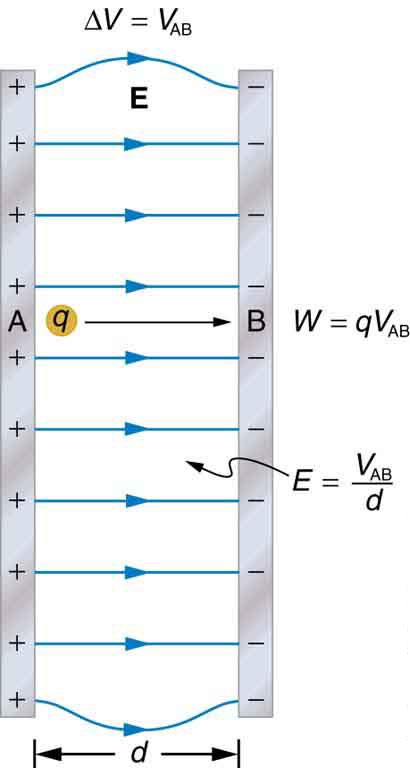
The work done by the electric field in Figure 19.5 to move a positive charge from A, the positive plate, higher potential, to B, the negative plate, lower potential, is
The opposite of the potential difference between points A and B, which we denote as , is
Entering this into the expression for work yields
Work is ; here , since the path is parallel to the field, and so . Since , we see that . Substituting this expression for work into the previous equation gives
The charge cancels, and so the voltage between points A and B is seen to be
where is the distance from A to B, or the distance between the plates in Figure 19.5. Note that the above equation implies the units for electric field are volts per meter. We already know the units for electric field are newtons per coulomb; thus the following relation among units is valid:
In more general situations, regardless of whether the electric field is uniform, it points in the direction of decreasing potential, because the force on a positive charge is in the direction of and also in the direction of lower potential . Furthermore, the magnitude of equals the rate of decrease of with distance. The faster decreases over distance, the greater the electric field. In equation form, the general relationship between voltage and electric field is
where is the distance over which the change in potential, , takes place. The minus sign tells us that points in the direction of decreasing potential. The electric field is said to be the gradient (as in grade or slope) of the electric potential.
For continually changing potentials, and become infinitesimals and differential calculus must be employed to determine the electric field.
Test Prep for AP Courses
A negatively charged massive particle is dropped from above the two plates in Figure 19.5 into the space between them. Which best describes the trajectory it takes?
- A rightward-curving parabola
- A leftward-curving parabola
- A rightward-curving section of a circle
- A leftward-curving section of a circle
(b)
Two massive particles with identical charge are launched into the uniform field between two plates from the same launch point with the same velocity. They both impact the positively charged plate, but the second one does so four times as far as the first. What sign is the charge? What physical difference would give them different impact points (quantify as a relative percent)? How does this compare to the gravitational projectile motion case?
Two plates are lying horizontally, but stacked with one 10.0 cm above the other. If the upper plate is held at +100 V, what is the magnitude and direction of the electric field between the plates if the lower is held at +50.0 V? -50.0 V?
- 500 V/m, 1500 V/m, down
- 500 V/m, 1500 V/m, up
- 1500 V/m, 500 V/m, down
- 1500 V/m, 500 V/m, up
(a)
Two parallel conducting plates are 15 cm apart, each with an area of 0.75 m2. The left one has a charge of -0.225 C placed on it, while the right has a charge of 0.225 C. What is the magnitude and direction of the electric field between the two?
Consider three parallel conducting plates, with a space of 3.0 cm between them. The leftmost one is at a potential of +45 V, the middle one is held at ground, and the rightmost is at a potential of -75 V. What is the magnitude of the average electric field on an electron traveling between the plates? (Assume that the middle one has holes for the electron to go through.)
- 1500 V/m
- 2500 V/m
- 4000 V/m
- 2000 V/m
(d)
A new kind of electron gun has a rear plate at −25.0 kV, a grounded plate 2.00 cm in front of that, and a +25.0 kV plate 4.00 cm in front of that. What is the magnitude of the average electric field?
A certain electric potential isoline graph has isolines every 5.0 V. If six of these lines cross a 40 cm path drawn between two points of interest, what is the (magnitude of the average) electric field along this path?
- 750 V/m
- 150 V/m
- 38 V/m
- 75 V/m
(d)
Given a system of two parallel conducting plates held at a fixed potential difference, describe what happens to the isolines of the electric potential between them as the distance between them is changed. How does this relate to the electric field strength?
Section Summary
- The voltage between points A and B is where is the distance from A to B, or the distance between the plates.
- In equation form, the general relationship between voltage and electric field is where is the distance over which the change in potential, , takes place. The minus sign tells us that points in the direction of decreasing potential.) The electric field is said to be the gradient (as in grade or slope) of the electric potential.
Conceptual Questions
Discuss how potential difference and electric field strength are related. Give an example.
What is the strength of the electric field in a region where the electric potential is constant?
Will a negative charge, initially at rest, move toward higher or lower potential? Explain why.
Problems & Exercises
Show that units of V/m and N/C for electric field strength are indeed equivalent.
What is the strength of the electric field between two parallel conducting plates separated by 1.00 cm and having a potential difference (voltage) between them of ?
The electric field strength between two parallel conducting plates separated by 4.00 cm is . (a) What is the potential difference between the plates? (b) The plate with the lowest potential is taken to be at zero volts. What is the potential 1.00 cm from that plate (and 3.00 cm from the other)?
(a)
(b)
How far apart are two conducting plates that have an electric field strength of between them, if their potential difference is 15.0 kV?
(a) Will the electric field strength between two parallel conducting plates exceed the breakdown strength for air () if the plates are separated by 2.00 mm and a potential difference of is applied? (b) How close together can the plates be with this applied voltage?
(a) No. The electric field strength between the plates is which is lower than the breakdown strength for air ().
(b) 1.7 mm
The voltage across a membrane forming a cell wall is 80.0 mV and the membrane is 9.00 nm thick. What is the electric field strength? (The value is surprisingly large, but correct. Membranes are discussed in Capacitors and Dielectrics and Nerve Conduction—Electrocardiograms.) You may assume a uniform electric field.
Membrane walls of living cells have surprisingly large electric fields across them due to separation of ions. (Membranes are discussed in some detail in Nerve Conduction—Electrocardiograms.) What is the voltage across an 8.00 nm–thick membrane if the electric field strength across it is 5.50 MV/m? You may assume a uniform electric field.
44.0 mV
Two parallel conducting plates are separated by 10.0 cm, and one of them is taken to be at zero volts. (a) What is the electric field strength between them, if the potential 8.00 cm from the zero volt plate (and 2.00 cm from the other) is 450 V? (b) What is the voltage between the plates?
Find the maximum potential difference between two parallel conducting plates separated by 0.500 cm of air, given the maximum sustainable electric field strength in air to be .
A doubly charged ion is accelerated to an energy of 32.0 keV by the electric field between two parallel conducting plates separated by 2.00 cm. What is the electric field strength between the plates?
An electron is to be accelerated in a uniform electric field having a strength of . (a) What energy in keV is given to the electron if it is accelerated through 0.400 m? (b) Over what distance would it have to be accelerated to increase its energy by 50.0 GeV?
(a)
(b)
Adapted from College Physics 2e by OpenStax (openstax.org), licensed under CC BY-NC-SA 4.0. Changes were made. License: CC-BY-NC-SA-4.0.