
13.4 Kinetic Theory: Atomic and Molecular Explanation of Pressure and Temperature
Learning Objectives
By the end of this section, you will be able to:
- Express the ideal gas law in terms of molecular mass and velocity.
- Define thermal energy.
- Calculate the kinetic energy of a gas molecule, given its temperature.
- Describe the relationship between the temperature of a gas and the kinetic energy of atoms and molecules.
- Describe the distribution of speeds of molecules in a gas.
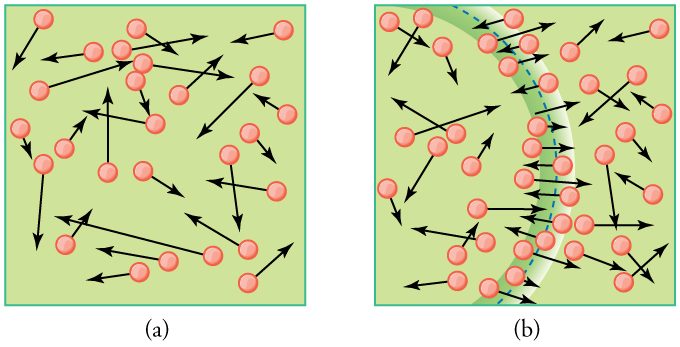
We have developed macroscopic definitions of pressure and temperature. Pressure is the force divided by the area on which the force is exerted, and temperature is measured with a thermometer. We gain a better understanding of pressure and temperature from the kinetic theory of gases, which assumes that atoms and molecules are in continuous random motion.
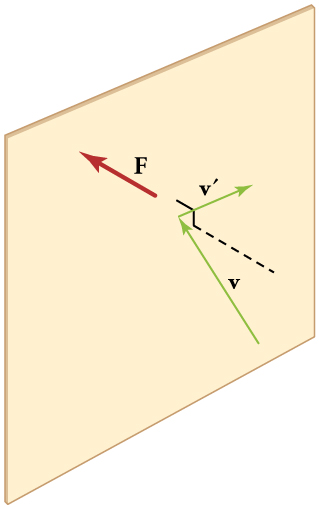
Figure 13.22 shows an elastic collision of a gas molecule with the wall of a container, so that it exerts a force on the wall (by Newton’s third law). Because a huge number of molecules will collide with the wall in a short time, we observe an average force per unit area. These collisions are the source of pressure in a gas. As the number of molecules increases, the number of collisions and thus the pressure increase. Similarly, the gas pressure is higher if the average velocity of molecules is higher. The actual relationship is derived in the Things Great and Small feature below. The following relationship is found:
where is the pressure (average force per unit area), is the volume of gas in the container, is the number of molecules in the container, is the mass of a molecule, and is the average of the molecular speed squared.
What can we learn from this atomic and molecular version of the ideal gas law? We can derive a relationship between temperature and the average translational kinetic energy of molecules in a gas. Recall the previous expression of the ideal gas law:
Equating the right-hand side of this equation with the right-hand side of gives
We can get the average kinetic energy of a molecule, , from the right-hand side of the equation by canceling and multiplying by 3/2. This calculation produces the result that the average kinetic energy of a molecule is directly related to absolute temperature.
The average translational kinetic energy of a molecule, , is called thermal energy. The equation is a molecular interpretation of temperature, and it has been found to be valid for gases and reasonably accurate in liquids and solids. It is another definition of temperature based on an expression of the molecular energy.
It is sometimes useful to rearrange , and solve for the average speed of molecules in a gas in terms of temperature,
where stands for root-mean-square (rms) speed.
Distribution of Molecular Speeds
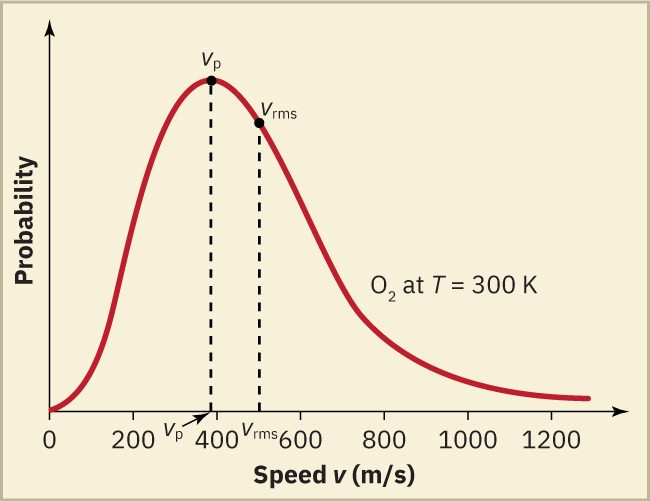
The motion of molecules in a gas is random in magnitude and direction for individual molecules, but a gas of many molecules has a predictable distribution of molecular speeds. This distribution is called the Maxwell-Boltzmann distribution, after its originators, who calculated it based on kinetic theory, and has since been confirmed experimentally. (See Figure 13.25.) The distribution has a long tail, because a few molecules may go several times the rms speed. The most probable speed is less than the rms speed . Figure 13.26 shows that the curve is shifted to higher speeds at higher temperatures, with a broader range of speeds.
The distribution of thermal speeds depends strongly on temperature. As temperature increases, the speeds are shifted to higher values and the distribution is broadened.
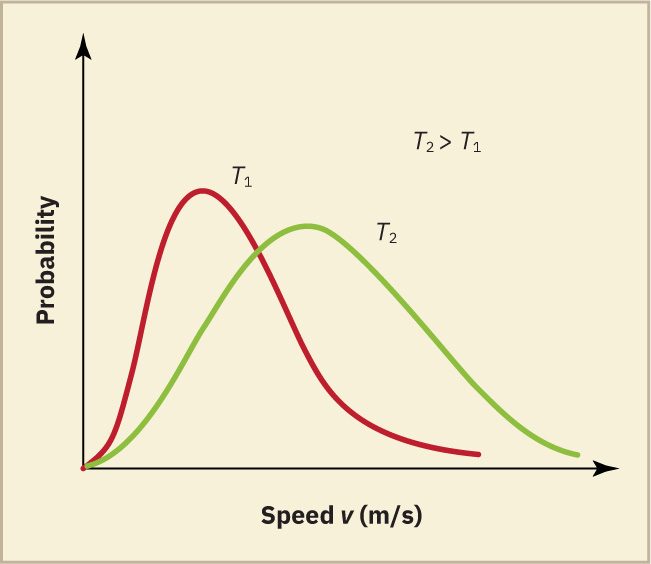
What is the implication of the change in distribution with temperature shown in Figure 13.26 for humans? All other things being equal, if a person has a fever, they are likely to lose more water molecules, particularly from linings along moist cavities such as the lungs and mouth, creating a dry sensation in the mouth.
If you consider a very small object such as a grain of pollen, in a gas, then the number of atoms and molecules striking its surface would also be relatively small. Would the grain of pollen experience any fluctuations in pressure due to statistical fluctuations in the number of gas atoms and molecules striking it in a given amount of time?
Yes. Such fluctuations actually occur for a body of any size in a gas, but since the numbers of atoms and molecules are immense for macroscopic bodies, the fluctuations are a tiny percentage of the number of collisions, and the averages spoken of in this section vary imperceptibly. Roughly speaking the fluctuations are proportional to the inverse square root of the number of collisions, so for small bodies they can become significant. This was actually observed in the 19th century for pollen grains in water, and is known as the Brownian effect.
Test Prep for AP Courses
Two samples of ideal gas in separate containers have the same number of molecules and the same temperature, but the molecular mass of gas X is greater than that of gas Y. Which of the following correctly compares the average speed of the molecules of the gases and the average force the gases exert on their respective containers?
| Average Speed of Molecules | Average Force on Container | |
|---|---|---|
| (a) | Greater for gas X | Greater for gas X |
| (b) | Greater for gas X | The forces cannot be compared without knowing the volumes of the gases. |
| (c) | Greater for gas Y | Greater for gas Y |
| (d) | Greater for gas Y | The forces cannot be compared without knowing the volumes of the gases. |
(d)
How will the average kinetic energy of a gas molecule change if its temperature is increased from 20ºC to 313ºC?
- It will become sixteen times its original value.
- It will become four times its original value
- It will become double its original value
- It will remain unchanged.
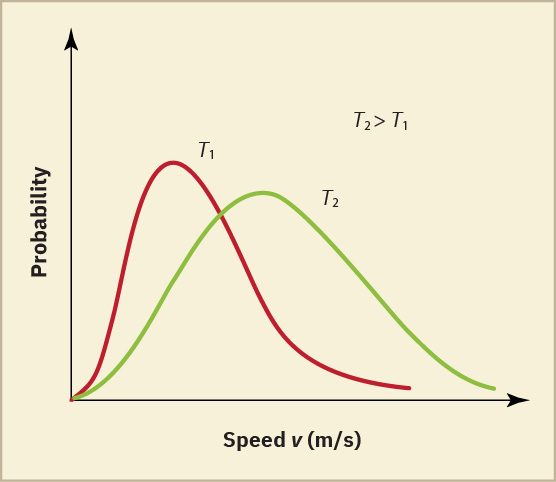
This graph shows the Maxwell-Boltzmann distribution of molecular speeds in an ideal gas for two temperatures, T1 and T2. Which of the following statements is false?
- T1 is lower than T2
- The rms speed at T1 is higher than that at T2.
- The peak of each graph shows the most probable speed at the corresponding temperature.
- None of the above.
(b)
Suppose you have gas in a cylinder with a movable piston which has an area of 0.40 m2. The pressure of the gas is 150 Pa when the height of the piston is 0.02 m. Find the force exerted by the gas on the piston. How does this force change if the piston is moved to a height of 0.03 m? Assume temperature remains constant.
What is the average kinetic energy of a nitrogen molecule (N2) if its rms speed is 560 m/s? At what temperature is this rms speed achieved?
(a) 7.29 × 10⁻²¹ J; (b) 352K or 79ºC
What will be the ratio of kinetic energies and rms speeds of a nitrogen molecule and a helium atom at the same temperature?
Section Summary
- Kinetic theory is the atomistic description of gases as well as liquids and solids.
- Kinetic theory models the properties of matter in terms of continuous random motion of atoms and molecules.
- The ideal gas law can also be expressed as where is the pressure (average force per unit area), is the volume of gas in the container, is the number of molecules in the container, is the mass of a molecule, and is the average of the molecular speed squared.
- Thermal energy is defined to be the average translational kinetic energy of an atom or molecule.
- The temperature of gases is proportional to the average translational kinetic energy of atoms and molecules.
or
- The motion of individual molecules in a gas is random in magnitude and direction. However, a gas of many molecules has a predictable distribution of molecular speeds, known as the Maxwell-Boltzmann distribution.
Conceptual Questions
How is momentum related to the pressure exerted by a gas? Explain on the atomic and molecular level, considering the behavior of atoms and molecules.
Problems & Exercises
Some incandescent light bulbs are filled with argon gas. What is for argon atoms near the filament, assuming their temperature is 2500 K?
Average atomic and molecular speeds are large, even at low temperatures. What is for helium atoms at 5.00 K, just one degree above helium’s liquefaction temperature?
(a) What is the average kinetic energy in joules of hydrogen atoms on the surface of the Sun? (b) What is the average kinetic energy of helium atoms in a region of the solar corona where the temperature is ?
(a)
(b)
The escape velocity of any object from Earth is 11.2 km/s. (a) Express this speed in m/s and km/h. (b) At what temperature would oxygen molecules (molecular mass is equal to 32.0 g/mol) have an average velocity equal to Earth’s escape velocity of 11.1 km/s?
The escape velocity from the Moon is much smaller than from Earth and is only 2.38 km/s. At what temperature would hydrogen molecules (molecular mass is equal to 2.016 g/mol) have an average velocity equal to the Moon’s escape velocity?
Nuclear fusion, the energy source of the Sun, hydrogen bombs, and fusion reactors, occurs much more readily when the average kinetic energy of the atoms is high—that is, at high temperatures. Suppose you want the atoms in your fusion experiment to have average kinetic energies of . What temperature is needed?
Suppose that the average velocity of carbon dioxide molecules (molecular mass is equal to 44.0 g/mol) in a flame is found to be . What temperature does this represent?
Hydrogen molecules (molecular mass is equal to 2.016 g/mol) have an average velocity equal to 193 m/s. What is the temperature?
Much of the gas near the Sun is atomic hydrogen. Its temperature would have to be for the average velocity to equal the escape velocity from the Sun. What is that velocity?
There are two important isotopes of uranium— and ; these isotopes are nearly identical chemically but have different atomic masses. Only is very useful in nuclear reactors. One of the techniques for separating them (gas diffusion) is based on the different average velocities of uranium hexafluoride gas, . (a) The molecular masses for and are 349.0 g/mol and 352.0 g/mol, respectively. What is the ratio of their average velocities? (b) At what temperature would their average velocities differ by 1.00 m/s? (c) Do your answers in this problem imply that this technique may be difficult?
Adapted from College Physics 2e by OpenStax (openstax.org), licensed under CC BY-NC-SA 4.0. Changes were made. License: CC-BY-NC-SA-4.0.