4.7 Further Applications of Newton’s Laws of Motion
Learning Objectives
By the end of this section, you will be able to:
Apply problem-solving techniques to solve for quantities in more complex systems of forces.
Integrate concepts from kinematics to solve problems using Newton's laws of motion.
There are many interesting applications of Newton’s laws of motion, a few more of which are presented in this section. These serve also to illustrate some further subtleties of physics and to help build problem-solving skills.
In the earlier example of a tightrope walker we noted that the tensions in wires supporting a mass were equal only because the angles on either side were equal. Consider the following example, where the angles are not equal; slightly more trigonometry is involved.
The bathroom scale is an excellent example of a normal force acting on a body. It provides a quantitative reading of how much it must push upward to support the weight of an object. But can you predict what you would see on the dial of a bathroom scale if you stood on it during an elevator ride? Will you see a value greater than your weight when the elevator starts up? What about when the elevator moves upward at a constant speed: will the scale still read more than your weight at rest? Consider the following example.
The solution to the previous example also applies to an elevator accelerating downward, as mentioned. When an elevator accelerates downward, is negative, and the scale reading is less than the weight of the person, until a constant downward velocity is reached, at which time the scale reading again becomes equal to the person’s weight. If the elevator is in free-fall and accelerating downward at , then the scale reading will be zero and the person will appear to be weightless.
Integrating Concepts: Newton’s Laws of Motion and Kinematics
Physics is most interesting and most powerful when applied to general situations that involve more than a narrow set of physical principles. Newton’s laws of motion can also be integrated with other concepts that have been discussed previously in this text to solve problems of motion. For example, forces produce accelerations, a topic of kinematics, and hence the relevance of earlier chapters. When approaching problems that involve various types of forces, acceleration, velocity, and/or position, use the following steps to approach the problem:
Problem-Solving Strategy
Step 1. Identify which physical principles are involved. Listing the givens and the quantities to be calculated will allow you to identify the principles involved.
Step 2. Solve the problem using strategies outlined in the text. If these are available for the specific topic, you should refer to them. You should also refer to the sections of the text that deal with a particular topic. The following worked example illustrates how these strategies are applied to an integrated concept problem.
Test Prep for AP Courses
A basketball player jumps as he shoots the ball. Describe the forces that are acting on the ball and on the basketball player. What are the results?
Two people push on a boulder to try to move it. The mass of the boulder is 825 kg. One person pushes north with a force of 64 N. The other pushes west with a force of 38 N. Predict the magnitude of the acceleration of the boulder. Assume that friction is negligible.
A free-body diagram would show a northward force of 64 N and a westward force of 38 N. The net force is equal to the sum of the two applied forces. It can be found using the Pythagorean theorem:
Since ,
The boulder will accelerate at 0.09 m/s2.
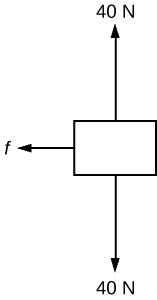
Figure 4.40
The figure shows the forces exerted on a block that is sliding on a horizontal surface: the gravitational force of 40 N, the 40 N normal force exerted by the surface, and a frictional force exerted to the left. The coefficient of friction between the block and the surface is 0.20. The acceleration of the block is most nearly
1.0 m/s2 to the right
1.0 m/s2 to the left
2.0 m/s2 to the right
2.0 m/s2 to the left
Summary
Newton’s laws of motion can be applied in numerous situations to solve problems of motion.
Some problems will contain multiple force vectors acting in different directions on an object. Be sure to draw diagrams, resolve all force vectors into horizontal and vertical components, and draw a free-body diagram. Always analyze the direction in which an object accelerates so that you can determine whether or .
The normal force on an object is not always equal in magnitude to the weight of the object. If an object is accelerating, the normal force will be less than or greater than the weight of the object. Also, if the object is on an inclined plane, the normal force will always be less than the full weight of the object.
Some problems will contain various physical quantities, such as forces, acceleration, velocity, or position. You can apply concepts from kinematics and dynamics in order to solve these problems of motion.
Conceptual Questions
To simulate the apparent weightlessness of space orbit, astronauts are trained in the hold of a cargo aircraft that is accelerating downward at . Why will they appear to be weightless, as measured by standing on a bathroom scale, in this accelerated frame of reference? Is there any difference between their apparent weightlessness in orbit and in the aircraft?
A cartoon shows the hat coming off the head of an elevator passenger when the elevator rapidly stops during an upward ride. Can this really happen without the person being tied to the floor of the elevator? Explain your answer.
Problem Exercises
A flea jumps by exerting a force of straight down on the ground. A breeze blowing on the flea parallel to the ground exerts a force of on the flea. Find the direction and magnitude of the acceleration of the flea if its mass is . Do not neglect the gravitational force.
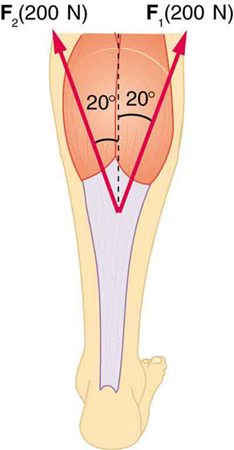
Two muscles in the back of the leg pull upward on the Achilles tendon, as shown in Figure 4.41. (These muscles are called the medial and lateral heads of the gastrocnemius muscle.) Find the magnitude and direction of the total force on the Achilles tendon. What type of movement could be caused by this force?
Figure 4.41Achilles tendon
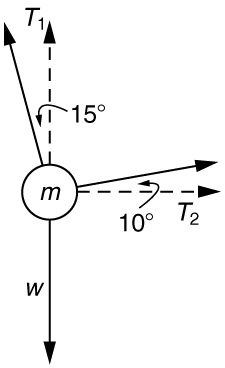
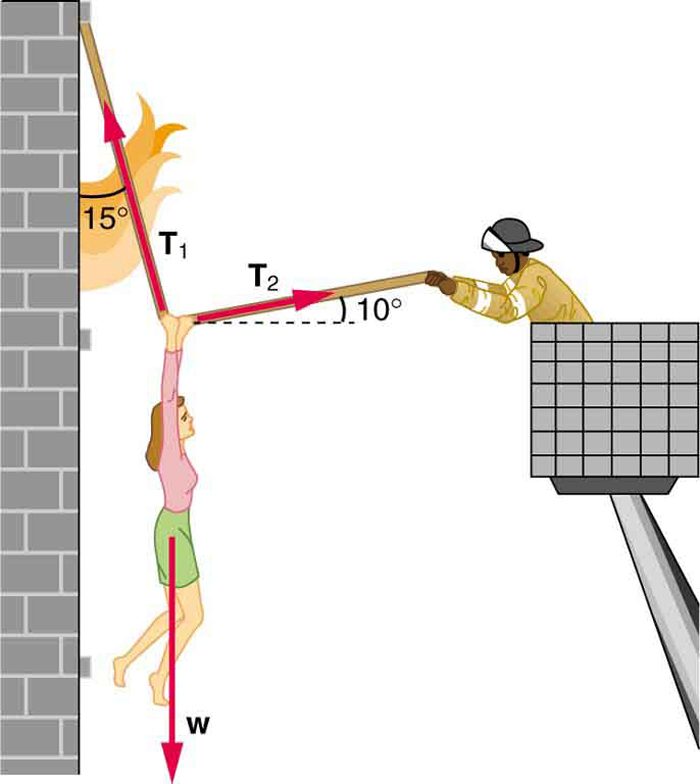
A 76.0-kg person is being pulled away from a burning building as shown in Figure 4.42. Calculate the tension in the two ropes if the person is momentarily motionless. Include a free-body diagram in your solution.
Figure 4.42The force needed to hold steady the person being rescued from the fire is less than her weight and less than the force in the other rope, since the more vertical rope supports a greater part of her weight (a vertical force).
Integrated Concepts A 35.0-kg dolphin decelerates from 12.0 to 7.50 m/s in 2.30 s to join another dolphin in play. What average force was exerted to slow him if he was moving horizontally? (The gravitational force is balanced by the buoyant force of the water.)
Integrated Concepts When starting a foot race, a 70.0-kg sprinter exerts an average force of 650 N backward on the ground for 0.800 s. (a) What is his final speed? (b) How far does he travel?
(a)
(b) 2.97 m
Integrated Concepts A large rocket has a mass of at takeoff, and its engines produce a thrust of . (a) Find its initial acceleration if it takes off vertically. (b) How long does it take to reach a velocity of 120 km/h straight up, assuming constant mass and thrust? (c) In reality, the mass of a rocket decreases significantly as its fuel is consumed. Describe qualitatively how this affects the acceleration and time for this motion.
Integrated Concepts A basketball player jumps straight up for a ball. To do this, they lower their body 0.300 m and then accelerate through this distance by forcefully straightening their legs. This player leaves the floor with a vertical velocity sufficient to carry the player 0.900 m above the floor. (a) Calculate the player's velocity when they leave the floor. (b) Calculate their acceleration while they are straightening their legs. They go from zero to the velocity found in part (a) in a distance of 0.300 m. (c) Calculate the force they exert on the floor to do this, given that their mass is 110 kg.
(a)
(b)
(c)
Exercise 4.47
Integrated Concepts A 2.50-kg fireworks shell is fired straight up from a mortar and reaches a height of 110 m. (a) Neglecting air resistance (a poor assumption, but we will make it for this example), calculate the shell’s velocity when it leaves the mortar. (b) The mortar itself is a tube 0.450 m long. Calculate the average acceleration of the shell in the tube as it goes from zero to the velocity found in (a). (c) What is the average force on the shell in the mortar? Express your answer in newtons and as a ratio to the weight of the shell.
Integrated Concepts Repeat Exercise 4.47 for a shell fired at an angle from the vertical.
(a) 47.1 m/s
(b)
(c)
. The average force is 252 times the shell’s weight.
Integrated Concepts An elevator filled with passengers has a mass of 1700 kg. (a) The elevator accelerates upward from rest at a rate of for 1.50 s. Calculate the tension in the cable supporting the elevator. (b) The elevator continues upward at constant velocity for 8.50 s. What is the tension in the cable during this time? (c) The elevator decelerates at a rate of for 3.00 s. What is the tension in the cable during deceleration? (d) How high has the elevator moved above its original starting point, and what is its final velocity?
Unreasonable Results (a) What is the final velocity of a car originally traveling at 50.0 km/h that decelerates at a rate of for 50.0 s? (b) What is unreasonable about the result? (c) Which premise is unreasonable, or which premises are inconsistent?
Unreasonable Results A 75.0-kg man stands on a bathroom scale in an elevator that accelerates from rest to 30.0 m/s in 2.00 s. (a) Calculate the scale reading in newtons and compare it with his weight. (The scale exerts an upward force on him equal to its reading.) (b) What is unreasonable about the result? (c) Which premise is unreasonable, or which premises are inconsistent?
Adapted from College Physics 2e by OpenStax (openstax.org), licensed under CC BY-NC-SA 4.0. Changes were made. License: CC-BY-NC-SA-4.0.
These eBooks are a prerelease and are not yet certified conformant with WCAG 2.1 AA or ADA Title II. Every page is built against an automated accessibility gate, and the published editions will meet ADA Title II requirements when they release in late September 2026. If something is unusable, please tell us.