
4.1 Development of Force Concept
Learning Objectives
By the end of this section, you will be able to:
- Understand the definition of force.
Dynamics is the study of the forces that cause objects and systems to move. To understand this, we need a working definition of force. Our intuitive definition of force—that is, a push or a pull—is a good place to start. We know that a push or pull has both magnitude and direction (therefore, it is a vector quantity) and can vary considerably in each regard. For example, a cannon exerts a strong force on a cannonball that is launched into the air. In contrast, Earth exerts only a tiny downward pull on a flea. Our everyday experiences also give us a good idea of how multiple forces add. If two people push in different directions on a third person, as illustrated in Figure 4.3, we might expect the total force to be in the direction shown. Since force is a vector, it adds just like other vectors, as illustrated in Figure 4.3(a) for two ice skaters. Forces, like other vectors, are represented by arrows and can be added using the familiar head-to-tail method or by trigonometric methods. These ideas were developed in Two-Dimensional Kinematics.
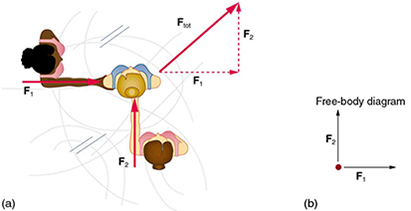
Figure 4.3(b) is our first example of a free-body diagram, which is a technique used to illustrate all the external forces acting on a body. The body is represented by a single isolated point (or free body), and only those forces acting on the body from the outside (external forces) are shown. (These forces are the only ones shown, because only external forces acting on the body affect its motion. We can ignore any internal forces within the body.) Free-body diagrams are very useful in analyzing forces acting on a system and are employed extensively in the study and application of Newton’s laws of motion.
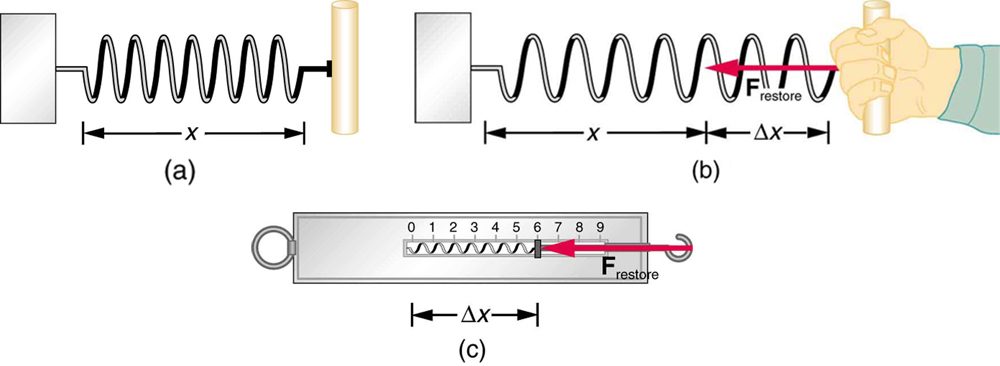
A more quantitative definition of force can be based on some standard force, just as distance is measured in units relative to a standard distance. One possibility is to stretch a spring a certain fixed distance, as illustrated in Figure 4.4, and use the force it exerts to pull itself back to its relaxed shape—called a restoring force—as a standard. The magnitude of all other forces can be stated as multiples of this standard unit of force. Many other possibilities exist for standard forces. (One that we will encounter in Magnetism is the magnetic force between two wires carrying electric current.) Some alternative definitions of force will be given later in this chapter.
Test Prep for AP Courses
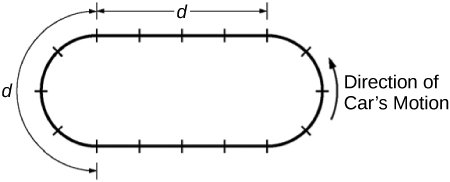
The figure above represents a racetrack with semicircular sections connected by straight sections. Each section has length d, and markers along the track are spaced d/4 apart. Two people drive cars counterclockwise around the track, as shown. Car X goes around the curves at constant speed vc, increases speed at constant acceleration for half of each straight section to reach a maximum speed of 2vc, then brakes at constant acceleration for the other half of each straight section to return to speed vc. Car Y also goes around the curves at constant speed vc, increases its speed at constant acceleration for one-fourth of each straight section to reach the same maximum speed 2vc, stays at that speed for half of each straight section, then brakes at constant acceleration for the remaining fourth of each straight section to return to speed vc.
(a) On the figures below, draw an arrow showing the direction of the net force on each of the cars at the positions noted by the dots. If the net force is zero at any position, label the dot with 0.
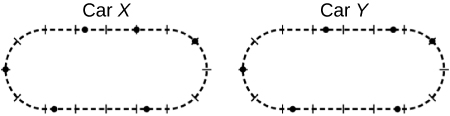
The position of the six dots on the Car Y track on the right are as follows:
- The first dot on the left center of the track is at the same position as it is on the Car X track.
- The second dot is just slight to the right of the Car X dot (less than a dash) past three perpendicular hash marks moving to the right.
- The third dot is about one and two-thirds perpendicular hash marks to the right of the center top perpendicular has mark.
- The fourth dot is in the same position as the Car X figure (one perpendicular hash mark above the center right perpendicular hash mark).
- The fifth dot is about one and two-third perpendicular hash marks to the right of the center bottom perpendicular hash mark.
- The sixth dot is in the same position as the Car Y dot (one and two third perpendicular hash marks to the left of the center bottom hash mark).
(b)
i. Indicate which car, if either, completes one trip around the track in less time, and justify your answer qualitatively without using equations.
ii. Justify your answer about which car, if either, completes one trip around the track in less time quantitatively with appropriate equations.
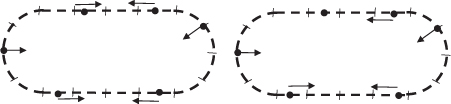
Car X is shown on the left, and Car Y is shown on the right.
i.
Car X takes longer to accelerate and does not spend any time traveling at top speed. Car Y accelerates over a shorter time and spends time going at top speed. So Car Y must cover the straightaways in a shorter time. Curves take the same time, so Car Y must overall take a shorter time.
ii.
The only difference in the calculations for the time of one segment of linear acceleration is the difference in distances. That shows that Car X takes longer to accelerate. The equation corresponds to Car Y traveling for a time at top speed.
Substituting into the displacement equation in part (b) ii gives . This shows that a car takes less time to reach its maximum speed when it accelerates over a shorter distance. Therefore, Car Y reaches its maximum speed more quickly, and spends more time at its maximum speed than Car X does, as argued in part (b) i.
Which of the following is an example of a body exerting a force on itself?
- a person standing up from a seated position
- a car accelerating while driving
- both of the above
- none of the above
A hawk accelerates as it glides in the air. Does the force causing the acceleration come from the hawk itself? Explain.
A body cannot exert a force on itself. The hawk may accelerate as a result of several forces. The hawk may accelerate toward Earth as a result of the force due to gravity. The hawk may accelerate as a result of the additional force exerted on it by wind. The hawk may accelerate as a result of orienting its body to create less air resistance, thus increasing the net force forward.
What causes the force that moves a boat forward when someone rows it?
- The force is caused by the rower’s arms.
- The force is caused by an interaction between the oars and gravity.
- The force is caused by an interaction between the oars and the water the boat is traveling in.
- The force is caused by friction.
Section Summary
- Dynamics is the study of how forces affect the motion of objects.
- Force is a push or pull that can be defined in terms of various standards, and it is a vector having both magnitude and direction.
- External forces are any outside forces that act on a body. A free-body diagram is a drawing of all external forces acting on a body.
Conceptual Questions
Propose a force standard different from the example of a stretched spring discussed in the text. Your standard must be capable of producing the same force repeatedly.
What properties do forces have that allow us to classify them as vectors?
Adapted from College Physics 2e by OpenStax (openstax.org), licensed under CC BY-NC-SA 4.0. Changes were made. License: CC-BY-NC-SA-4.0.