7.1 Probability Chapter Overview In this chapter, you will learn to:
Write sample spaces. Determine whether two events are mutually exclusive. Use the Addition Rule. Calculate probabilities using both tree diagrams and combinations. Do problems involving conditional probability. Determine whether two events are independent. Sample Spaces and Probability If two coins are tossed, what is the probability that both coins will fall heads? The problem seems simple enough, but it is not uncommon to hear the incorrect answer
1 / 3 size 12{1/3} {}
HH HT TH TT
The possibility HT, for example, indicates a head on the penny and a tail on the nickel, while TH represents a tail on the penny and a head on the nickel.
It is for this reason, we emphasize the need for understanding sample spaces.
An act of flipping coins, rolling dice, drawing cards, or surveying people are referred to as an experiment .
Example 1
If a die is rolled, write a sample space.
A die has six faces each having an equally likely chance of appearing. Therefore, the set of all possible outcomes
S size 12{S} {}
{ 1,2,3,4,5,6 } size 12{ left lbrace 1,2,3,4,5,6 right rbrace } {}
Example 2
A family has three children. Write a sample space.
The sample space consists of eight possibilities.
{ BBB , BBG , BGB , BGG , GBB , GBG , GGB , GGG } size 12{ left lbrace ital "BBB", ital "BBG", ital "BGB", ital "BGG", ital "GBB", ital "GBG", ital "GGB", ital "GGG" right rbrace } {}
The possibility
BGB size 12{ ital "BGB"} {}
We illustrate these possibilities with a tree diagram.
Figure 7.1 Example 3
Two dice are rolled. Write the sample space.
We assume one of the dice is red, and the other green. We have the following 36 possibilities.
The entry (2, 5), for example, indicates that the red die shows a two, and the green a 5.
Now that we understand the concept of a sample space, we will define probability.
Probability For a sample space
S size 12{S} {} A size 12{A} {} S size 12{S} {}
If
A size 12{A} {} A size 12{A} {} P ( A ) size 12{P left (A right )} {}
0
≤
P
( A
) ≤
1
size 12{0 <= P left (A right ) <= 1} {}
The sum of the probabilities of all the outcomes in
S size 12{S} {} Example 4
If two dice, one red and one green, are rolled, find the probability that the red die shows a 3 and the green shows a six.
Since two dice are rolled, there are 36 possibilities. The probability of each outcome, listed in Example 3 , is equally likely.
Since (3, 6) is one such outcome, the probability of obtaining (3, 6) is
1 / 36 size 12{1/"36"} {}
The example we just considered consisted of only one outcome of the sample space. We are often interested in finding probabilities of several outcomes represented by an event.
An event is a subset of a sample space. If an event consists of only one outcome, it is called a simple event .
Example 5
If two dice are rolled, find the probability that the sum of the faces of the dice is 7.
Let
E size 12{E} {}
Since the possible cases for the sum to be 7 are: (1, 6), (2,5), (3, 4), (4, 3), (5, 2), and (6, 1).
E = { ( 1,6 ) , ( 2,5 ) , ( 3,4 ) ( 4,3 ) , ( 5,2 ) , and ( 6,1 ) } size 12{E= left lbrace left (1,6 right ), left (2,5 right ), left (3,4 right ) left (4,3 right ), left (5,2 right )", and " left (6,1 right ) right rbrace } {}
and the probability of the event
E size 12{E} {}
P ( E ) = 6 / 36 size 12{P left (E right )=6/"36"} {} 1 / 6 size 12{1/6} {}
Example 6
A jar contains 3 red, 4 white, and 3 blue marbles. If a marble is chosen at random, what is the probability that the marble is a red marble or a blue marble?
We assume the marbles are
r 1 size 12{r rSub { size 8{1} } } {} r 2 size 12{r rSub { size 8{2} } } {} r 3 size 12{r rSub { size 8{3} } } {} w 1 size 12{w rSub { size 8{1} } } {} w 2 size 12{w rSub { size 8{2} } } {} w 3 size 12{w rSub { size 8{3} } } {} w 4 size 12{w rSub { size 8{4} } } {} b 1 size 12{b rSub { size 8{1} } } {} b 2 size 12{b rSub { size 8{2} } } {} b 3 size 12{b rSub { size 8{3} } } {} C size 12{C} {}
The sample space
S = { r 1 , r 2 , r 3, w 1 , w 2 , w 3 , w 4 , b 1 , b 2 , b 3 } size 12{S= left lbrace r rSub { size 8{1} },r rSub { size 8{2} },r rSub { size 8{3,} } w rSub { size 8{1} },w rSub { size 8{2} },w rSub { size 8{3} },w rSub { size 8{4} },b rSub { size 8{1} },b rSub { size 8{2} },b rSub { size 8{3} } right rbrace } {}
And the event
C = { r 1 , r 2 , r 3 , b 1 , b 2 , b 3 } size 12{C= left lbrace r rSub { size 8{1} },r rSub { size 8{2} },r rSub { size 8{3} },b rSub { size 8{1} },b rSub { size 8{2} },b rSub { size 8{3} } right rbrace } {}
Therefore, the probability of
C size 12{C} {}
P ( C ) = 6 / 10 size 12{P left (C right )=6/"10"} {} 3 / 5 size 12{3/5} {}
Example 7
A jar contains three marbles numbered 1, 2, and 3. If two marbles are drawn, what is the probability that the sum of the numbers is 4?
Since two marbles are drawn, the sample space consists of the following six possibilities.
S = { ( 1,2 ) , ( 1,3 ) , ( 2,3 ) , ( 2,1 ) , ( 3,1 ) , ( 3,2 ) } size 12{S= left lbrace left (1,2 right ), left (1,3 right ), left (2,3 right ), left (2,1 right ), left (3,1 right ), left (3,2 right ) right rbrace } {}
Let the event F represent that the sum of the numbers is four. Then
F = [ ( 1,3 ) , ( 3,1 ) ] size 12{F= left [ left (1,3 right ), left (3,1 right ) right ]} {}
Therefore, the probability of
F size 12{F} {}
P ( F ) = 2 / 6 size 12{P left (F right )=2/6} {} 1 / 3 size 12{1/3} {}
Example 8
A jar contains three marbles numbered 1, 2, and 3. If two marbles are drawn, what is the probability that the sum of the numbers is at least 4?
The sample space, as in Example 7 , consists of the following six possibilities.
S = { ( 1,2 ) , ( 1,3 ) , ( 2,3 ) , ( 2,1 ) , ( 3,1 ) , ( 3,2 ) } size 12{S= left lbrace left (1,2 right ), left (1,3 right ), left (2,3 right ), left (2,1 right ), left (3,1 right ), left (3,2 right ) right rbrace } {}
Let the event
A size 12{A} {}
F = { ( 1,3 ) , ( 3,1 ) , ( 2,3 ) , ( 3,2 ) } size 12{F= left lbrace left (1,3 right ), left (3,1 right ), left (2,3 right ), left (3,2 right ) right rbrace } {}
Therefore, the probability of
F size 12{F} {}
P ( F ) = 4 / 6 size 12{P left (F right )=4/6} {} 2 / 3 size 12{2/3} {}
Mutually Exclusive Events and the Addition Rule In the the related section, we learned to find the union, intersection, and complement of a set. We will now use these set operations to describe events.
The union of two events
E size 12{E} {} F size 12{F} {} E ∪ F size 12{E union F} {} E size 12{E} {} F size 12{F} {}
The intersection of two events
E size 12{E} {} F size 12{F} {} E ∩ F size 12{E intersection F} {} E size 12{E} {} F size 12{F} {}
The complement of an event
E size 12{E} {} E c size 12{E rSup { size 8{c} } } {} S size 12{S} {} E size 12{E} {} P ( E C ) = 1 − P ( E ) size 12{P left (E rSup { size 8{C} } right )=1 - P left (E right )} {} n size 12{n} {} E size 12{E} {} k size 12{k} {} E c size 12{E rSup { size 8{c} } } {} n − k size 12{n - k} {}
P ( E C ) = n − k n = 1 − k n = 1 − P ( E ) size 12{P left (E rSup { size 8{C} } right )= { {n - k} over {n} } =1 - { {k} over {n} } =1 - P left (E right )} {}
Of particular interest to us are the events whose outcomes do not overlap. We call these events mutually exclusive.
Two events
E size 12{E} {} F size 12{F} {} mutually exclusive if they do not intersect. That is,
E ∩ F = ∅ size 12{E intersection F=" 00000"} {}
Next we'll determine whether a given pair of events are mutually exclusive.
Example 9
A card is drawn from a standard deck. Determine whether the pair of events given below is mutually exclusive.
E = { The card drawn is an Ace } size 12{E= left lbrace "The card drawn is an Ace" right rbrace } {}
F = { The card drawn is a heart } size 12{F= left lbrace "The card drawn is a heart" right rbrace } {}
Clearly the ace of hearts belongs to both sets. That is
E ∩ F = { Ace of hearts } ≠ ∅ size 12{E intersection F= left lbrace "Ace of hearts" right rbrace <> "00000"} {}
Therefore, the events
E size 12{E} {} F size 12{F} {}
Example 10
Two dice are rolled. Determine whether the pair of events given below is mutually exclusive.
G = { The sum of the faces is six } size 12{G= left lbrace "The sum of the faces is six" right rbrace } {}
H = { One die shows a four } size 12{H= left lbrace "One die shows a four" right rbrace } {}
For clarity, we list the elements of both sets.
G = { ( 1,5 ) , ( 2,4 ) , ( 3,3 ) , ( 4,2 ) , ( 5,1 ) } size 12{G= left lbrace left (1,5 right ), left (2,4 right ), left (3,3 right ), left (4,2 right ), left (5,1 right ) right rbrace } {}
H = { ( 2,4 ) , ( 4,2 ) } size 12{H= left lbrace left (2,4 right ), left (4,2 right ) right rbrace } {}
Clearly,
G ∩ H = { ( 2,4 ) , ( 4,2 ) } ≠ Ø size 12{G intersection H= left lbrace left (2,4 right ), left (4,2 right ) right rbrace <> "Ø"} {}
Therefore, the two sets are not mutually exclusive.
Example 11
A family has three children. Determine whether the following pair of events are mutually exclusive.
M = { The family has at least one boy } size 12{M= left lbrace "The family has at least one boy" right rbrace } {}
N = { The family has all girls } size 12{N= left lbrace "The family has all girls" right rbrace } {}
Although the answer may be clear, we list both the sets.
M = { BBB , BBG , BGB , BGG , GBB , GBG , GGB } size 12{M= left lbrace ital "BBB", ital "BBG", ital "BGB", ital "BGG", ital "GBB", ital "GBG", ital "GGB" right rbrace } {} N = { GGG } size 12{N= left lbrace ital "GGG" right rbrace } {}
Clearly,
M ∩ N = Ø size 12{M intersection N="Ø"} {}
Therefore, the events
M size 12{M} {} N size 12{N} {}
We will now consider problems that involve the union of two events.
Example 12
If a die is rolled, what is the probability of obtaining an even number or a number greater than four?
Let
E size 12{E} {} F size 12{F} {}
The sample space
S = { 1,2,3,4,5,6 } size 12{S= left lbrace 1,2,3,4,5,6 right rbrace } {} E = { 2,4,6 } size 12{E= left lbrace 2,4,6 right rbrace } {} F = { 5,6 } size 12{F= left lbrace 5,6 right rbrace } {}
We need to find
P ( E ∪ F ) size 12{P left (E union F right )} {}
Since
P ( E ) = 3 / 6 size 12{P left (E right )=3/6} {} P ( F ) = 2 / 6 size 12{P left (F right )=2/6} {} P ( E ∪ F ) = 3 / 6 + 2 / 6 size 12{P left (E union F right )=3/6+2/6} {} E size 12{E} {} F size 12{F} {} E size 12{E} {} F size 12{F} {} E ∪ F size 12{E union F} {} P ( E ∪ F ) = 4 / 6 size 12{P left (E union F right )=4/6} {} 5 / 6 size 12{5/6} {}
This can be illustrated by a Venn diagram.
The sample space
S size 12{S} {} E size 12{E} {} F size 12{F} {} E ∩ F size 12{E intersection F} {}
S = { 1,2,3,4,5,6 } size 12{S= left lbrace 1,2,3,4,5,6 right rbrace } {} E = { 2,4,6 } size 12{E= left lbrace 2,4,6 right rbrace } {} F = { 5,6 } size 12{F= left lbrace 5,6 right rbrace } {} E ∩ F = { 6 } size 12{E intersection F= left lbrace 6 right rbrace } {}
Figure 7.2 The above figure shows S E F E ∩ F
Finding the probability of E ∪ F E F n ( E ) E n ( F ) F E F E F n ( E ) + n ( F ) n ( E ∩ F )
n ( E ∪ F ) = n ( E ) + n ( F ) − n ( E ∩ F )
By dividing the entire equation by n ( S )
n ( E ∪ F ) n ( S ) = n ( E ) n ( S ) + n ( F ) n ( S ) − n ( E ∩ F ) n ( S )
Since the probability of an event is the number of elements in that event divided by the number of all possible outcomes, we have
P ( E ∪ F ) = P ( E ) + P ( F ) − P ( E ∩ F )
Applying the above for this example, we get
P ( E ∪ F ) = 3 / 6 + 2 / 6 − 1 / 6 = 4 / 6
This is because, when we add P ( E ) P ( F ) P ( E ∩ F ) P ( E ∩ F )
This gives us the general formula, called the Addition Rule , for finding the probability of the
union of two events. It states
P ( E ∪ F ) = P ( E ) + P ( F ) − P ( E ∩ F )
If two events E and F are mutually exclusive, then E ∩ F = ∅ P ( E ∩ F ) = 0
P ( E ∪ F ) = P ( E ) + P ( F )
Example 13
If a card is drawn from a deck, use the addition rule to find the probability of obtaining an ace or a heart.
Let
A size 12{A} {} H size 12{H} {}
Since there are four aces, and thirteen hearts in the deck,
P ( A ) = 4 / 52 size 12{P left (A right )=4/"52"} {} P ( H ) = 13 / 52 size 12{P left (H right )="13"/"52"} {} P ( A ∩ H ) = 1 / 52 size 12{P left (A intersection H right )=1/"52"} {}
We need to find
P ( A ∪ H ) size 12{P left (A union H right )} {}
P ( A ∪ H ) = P ( A ) + P ( H ) − P ( A ∩ H ) = 4 / 52 + 13 / 52 − 1 / 52 = 16 / 52 size 12{P left (A union H right )=P left (A right )+P left (H right )–P left (A intersection H right )=4/"52"+"13"/"52" - 1/"52"="16"/"52"} {}
Example 14
Two dice are rolled, and the events
F size 12{F} {} T size 12{T} {}
F = { The sum of the dice is four } size 12{F= left lbrace "The sum of the dice is four" right rbrace } {} T = { At least one die shows a three } size 12{T= left lbrace "At least one die shows a three" right rbrace } {}
Find
P ( F ∪ T ) size 12{P left (F union T right )} {}
We list
F size 12{F} {} T size 12{T} {} F ∩ T size 12{F intersection T} {}
F = { ( 1,3 ) , ( 2,2 ) , ( 3,1 ) } size 12{F= left lbrace left (1,3 right ), left (2,2 right ), left (3,1 right ) right rbrace } {}
T = { ( 3,1 ) , ( 3,2 ) , ( 3,3 ) , ( 3,4 ) , ( 3,5 ) , ( 3,6 ) , ( 1,3 ) , ( 2,3 ) , ( 4,3 ) , ( 5,3 ) , ( 6,3 ) } size 12{T= left lbrace left (3,1 right ), left (3,2 right ), left (3,3 right ), left (3,4 right ), left (3,5 right ), left (3,6 right ), left (1,3 right ), left (2,3 right ), left (4,3 right ), left (5,3 right ), left (6,3 right ) right rbrace } {}
F ∩ T = { ( 1,3 ) , ( 3,1 ) } size 12{F intersection T= left lbrace left (1,3 right ), left (3,1 right ) right rbrace } {}
Since
P ( F ∪ T ) = P ( F ) + P ( T ) − P ( F ∩ T ) size 12{P left (F union T right )=P left (F right )+P left (T right ) - P left (F intersection T right )} {}
We have
P ( F ∪ T ) = 3 / 36 + 11 / 36 − 2 / 36 = 12 / 36 size 12{P left (F union T right )=3/"36"+"11"/"36" - 2/"36"="12"/"36"} {}
Example 15
Mr. Washington is seeking a mathematics instructor's position at his favorite community college in Cupertino. His employment depends on two conditions: whether the board approves the position, and whether the hiring committee selects him. There is a 80% chance that the board will approve the position, and there is a 70% chance that the hiring committee will select him. If there is a 90% chance that at least one of the two conditions, the board approval or his selection, will be met, what is the probability that Mr. Washington will be hired?
Let
A size 12{A} {}
P ( A ) = . 80 size 12{P left (A right )= "." "80"} {} P ( S ) = . 70 size 12{P left (S right )= "." "70"} {} P ( A ∪ S ) = . 90 size 12{P left (A union S right )= "." "90"} {}
We need to find,
P ( A ∩ S ) size 12{P left (A intersection S right )} {}
The addition formula states that,
P ( A ∪ S ) = P ( A ) + P ( S ) − P ( A ∩ S ) size 12{P left (A union S right )=P left (A right )+P left (S right ) - P left (A intersection S right )} {}
Substituting the known values, we get
. 90 = . 80 + . 70 − P ( A ∩ S ) size 12{ "." "90"= "." "80"+ "." "70" - P left (A intersection S right )} {}
Therefore,
P ( A ∩ S ) = . 60 size 12{P left (A intersection S right )= "." "60"} {}
Example 16
The probability that this weekend will be cold is
. 6 size 12{ "." 6} {} . 7 size 12{ "." 7} {} . 5 size 12{ "." 5} {}
Let
C size 12{C} {} R size 12{R} {}
P ( C ) = . 6 size 12{P left (C right )= "." 6} {} P ( R ) = . 7 size 12{P left (R right )= "." 7} {} P ( C ∩ R ) = . 5 size 12{P left (C intersection R right )= "." 5} {}
P ( C ∪ R ) = P ( C ) + P ( R ) − P ( C ∩ R ) = . 6 + . 7 − . 5 = . 8 size 12{P left (C union R right )=P left (C right )+P left (R right ) - P left (C intersection R right )= "." 6+ "." 7 - "." 5= "." 8} {}
We want to find
P ( ( C ∪ R ) c ) size 12{P left ( left (C union R right ) rSup { size 8{c} } right )} {}
P ( ( C ∪ R ) c ) = 1 − P ( C ∪ R ) = 1 − . 8 = . 2 size 12{P left ( left (C union R right ) rSup { size 8{c} } right )=1 - P left (C union R right )=1 - "." 8= "." 2} {}
We summarize this section by listing the important rules.
Example 17
The Addition Rule
For Two Events
E size 12{E} {} F size 12{F} {} P ( E ∪ F ) = P ( E ) + P ( F ) − P ( E ∩ F ) size 12{P left (E union F right )=P left (E right )+P left (F right ) - P left (E intersection F right )} {}
The Addition Rule for Mutually Exclusive Events
If Two Events
E size 12{E} {} F size 12{F} {} P ( E ∪ F ) = P ( E ) + P ( F ) size 12{P left (E union F right )=P left (E right )+P left (F right )} {}
The Complement Rule
If
E c size 12{E rSup { size 8{c} } } {} E size 12{E} {} P ( E c ) = 1 − P ( E ) size 12{P left (E rSup { size 8{c} } right )=1 - P left (E right )} {}
Probability Using Tree Diagrams and Combinations In this section, we will apply previously learnt counting techniques in calculating probabilities, and use tree diagrams to help us gain a better understanding of what is involved.
We begin with an example.
Example 18
Suppose a jar contains 3 red and 4 white marbles. If two marbles are drawn with replacement, what is the probability that both marbles are red?
Let
E size 12{E} {} F size 12{F} {}
We need to find
P ( E ∩ F ) size 12{P left (E intersection F right )} {}
By the statement, "two marbles are drawn with replacement," we mean that the first marble is replaced before the second marble is drawn.
There are 7 choices for the first draw. And since the first marble is replaced before the second is drawn, there are, again, seven choices for the second draw. Using the multiplication axiom, we conclude that the sample space
S size 12{S} {} 3 × 3 = 9 size 12{3 times 3=9} {}
P ( E ∩ F ) = 9 49 = 3 7 ⋅ 3 7 size 12{P left (E intersection F right )= { {9} over {"49"} } = { {3} over {7} } cdot { {3} over {7} } } {}
Further note that in this particular case
P ( E ∩ F ) = P ( E ) ⋅ P ( F ) size 12{P left (E intersection F right )=P left (E right ) cdot P left (F right )} {}
Example 19
If in the Example 18 , the two marbles are drawn without replacement, then what is the probability that both marbles are red?
By the statement, "two marbles are drawn without replacement," we mean that the first marble is not replaced before the second marble is drawn.
Again, we need to find
P ( E ∩ F ) size 12{P left (E intersection F right )} {}
There are, again, 7 choices for the first draw. And since the first marble is not replaced before the second is drawn, there are only six choices for the second draw. Using the multiplication axiom, we conclude that the sample space
S size 12{S} {} 3 × 2 = 6 size 12{3 times 2=6} {}
P ( E ∩ F ) = 6 42 = 3 7 ⋅ 2 6 size 12{P left (E intersection F right )= { {6} over {"42"} } = { {3} over {7} } cdot { {2} over {6} } } {}
Here
3 / 7 size 12{3/7} {} P ( E ) size 12{P left (E right )} {} 2 / 6 size 12{2/6} {} P ( Red on the second ∣ red on first ) size 12{P left ("Red on the second" \lline "red on first" right )} {} P ( F ∣ E ) size 12{P left (F \lline E right )} {}
P ( E ∩ F ) = P ( E ) ⋅ P ( F ∣ E ) size 12{P left (F intersection E right )=P left (E right ) cdot P left (E \lline F right )} {}
The above result is an important one and will appear again in later sections.
We now demonstrate the above results with a tree diagram.
Example 20
Suppose a jar contains 3 red and 4 white marbles. If two marbles are drawn without replacement, find the following probabilities using a tree diagram.
The probability that both marbles are white. The probability that the first marble is red and the second white. The probability that one marble is red and the other white. Let
R size 12{R} {} W size 12{W} {}
We draw the following tree diagram.
Figure 7.3 Although the tree diagrams give us better insight into a problem, they are not practical for problems where more than two or three things are chosen. In such cases, we use the concept of combinations that we learned in the related section. This method is best suited for problems where the order in which the objects are chosen is not important, and the objects are chosen without replacement.
Example 21
Suppose a jar contains 3 red, 2 white, and 3 blue marbles. If three marbles are drawn without replacement, find the following probabilities.
P ( Two red and one white ) size 12{P left ("Two red and one white" right )} {}
P ( One of each color ) size 12{P left ("One of each color" right )} {}
P ( None blue ) size 12{P left ("None blue" right )} {}
P ( At least one blue ) size 12{P left ("At least one blue" right )} {} Let us suppose the marbles are labeled as
R 1 size 12{R rSub { size 8{1} } } {} R 2 size 12{R rSub { size 8{2} } } {} R 3 size 12{R rSub { size 8{3} } } {} W 1 size 12{W rSub { size 8{1} } } {} W 2 size 12{W rSub { size 8{2} } } {} B 1 size 12{B rSub { size 8{1} } } {} B 2 size 12{B rSub { size 8{2} } } {} B 3 size 12{B rSub { size 8{3} } } {}
P ( Two red and one white ) size 12{P left ("Two red and one white" right )} {}
We analyze the problem in the following manner.
Since we are choosing 3 marbles from a total of 8, there are
8 C 3 = 56 size 12{8C3="56"} {} 3 C 2 × 2 C 1 = 6 size 12{3C2 times 2C1=6} {}
P ( Two red and one white ) = 3 C 2 × 2 C 1 8 C 3 = 6 56 size 12{P left ("Two red and one white" right )= { {3C2 times 2C1} over {8C3} } = { {6} over {"56"} } } {}
P ( One of each color ) size 12{P left ("One of each color" right )} {}
Again, there are
8 C 3 = 56 size 12{8C3="56"} {} 3 C 1 × 2 C 1 × 3 C 1 = 18 size 12{3C1 times 2C1 times 3C1="18"} {}
P ( One of each color ) = 3 C 1 × 2 C 1 × 3 C 1 8 C 3 = 18 56 size 12{P left ("One of each color" right )= { {3C1 times 2C1 times 3C1} over {8C3} } = { {"18"} over {"56"} } } {}
P ( None blue ) size 12{P left ("None blue" right )} {}
There are 5 non-blue marbles, therefore
P ( None blue ) = 5 C 3 8 C 3 = 10 56 = 5 28 size 12{P left ("None blue" right )= { {5C3} over {8C3} } = { {"10"} over {"56"} } = { {5} over {"28"} } } {}
P ( At least one blue ) size 12{P left ("At least one blue" right )} {}
By "at least one blue marble," we mean the following: one blue marble and two non-blue marbles, or two blue marbles and one non-blue marble, or all three blue marbles. So we have to find the sum of the probabilities of all three cases.
P ( At least one blue ) = P ( one blue, two non-blue ) + P ( two blue, one non-blue ) + P ( three blue ) size 12{P left ("At least one blue" right )=P left ("one blue, two non-blue" right )+P left ("two blue, one non-blue" right )+P left ("three blue" right )} {}
P ( At least one blue ) = 3 C 1 × 5 C 2 8 C 3 + 3 C 2 × 5 C 1 8 C 3 + 3 C 3 8 C 3 size 12{P left ("At least one blue" right )= { {3C1 times 5C2} over {8C3} } + { {3C2 times 5C1} over {8C3} } + { {3C3} over {8C3} } } {}
P ( At least one blue ) = 30 / 56 + 15 / 56 + 1 / 56 = 46 / 56 = 23 / 28 size 12{P left ("At least one blue" right )="30"/"56"+"15"/"56"+1/"56"="46"/"56"="23"/"28"} {}
Alternately,
we use the fact that
P ( E ) = 1 − P ( E c ) size 12{P left (E right )=1 - P left (E rSup { size 8{c} } right )} {}
If the event
E = At least one blue size 12{E="At least one blue"} {} E c = None blue size 12{E rSup { size 8{c} } ="None blue"} {}
But from part c of this example, we have
( E c ) = 5 / 28 size 12{ left (E rSup { size 8{c} } right )=5/"28"} {}
Therefore,
P ( E ) = 1 − 5 / 28 = 23 / 28 size 12{P left (E right )=1 - 5/"28"="23"/"28"} {}
Example 22
Five cards are drawn from a deck. Find the probability of obtaining two pairs, that is, two cards of one value, two of another value, and one other card.
Let us first do an easier problem–the probability of obtaining a pair of kings and queens.
Since there are four kings, and four queens in the deck, the probability of obtaining two kings, two queens and one other card is
P ( A pair of kings and queens ) = 4 C 2 × 4 C 2 × 44 C1 52 C5 size 12{P left ("A pair of kings and queens" right )= { {4C2 times 4C2 times "44"C1} over {"52"C5} } } {}
To find the probability of obtaining two pairs, we have to consider all possible pairs.
Since there are altogether 13 values, that is, aces, deuces, and so on, there are
13 C2 size 12{"13"C2} {}
P ( Two pairs ) = 13 C2 ⋅ 4 C 2 × 4 C 2 × 44 C1 52 C5 = . 04754 size 12{P left ("Two pairs" right )="13"C2 cdot { {4C2 times 4C2 times "44"C1} over {"52"C5} } = "." "04754"} {}
We end the section by solving a problem called the Birthday Problem .
Example 23
If there are 25 people in a room, what is the probability that at least two people have the same birthday?
Let event
E size 12{E} {}
We first find the probability that no two people have the same birthday.
We analyze as follows.
Suppose there are 365 days to every year. According to the multiplication axiom, there are
365 25 size 12{"365" rSup { size 8{"25"} } } {} 365 25 size 12{"365" rSup { size 8{"25"} } } {}
P ( No two have the same birthday ) = 365 ⋅ 364 ⋅ 363 ⋯ 341 365 25 = 365 P 25 365 25 size 12{P left ("No two have the same birthday" right )= { {"365" cdot "364" cdot "363" dotsaxis "341"} over {"365" rSup { size 8{"25"} } } } = { {"365"P"25"} over {"365" rSup { size 8{"25"} } } } } {}
Since
P ( at least two people have the same birthday ) = 1 − P ( No two have the same birthday ) , size 12{P left ("at least two people have the same birthday" right )=1 - P left ("No two have the same birthday" right ),} {}
P ( at least two people have the same birthday ) = 1 − 365 P 25 365 25 = . 5687 size 12{P left ("at least two people have the same birthday" right )=1 - { {"365"P"25"} over {"365" rSup { size 8{"25"} } } } = "." "5687"} {}
Conditional Probability Suppose you and a friend wish to play a game that involves choosing a single card from a well-shuffled deck. Your friend deals you one card, face down, from the deck and offers you the following deal: If the card is a king, he will pay you $5, otherwise, you pay him $1. Should you play the game?
You reason in the following manner. Since there are four kings in the deck, the probability of obtaining a king is
4 / 52 size 12{4/"52"} {} 1 / 13 size 12{1/"13"} {} 12 / 13 size 12{"12"/"13"} {}
Now consider the following scenario. While your friend was dealing the card, you happened to get a glance of it and noticed that the card was a face card. Should you, now, play the game?
Since there are 12 face cards in the deck, the total elements in the sample space are no longer 52, but just 12. This means the chance of obtaining a king is
4 / 12 size 12{4/"12"} {} 1 / 3 size 12{1/3} {} 1 / 3 size 12{1/3} {} 2 / 3 size 12{2/3} {}
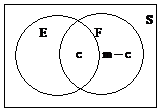
In the second part of the above example, we were finding the probability of obtaining a king knowing that a face card had shown. This is an example of conditional probability . Whenever we are finding the probability of an event E under the condition that another event F has happened, we are finding conditional probability.
The symbol
P ( E ∣ F ) size 12{P left (E \lline F right )} {} E size 12{E} {} F size 12{F} {} P ( E ∣ F ) size 12{P left (E \lline F right )} {} E size 12{E} {} F size 12{F} {}
Example 24
A family has three children. Find the conditional probability of having two boys and a girl given that the first born is a boy.
Let event
E size 12{E} {} F size 12{F} {}
First, we list the sample space for a family of three children as follows.
S = { BBB , BBG , BGB , BGG , GBB , GBG , GGB , GGG } size 12{S= left lbrace ital "BBB", ital "BBG", ital "BGB", ital "BGG", ital "GBB", ital "GBG", ital "GGB", ital "GGG" right rbrace } {}
Since we know that the first born is a boy, our possibilities narrow down to four outcomes,
BBB size 12{ ital "BBB"} {} BBG size 12{ ital "BBG"} {} BGB size 12{ ital "BGB"} {} BGG size 12{ ital "BGG"} {}
Among the four,
BBG size 12{ ital "BBG"} {} BGB size 12{ ital "BGB"} {}
Therefore,
P ( E ∣ F = 2 / 4 size 12{P \( E \lline F rbrace =2/4} {} 1 / 2 size 12{1/2} {}
Let us now develop a formula for the conditional probability
P ( E ∣ F ) size 12{P left (E \lline F right )} {}
Suppose an experiment consists of
n size 12{n} {} m size 12{m} {} F size 12{F} {} c size 12{c} {} E ∩ F size 12{E intersection F} {}
Figure 7.4 If the event
F size 12{F} {} F size 12{F} {} F size 12{F} {} F size 12{F} {} F size 12{F} {} m size 12{m} {} P ( E ∣ F ) size 12{P left (E \lline F right )} {} E size 12{E} {} E size 12{E} {} F size 12{F} {} E size 12{E} {} F size 12{F} {} E ∩ F size 12{E intersection F} {}
P
(
E
∣
F
) =
c
m
size 12{P left (E \lline F right )= { {c} over {m} } } {}
Dividing both the numerator and the denominator by
n size 12{n} {}
P
(
E
∣
F
) =
c
/
n
m
/
n
size 12{P left (E \lline F right )= { {c/n} over {m/n} } } {}
But
c / n = P ( E ∩ F ) size 12{c/n=P left (E intersection F right )} {} m / n = P ( F ) size 12{m/n=P left (F right )} {}
Substituting, we derive the following formula for
P ( E ∣ F ) size 12{P left (E \lline F right )} {}
Example 25
For Two Events
E size 12{E} {} F size 12{F} {} E size 12{E} {} F size 12{F} {}
P
(
E
∣
F
) =
P
(
E
∩
F
)
P
( F
)
size 12{P left (E \lline F right )= { {P left (E intersection F right )} over {P left (F right )} } } {}
Example 26
A single die is rolled. Use the above formula to find the conditional probability of obtaining an even number given that a number greater than three has shown.
Let
E size 12{E} {} F size 12{F} {} P ( E ∣ F ) size 12{P left (E \lline F right )} {}
E = { 2,4,6 } size 12{E= left lbrace 2,4,6 right rbrace } {} F = { 4,5,6 } size 12{F= left lbrace 4,5,6 right rbrace } {} E ∩ F = { 4,6 } size 12{E intersection F= left lbrace 4,6 right rbrace } {}
Therefore,
P ( F ) = 3 / 6 size 12{P left (F right )=3/6} {} P ( E ∩ F ) = 2 / 6 size 12{P left (E intersection F right )=2/6} {}
P ( E ∣ F ) = P ( E ∩ F ) P ( F ) = 2 / 6 3 / 6 = 2 3 size 12{P left (E \lline F right )= { {P left (E intersection F right )} over {P left (F right )} } = { {2/6} over {3/6} } = { {2} over {3} } } {}
Example 27
The following table shows the distribution by gender of students at a community college who take public transportation and the ones who drive to school.
The events
M size 12{M} {} F size 12{F} {} P size 12{P} {} D size 12{D} {}
P ( D ∣ M ) size 12{P left (D \lline M right )} {}
P ( F ∣ D ) size 12{P left (F \lline D right )} {}
P ( M ∣ P ) size 12{P left (M \lline P right )} {} We use the conditional probability formula
P ( E ∣ F ) = P ( E ∩ F ) P ( F ) size 12{P left (E \lline F right )= { {P left (E intersection F right )} over {P left (F right )} } } {}
P ( D ∣ M ) = P ( D ∩ M ) P ( M ) = 39 / 100 47 / 100 = 39 47 size 12{P left (D \lline M right )= { {P left (D intersection M right )} over {P left (M right )} } = { {"39"/"100"} over {"47"/"100"} } = { {"39"} over {"47"} } } {}
P ( F ∣ D ) = P ( F ∩ D ) P ( D ) = 40 / 100 79 / 100 = 40 79 size 12{P left (F \lline D right )= { {P left (F intersection D right )} over {P left (D right )} } = { {"40"/"100"} over {"79"/"100"} } = { {"40"} over {"79"} } } {}
P ( M ∣ P ) = P ( M ∩ P ) P ( P ) = 8 / 100 21 / 100 = 8 21 size 12{P left (M \lline P right )= { {P left (M intersection P right )} over {P left (P right )} } = { {8/"100"} over {"21"/"100"} } = { {8} over {"21"} } } {} Example 28
Given
P ( E ) = . 5 size 12{P left (E right )= "." 5} {} P ( F ) = .7 size 12{P left (F right )=/7} {} P ( E ∩ F ) = .3 size 12{P left (E intersection F right )} {}
P ( E ∣ F ) size 12{P left (E \lline F right )} {}
P ( F ∣ E ) size 12{P left (F \lline E right )} {} We use the conditional probability formula
P ( E ∣ F ) = P ( E ∩ F ) P ( F ) size 12{P left (E \lline F right )= { {P left (E intersection F right )} over {P left (F right )} } } {}
P ( E ∣ F ) = . 3 . 7 = 3 7 size 12{P left (E \lline F right )= { { "." 3} over { "." 7} } = { {3} over {7} } } {}
P ( F ∣ E ) = . 3 / . 5 = 3 / 5 size 12{P left (F \lline E right )= "." 3/ "." 5=3/5} {} Example 29
Given two mutually exclusive events
E size 12{E} {} F size 12{F} {} P ( E ) = . 4 size 12{P left (E right )= "." 4} {} P ( F ) = . 9 size 12{P left (F right )= "." 9} {} P ( E ∣ F ) size 12{P left (E \lline F right )} {}
Since
E size 12{E} {} F size 12{F} {} P ( E ∩ F ) = 0 size 12{P left (E intersection F right )=0} {}
P ( E | F ) = 0
.9 = 0 size 12{P left (E intersection F right )=0} {}
Example 30
Given
P ( F ∣ E ) = . 5 size 12{P left (F \lline E right )= "." 5} {} P ( E ∩ F ) = . 3 size 12{P left (E intersection F right )= "." 3} {} P ( E ) size 12{P left (E right )} {}
Using the conditional probability formula
P ( E ∣ F ) = P ( E ∩ F ) P ( F ) size 12{P left (E \lline F right )= { {P left (E intersection F right )} over {P left (F right )} } } {}
P ( F ∣ E ) = P ( E ∩ F ) P ( E ) size 12{P left (F \lline E right )= { {P left (E intersection F right )} over {P left (E right )} } } {}
Substituting,
. 5 = . 3 P ( E ) size 12{ "." 5= { { "." 3} over {P left (E right )} } } {} P ( E ) = 3 / 5 size 12{P left (E right )=3/5} {}
Example 31
In a family of three children, find the conditional probability of having two boys and a girl, given that the family has at least two boys.
Let event
E size 12{E} {} F size 12{F} {} P ( E ∣ F ) size 12{P left (E \lline F right )} {}
We list the sample space along with the events
E size 12{E} {} F size 12{F} {}
S = { BBB , BBG , BGB , BGG , GBB , GGB , GGG } size 12{S= left lbrace ital "BBB", ital "BBG", ital "BGB", ital "BGG", ital "GBB", ital "GGB", ital "GGG" right rbrace } {}
E = { BBG , BGB , GBB } size 12{E= left lbrace ital "BBG", ital "BGB", ital "GBB" right rbrace } {} F = { BBB , BBG , BGB , GBB } size 12{F= left lbrace ital "BBB", ital "BBG", ital "BGB", ital "GBB" right rbrace } {}
E ∩ F = { BBG , BGB , GBB } size 12{E intersection F= left lbrace ital "BBG", ital "BGB", ital "GBB" right rbrace } {}
Therefore,
P ( F ) = 4 / 8 size 12{P left (F right )=4/8} {} P ( E ∩ F ) = 3 / 8 size 12{P left (E intersection F right )=3/8} {}
And
P ( E ∣ F ) − 3 / 8 4 / 8 = 3 4 size 12{P left (E \lline F right ) - { {3/8} over {4/8} } = { {3} over {4} } } {}
Example 32
At a community college 65% of the students use iPads, 50% use Macs, and 20% use both. If a student is chosen at random, find the following probabilities.
The student uses an iPad given that he uses a Mac. The student uses a Mac knowing that he uses an iPad. Let event
I size 12{I} {} M size 12{M} {}
P ( I ∣ M ) = . 20 . 50 = 2 5 size 12{P left (I \lline M right )= { { "." "20"} over { "." "50"} } = { {2} over {5} } } {}
P ( M ∣ I ) = . 20 . 65 = 4 13 size 12{P left (M \lline I right )= { { "." "20"} over { "." "65"} } = { {4} over {"13"} } } {} Independent Events In, we considered conditional probabilities. In some examples, the probability of an event changed when additional information was provided. For instance, the probability of obtaining a king from a deck of cards, changed from
4 / 52 size 12{4/"52"} {} 4 / 12 size 12{4/"12"} {}
The reader should observe that in the above example,
P
(
The card is a king
∣
A red card has shown
) =
P
( The card is a king
)
size 12{P left ("The card is a king" \lline " A red card has shown" right )=P left ("The card is a king" right )} {}
In other words, the additional information, a red card has shown, did not affect the probability of obtaining a king. Whenever the probability of an event
E size 12{E} {} F size 12{F} {} E size 12{E} {} F size 12{F} {} independent . This leads to the following definition.
Two Events
E size 12{E} {} F size 12{F} {} independent if and only if at least one of the following two conditions is true.
P ( E ∣ F ) = P ( E ) size 12{P left (E \lline F right )=P left (E right )} {}
P
(
F
∣
E
) =
P
( F
)
size 12{P left (F \lline E right )=P left (F right )} {}
If the events are not independent, then they are dependent.
Next, we need to develop a test to determine whether two events are independent.
We recall the conditional probability formula.
P ( E ∣ F ) = P ( E ∩ F ) P ( F ) size 12{P left (E \lline F right )= { {P left (E intersection F right )} over {P left (F right )} } } {}
Multiplying both sides by
P ( F ) size 12{P left (F right )} {}
P ( E ∩ F ) = P ( E ∣ F ) P ( F ) size 12{P left (E intersection F right )=P left (E \lline F right )P left (F right )} {}
Now if the two events are independent, then by definition
P ( E ∣ F ) = P ( E ) size 12{P left (E \lline F right )=P left (E right )} {}
Substituting,
P ( E ∩ F ) = P ( E ) P ( F ) size 12{P left (E intersection F right )=P left (E right )P left (F right )} {}
We state it formally as follows.
Test for Independence Two Events
E size 12{E} {} F size 12{F} {}
P ( E ∩ F ) = P ( E ) P ( F ) size 12{P left (E intersection F right )=P left (E right )P left (F right )} {}
Example 34
The table below shows the distribution of color-blind people by gender.
Where
M size 12{M} {} F size 12{F} {} C size 12{C} {} N size 12{N} {}
According to the test,
C size 12{C} {} M size 12{M} {} P ( C ∩ M ) = P ( C ) P ( M ) size 12{P left (C intersection M right )=P left (C right )P left (M right )} {}
P ( C ) = 7 / 100 size 12{P left (C right )=7/"100"} {} ,
P ( M ) = 52 / 100 size 12{P left (M right )="52"/"100"} {} and
P ( C ∩ M ) = 6 / 100 size 12{P left (C intersection M right )=6/"100"} {}
P ( C ) P ( M ) = ( 7 / 100 ) ( 52 / 100 ) = . 0364 size 12{P left (C right )P left (M right )= left (7/"100" right ) left ("52"/"100" right )= "." "0364"} {}
and
P ( C ∩ M ) = . 06 size 12{P left (C intersection M right )= "." "06"} {}
Clearly
. 0364 ≠ . 06 size 12{ "." "0364" <> "." "06"} {}
Therefore, the two events are not independent. We may say they are dependent.
Example 35
In a survey of 100 women, 45 wore makeup, and 55 did not. Of the 45 who wore makeup, 9 had a low self-image, and of the 55 who did not, 11 had a low self-image. Are the events "wearing makeup" and "having a low self-image" independent?
Let
M size 12{M} {} L size 12{L} {}
P ( M ∩ L ) = 9 / 100 size 12{P left (M intersection L right )=9/"100"} {} P ( M ) = 45 / 100 size 12{P left (M right )="45"/"100"} {} P ( L ) = 20 / 100 size 12{P left (L right )="20"/"100"} {}
In order for two events to be independent, we must have
P ( M ∩ L ) = P ( M ) P ( L ) size 12{P left (M intersection L right )=P left (M right )P left (L right )} {}
Since
9 / 100 = ( 45 / 100 ) ( 20 / 100 ) size 12{9/"100"= left ("45"/"100" right ) left ("20"/"100" right )} {}
The two events "wearing makeup" and "having a low self-image" are independent.
Example 36
A coin is tossed three times, and the events
E size 12{E} {} F size 12{F} {} G size 12{G} {}
E size 12{E} {}
F size 12{F} {}
G size 12{G} {}
Determine whether the following events are independent.
E size 12{E} {} F size 12{F} {}
F size 12{F} {} G size 12{G} {}
E size 12{E} {} G size 12{G} {} To make things easier, we list the sample space, the events, their intersections and the corresponding probabilities.
S = { HHH , HHT , HTH , HTT , THH , THT , TTH , TTT } size 12{S= left lbrace ital "HHH", ital "HHT", ital "HTH", ital "HTT", ital "THH", ital "THT", ital "TTH", ital "TTT" right rbrace } {}
E = { HHH , HHT , HTH , HTT } size 12{E= left lbrace ital "HHH", ital "HHT", ital "HTH", ital "HTT" right rbrace } {} P ( E ) = 4 / 8 size 12{P left (E right )=4/8} {} 1 / 2 size 12{1/2} {}
F = { HHH , HHT , HTH , THH } size 12{F= left lbrace ital "HHH", ital "HHT", ital "HTH", ital "THH" right rbrace } {} P ( F ) = 4 / 8 size 12{P left (F right )=4/8} {} 1 / 2 size 12{1/2} {}
G = { HHT , THH } size 12{G= left lbrace ital "HHT", ital "THH" right rbrace } {} P ( G ) = 2 / 8 size 12{P left (G right )=2/8} {} 1 / 4 size 12{1/4} {}
E ∩ F = { HHH , HHT , HTH } size 12{E intersection F= left lbrace ital "HHH", ital "HHT", ital "HTH" right rbrace } {} P ( E ∩ F ) = 3 / 8 size 12{P left (E intersection F right )=3/8} {}
E ∩ G = { HHT , THH } size 12{E intersection G= left lbrace ital "HHT", ital "THH" right rbrace } {} P ( F ∩ G ) = 2 / 8 size 12{P left (F intersection G right )=2/8} {} 1 / 4 size 12{1/4} {}
E
∩
G
=
{
HHT
}
size 12{E intersection G= left lbrace ital "HHT" right rbrace } {}
P
(
E
∩
G
) =
1
/
8
size 12{P left (E intersection G right )=1/8} {}
In order for
E size 12{E} {} F size 12{F} {}
P ( E ∩ F ) = P ( E ) P ( F ) size 12{P left (E intersection F right )=P left (E right )P left (F right )} {}
But
3 / 8 ≠ 1 / 2 ⋅ 1 / 2 size 12{3/8 <> 1/2 cdot 1/2} {}
Therefore,
E size 12{E} {} F size 12{F} {}
F size 12{F} {} G size 12{G} {}
P ( F ∩ G ) = P ( F ) P ( G ) size 12{P left (F intersection G right )=P left (F right )P left (G right )} {}
Since
1 / 4 ≠ 1 / 2 ⋅ 1 / 4 size 12{1/4≠1/2 cdot 1/4} {}
F size 12{F} {} G size 12{G} {}
We look at
P ( E ∩ G ) = P ( E ) P ( G ) size 12{P left (E intersection G right )=P left (E right )P left (G right )} {}
1 / 8 = 1 / 2 ⋅ 1 / 4 size 12{1/8=1/2 cdot 1/4} {}
Therefore,
E size 12{E} {} G size 12{G} {}
Example 37
The probability that Jaime will visit his aunt in Baltimore this year is
. 30 size 12{ "." "30"} {} . 50 size 12{ "." "50"} {}
Let
A size 12{A} {} R size 12{R} {}
We are given
P ( A ) = . 30 size 12{P left (A right )= "." "30"} {} P ( R ) = . 50 size 12{P left (R right )= "." "50"} {} P ( A ∩ R ) size 12{P left (A intersection R right )} {}
Since we are told that the events
A size 12{A} {} R size 12{R} {}
P ( A ∩ R ) = P ( A ) P ( R ) = ( . 30 ) ( . 50 ) = . 15 size 12{P left (A intersection R right )=P left (A right )P left (R right )= left ( "." "30" right ) left ( "." "50" right )= "." "15"} {} .
Example 38
Given
P ( B ∣ A ) = . 4 size 12{P left (B \lline A right )= "." 4} {} A size 12{A} {} B size 12{B} {} P ( B ) size 12{P left (B right )} {}
If
A size 12{A} {} B size 12{B} {} P ( B ∣ A ) = P ( B ) size 12{P left (B \lline A right )=P left (B right )} {}
Therefore,
P ( B ) = . 4 size 12{P left (B right )= "." 4} {}
Example 39
Given
P ( A ) = . 7 size 12{P left (A right )= "." 7} {} P ( B ∣ A ) = . 5 size 12{P left (B \lline A right )= "." 5} {} P ( A ∩ B ) size 12{P left (A intersection B right )} {}
By definition
P ( B ∣ A ) = P ( A ∩ B ) P ( A ) size 12{P left (B \lline A right )= { {P left (A intersection B right )} over {P left (A right )} } } {}
Substituting, we have
. 5 = P ( A ∩ B ) . 7 size 12{ "." 5= { {P left (A intersection B right )} over { "." 7} } } {}
Therefore,
P ( A ∩ B ) = . 35 size 12{P left (A intersection B right )= "." "35"} {}
Example 40
Given P ( A ) = .5 P ( A ∪ B ) = .7 A B P ( B )
The addition rule states that
P ( A ∪ B ) = P ( A ) + P ( B ) − P ( A ∩ B )
Since A B P ( A ∩ B ) = P ( A ) P ( B )
We substitute for P ( A ∩ B )
P ( A ∪ B ) = P ( A ) + P ( B ) − P ( A ) P ( B )
By letting P ( B ) = x
.7 = .5 + x − .5 x
.7 = .5 + .5 x
.2 = .5 x
.4 = x
Therefore, P ( B ) = .4
Adapted from Applied Finite Mathematics by Rupinder Sekhon (De Anza College), originally published by OpenStax CNX (cnx.org, collection col10613) under CC BY 3.0 (creativecommons.org/licenses/by/3.0/); that original material remains under CC BY 3.0. Includes material adapted from Applied Finite Mathematics (Sekhon and Bloom), LibreTexts, under CC BY 4.0. Changes were made. This adaptation by XYZ Homework is licensed under CC BY 4.0. License: CC-BY-4.0 .