6.1 Sets and Counting Chapter Overview In this chapter, you will learn to:
Use set theory and Venn diagrams to solve counting problems. Use the Multiplication Axiom to solve counting problems. Use Permutations to solve counting problems. Use Combinations to solve counting problems. Use the Binomial Theorem to expand
( x + y ) n size 12{ left (x+y right ) rSup { size 8{n} } } {} Sets In this section, we will familiarize ourselves with set operations and notations, so that we can apply these concepts to both counting and probability problems. We begin by defining some terms.
A set is a collection of objects, and its members are called the elements of the set. We name the set by using capital letters, and enclose its members in braces. Suppose we need to list the members of the chess club. We use the following set notation.
C
=
{ Ken, Bob, Tran, Shanti, Eric
}
size 12{C= left lbrace "Ken, Bob, Tran, Shanti, Eric" right rbrace } {}
A set that has no members is called an empty set . The empty set is denoted by the symbol Ø.
Two sets are equal if they have the same elements.
A set
A size 12{A} {} subset of a set
B size 12{B} {} A size 12{A} {} B size 12{B} {}
Suppose
C = { Al, Bob, Chris, David, Ed } size 12{C= left lbrace "Al, Bob, Chris, David, Ed" right rbrace } {} A = { Bob, David } size 12{A= left lbrace "Bob, David" right rbrace } {} A size 12{A} {} C size 12{C} {} A ⊆ C size 12{A subseteq C} {}
Every set is a subset of itself, and the empty set is a subset of every set.
Union Of Two Sets Let
A size 12{A} {} B size 12{B} {} A size 12{A} {} B size 12{B} {} A ∪ B size 12{A union B} {} A size 12{A} {} B size 12{B} {} A size 12{A} {} B size 12{B} {}
Intersection Of Two Sets Let
A size 12{A} {} B size 12{B} {} A size 12{A} {} B size 12{B} {} A ∩ B size 12{A intersection B} {} A size 12{A} {} B size 12{B} {}
A universal set U size 12{U} {}
Complement of a Set Let
A size 12{A} {} A size 12{A} {} A ˉ size 12{ { bar {A}}} {} U size 12{U} {} A size 12{A} {}
Disjoint Sets Two sets
A size 12{A} {} B size 12{B} {}
Example 1
List all the subsets of the set of primary colors
{ red, yellow, blue } size 12{ left lbrace "red, yellow, blue" right rbrace } {}
The subsets are ∅,
{ red } size 12{ left lbrace "red" right rbrace } {} { yellow } size 12{ left lbrace "yellow" right rbrace } {} { blue } size 12{ left lbrace "blue" right rbrace } {} { red, yellow } size 12{ left lbrace "red, yellow" right rbrace } {} { red, blue } size 12{ left lbrace "red, blue" right rbrace } {} { yellow, blue } size 12{ left lbrace "yellow, blue" right rbrace } {} { red, yellow, blue } size 12{ left lbrace "red, yellow, blue" right rbrace } {}
Note that the empty set is a subset of every set, and a set is a subset of itself.
Example 2
Let
F = { Curry, Davis, James, Mahomes, Williams } size 12{F= left lbrace "Curry, Davis, James, Mahomes, Williams" right rbrace } {} B = { Davis, James, Judge, Ohtani } size 12{B= left lbrace "Davis, James, Judge, Ohtani" right rbrace } {} F size 12{F} {} B size 12{B} {}
The intersection of the two sets is the set whose elements belong to both sets. Therefore,
F ∩ B = { Davis, James } size 12{F intersection B= left lbrace "Davis, James" right rbrace } {}
Example 3
Find the union of the sets
F size 12{F} {} B size 12{B} {}
F = { Alex, Jordan, Morgan, Sam, Taylor } size 12{F= left lbrace "Alex, Jordan, Morgan, Sam, Taylor" right rbrace } {} B = { Chris, Jordan, Riley, Sam } size 12{B= left lbrace "Chris, Jordan, Riley, Sam" right rbrace } {}
The union of two sets is the set whose elements are either in
A size 12{A} {} B size 12{B} {} A size 12{A} {} B size 12{B} {}
F ∪ B = { Alex, Chris, Jordan, Morgan, Riley, Sam, Taylor } size 12{F union B= left lbrace "Alex, Chris, Jordan, Morgan, Riley, Sam, Taylor" right rbrace } {}
Observe that when writing the union of two sets, the repetitions are avoided.
Example 4
Let the universal set
U = { red, orange, yellow, green, blue, indigo, violet } size 12{U= left lbrace "red, orange, yellow, green, blue, indigo, violet" right rbrace } {} P = { red, yellow, blue } size 12{P= left lbrace "red, yellow, blue" right rbrace } {} P size 12{P} {}
The complement of a set
P size 12{P} {} U size 12{U} {} P size 12{P} {}
P ˉ = { orange, green, indigo, violet } size 12{ { bar {P}}= left lbrace "orange, green, indigo, violet" right rbrace } {}
To achieve a better understanding, let us suppose that the universal set
U size 12{U} {} P size 12{P} {} P ˉ size 12{ { bar {P}}} {}
Example 5
Let
U = { red, orange, yellow, green, blue, indigo, violet } size 12{U= left lbrace "red, orange, yellow, green, blue, indigo, violet" right rbrace } {} P = { red, yellow, blue } size 12{P= left lbrace "red, yellow, blue" right rbrace } {} Q = { red, green } size 12{Q= left lbrace "red, green" right rbrace } {} R = { orange, green, indigo } size 12{R= left lbrace "orange, green, indigo" right rbrace } {} P ∪ Q ¯ ∩ R ˉ size 12{ {overline {P union Q}} intersection { bar {R}}} {}
We do the problems in steps.
P ∪ Q = { red, yellow, blue, green } P ∪ Q ¯ = { orange, indigo, violet } R ˉ = { red, yellow, blue, violet } P ∪ Q ¯ ∩ R ˉ = { violet } size 12{ matrix {
P union Q= left lbrace "red, yellow, blue, green" right rbrace {} ##
{overline {P union Q}} = left lbrace "orange, indigo, violet" right rbrace {} ##
{ bar {R}}= left lbrace "red, yellow, blue, violet" right rbrace {} ##
{overline {P union Q}} intersection { bar {R}}= left lbrace "violet" right rbrace
} } {}
We now use Venn diagrams to illustrate the relations between sets. In the late 1800s, an English logician named John Venn developed a method to represent relationship between sets. He represented these relationships using diagrams, which are now known as Venn diagrams. A Venn diagram represents a set as the interior of a circle. Often two or more circles are enclosed in a rectangle where the rectangle represents the universal set. To visualize an intersection or union of a set is easy. In this section, we will mainly use Venn diagrams to sort various populations and count objects.
Example 6
Suppose a survey of car enthusiasts showed that over a certain time period, 30 drove cars with automatic transmissions, 20 drove cars with standard transmissions, and 12 drove cars of both types. If every one in the survey drove cars with one of these transmissions, how many people participated in the survey?
We will use Venn diagrams to solve this problem.
Let the set
A size 12{A} {} S size 12{S} {}
Since 12 people drove both cars, we place the number 12 in the region common to both sets.
Figure 6.1 Because 30 people drove cars with automatic transmissions, the circle A must contain 30 elements. This means x + 12 = 30 x = 18 y + 12 = 20 y = 8
Now that all the information is sorted out, it is easy to read from the diagram that 18 people drove cars with automatic transmissions only, 12 people drove both types of cars, and 8 drove cars with standard transmissions only. Therefore, 18 + 12 + 8 = 38
Example 7
A survey of 100 people in California indicates that 60 people have visited Disneyland, 15 have visited Knott's Berry Farm, and 6 have visited both. How many people have visited neither place?
The problem is similar to the one in Example 6 .
Let the set
D size 12{D} {} K size 12{K} {}
Figure 6.2 We fill the three regions associated with the sets D and K in the same manner as before. Since 100 people participated in the survey, the rectangle representing the universal set U must contain 100 objects. Let x represent those people in the universal set that are neither in the set D nor in K. This means 54 + 6 + 9 + x = 100 x = 31
Therefore, there are 31 people in the survey who have visited neither place.
Example 8
A survey of 100 exercise conscious people resulted in the following information:
50 jog, 30 swim, and 35 cycle 14 jog and swim 7 swim and cycle 9 jog and cycle 3 people take part in all three activities How many jog but do not swim or cycle? How many take part in only one of the activities? How many do not take part in any of these activities? Let
J size 12{J} {} S size 12{S} {} C size 12{C} {}
In using Venn diagrams, our ultimate aim is to assign a number to each region. We always begin by first assigning the number to the innermost region and then working our way out.
Figure 6.3 We place a 3 in the innermost region of because it represents the number of people who participate in all three activities. Next we compute x, y and z.
Since 14 people jog and swim, x + 3 = 14 x = 11
The fact that 9 people jog and cycle results in y + 3 = 9 y = 6
Since 7 people swim and cycle, z + 3 = 7 z = 4
This information is depicted.
Now we proceed to find the unknowns m, n and p.
Since 50 people jog, m + 11 + 6 + 3 = 50 m = 30
Thirty people swim, therefore, n + 11 + 4 + 3 = 30 n = 12
Thirty five people cycle, therefore, p + 6 + 4 + 3 = 35 p = 22
By adding all the entries in all three sets, we get a sum of 88. Since 100 people were surveyed, the number inside the universal set but outside of all three sets is 100 – 88, or 12.
In, the information is sorted out, and the questions can readily be answered.
The number of people who jog but do not swim or cycle is 30. The number who take part in only one of these activities is 30 + 12 + 22 = 64 The number of people who do not take part in any of these activities is 12. Tree Diagrams and the Multiplication Axiom In this chapter, we are trying to develop counting techniques that will be used in the the related section to study probability. One of the most fundamental of such techniques is called the Multiplication Axiom. Before we introduce the multiplication axiom, we first look at some examples.
Example 9
If a woman has two blouses and three skirts, how many different outfits consisting of a blouse and a skirt can she wear?
Suppose we call the blouses
b 1 size 12{b rSub { size 8{1} } } {} and b 2 size 12{b rSub { size 8{2} } } {} , and skirts s 1 size 12{s rSub { size 8{1} } } {} , s 2 size 12{s rSub { size 8{2} } } {} , and
s 3 size 12{s rSub { size 8{3} } } {}
We can have the following six outfits.
b 1 s 1 size 12{b rSub { size 8{1} } s rSub { size 8{1} } } {} , b 1 s 2 size 12{b rSub { size 8{1} } s rSub { size 8{2} } } {} , b 1 s 3 size 12{b rSub { size 8{1} } s rSub { size 8{3} } } {} , b 2 s 1 size 12{b rSub { size 8{2} } s rSub { size 8{1} } } {} , b 2 s 2 size 12{b rSub { size 8{2} } s rSub { size 8{2} } } {} , b 2 s 3 size 12{b rSub { size 8{2} } s rSub { size 8{3} } } {}
Alternatively, we can draw a tree diagram:
Figure 6.4 The tree diagram gives us all six possibilities. The method involves two steps. First the woman chooses a blouse. She has two choices: blouse one or blouse two. If she chooses blouse one, she has three skirts to match it with; skirt one, skirt two, or skirt three. Similarly if she chooses blouse two, she can match it with each of the three skirts, again. The tree diagram helps us visualize these possibilities.
The reader should note that the process involves two steps. For the first step of choosing a blouse, there are two choices, and for each choice of a blouse, there are three choices of choosing a skirt. So altogether there are 2 ⋅ 3 = 6
If, in the above example, we add the shoes to the outfit, we have the following problem.
Example 10
If a woman has two blouses, three skirts, and two pumps, how many different outfits consisting of a blouse, a skirt, and a pair of pumps can she wear?
Suppose we call the blouses
b 1 size 12{b rSub { size 8{1} } } {} b 2 size 12{b rSub { size 8{2} } } {} s 1 size 12{s rSub { size 8{1} } } {} s 2 size 12{s rSub { size 8{2} } } {} s 3 size 12{s rSub { size 8{3} } } {} p 1 size 12{p rSub { size 8{1} } } {} p 2 size 12{p rSub { size 8{2} } } {}
The following tree diagram results.
Figure 6.5 We count the number of branches in the tree, and see that there are 12 different possibilities. This time the method involves three steps. First, the woman chooses a blouse. She has two choices: blouse one or blouse two. Now suppose she chooses blouse one. This takes us to step two of the process which consists of choosing a skirt. She has three choices for a skirt, and let us suppose she chooses skirt two. Now that she has chosen a blouse and a skirt, we have moved to the third step of choosing a pair of pumps. Since she has two pairs of pumps, she has two choices for the last step. Let us suppose she chooses pumps two. She has chosen the outfit consisting of blouse one, skirt two, and pumps two, or b 1 s 2 p 2
The important thing to observe here, again, is that this is a three step process. There are two choices for the first step of choosing a blouse. For each choice of a blouse, there are three choices of choosing a skirt, and for each combination of a blouse and a skirt, there are two choices of selecting a pair of pumps. All in all, we have 2 ⋅ 3 ⋅ 2 = 12
The tree diagrams help us visualize the different possibilities, but they are not practical when the possibilities are numerous. Besides, we are mostly interested in finding the number of elements in the set and not the actual possibilities. But once the problem is envisioned, we can solve it without a tree diagram. The two examples we just solved may have given us a clue to do just that.
Let us now try to solve Example 10 without a tree diagram. Recall that the problem involved three steps: choosing a blouse, choosing a skirt, and choosing a pair of pumps. The number of ways of choosing each are listed below.
By multiplying these three numbers we get 12, which is what we got when we did the problem using a tree diagram.
The procedure we just employed is called the multiplication axiom.
Example 11 THE MULTIPLICATION AXIOM
If a task can be done in m ways, and a second task can be done in n ways, then the operation involving the first task followed by the second can be performed in
m ·
n ways.
The general multiplication axiom is not limited to just two tasks and can be used for any number of tasks.
Example 12
A truck license plate consists of a letter followed by four digits. How many such license plates are possible?
Since there are 26 letters and 10 digits, we have the following choices for each.
Therefore, the number of possible license plates is 26 ⋅ 10 ⋅ 10 ⋅ 10 ⋅ 10 = 260,000
Example 13
In how many different ways can a 3-question true-false test be answered?
Since there are two choices for each question, we have
Applying the multiplication axiom, we get
2 ⋅ 2 ⋅ 2 = 8 size 12{2 cdot 2 cdot 2=8} {}
We list all eight possibilities below.
TTT, TTF, TFT, TFF, FTT, FTF, FFT, FFF
The reader should note that the first letter in each possibility is the answer corresponding to the first question, the second letter corresponds to the answer to the second question and so on. For example, TFF, says that the answer to the first question is given as true, and the answers to the second and third questions false.
Example 14
In how many different ways can four people be seated in a row?
Suppose we put four chairs in a row, and proceed to put four people in these seats.
There are four choices for the first chair we choose. Once a person sits down in that chair, there are only three choices for the second chair, and so on. We list as shown below.
So there are altogether
4 ⋅ 3 ⋅ 2 ⋅ 1 = 24 size 12{4 cdot 3 cdot 2 cdot 1="24"} {}
Example 15
How many three-letter word sequences can be formed using the letters
{ A , B , C } size 12{ left lbrace A,B,C right rbrace } {}
The problem is very similar to Example 14 .
Imagine a child having three building blocks labeled
A size 12{A} {} B size 12{B} {} C size 12{C} {} A size 12{A} {} B size 12{B} {} C size 12{C} {} B size 12{B} {} A size 12{A} {} C size 12{C} {}
Therefore, 6 different word sequences can be formed.
Finally, we'd like to illustrate this with a tree diagram.
Figure 6.6 All six possibilities are displayed in the tree diagram.
Permutations In Example 15 , we were asked to find the word sequences formed by using the letters
{ A , B , C } size 12{ left lbrace A,B,C right rbrace } {}
ABC size 12{ ital "ABC"} {} ACB size 12{ ital "ACB"} {} BAC size 12{ ital "BAC"} {} BCA size 12{ ital "BCA"} {} CAB size 12{ ital "CAB"} {} CBA size 12{ ital "CBA"} {}
Arrangements like these, where order is important and no element is repeated, are called permutations.
Example 17
How many three-letter word sequences can be formed using the letters
{ A , B , C , D } size 12{ left lbrace A,B,C,D right rbrace } {}
There are four choices for the first letter of our word, three choices for the second letter, and two choices for the third.
Applying the multiplication axiom, we get
4 ⋅ 3 ⋅ 2 = 24 size 12{4 cdot 3 cdot 2="24"} {}
Example 18
How many permutations of the letters of the word ARTICLE have consonants in the first and last positions?
In the word ARTICLE, there are 4 consonants.
Since the first letter must be a consonant, we have four choices for the first position, and once we use up a consonant, there are only three consonants left for the last spot. We show as follows:
Since there are no more restrictions, we can go ahead and make the choices for the rest of the positions.
So far we have used up 2 letters, therefore, five remain. So for the next position there are five choices, for the position after that there are four choices, and so on. We get
So the total permutations are
4 ⋅ 5 ⋅ 4 ⋅ 3 ⋅ 2 ⋅ 1 ⋅ 3 = 1440 size 12{4 cdot 5 cdot 4 cdot 3 cdot 2 cdot 1 cdot 3="1440"} {}
Example 19
Given five letters
{ A , B , C , D , E } size 12{ left lbrace A,B,C,D,E right rbrace } {}
The number of four-letter word sequences.
The number of three-letter word sequences.
The number of two-letter word sequences.
The problem is easily solved by the multiplication axiom, and answers are as follows:
a. The number of four-letter word sequences is
5 ⋅ 4 ⋅ 3 ⋅ 2 = 120 size 12{5 cdot 4 cdot 3 cdot 2="120"} {}
b. The number of three-letter word sequences is
5 ⋅ 4 ⋅ 3 = 60 size 12{5 cdot 4 cdot 3="60"} {}
c. The number of two-letter word sequences is
5 ⋅ 4 = 20 size 12{5 cdot 4="20"} {}
We often encounter situations where we have a set of
n size 12{n} {} r size 12{r} {} permutations of n size 12{n} {} objects taken r size 12{r} {} at a time , and we write it as n Pr size 12{n"Pr"} {}
Therefore, Example 19 can also be answered as listed below.
The number of four-letter word sequences is
5 P 4 = 120 size 12{5P4="120"} {}
The number of three-letter word sequences is
5 P 3 = 60 size 12{5P3="60"} {}
The number of two-letter word sequences is
5 P 2 = 20 size 12{5P2="20"} {}
Before we give a formula for
n Pr size 12{n"Pr"} {}
Example 20 Factorial
n ! = n ( n − 1 ) ( n − 2 ) ( n − 3 ) ⋯ 3 ⋅ 2 ⋅ 1 size 12{n!=n left (n - 1 right ) left (n - 2 right ) left (n - 3 right ) dotsaxis 3 cdot 2 cdot 1} {}
Where
n size 12{n} {}
0
!
=
1
size 12{0!=1} {}
Now we define n Pr size 12{n"Pr"} {}
Example 21 The Number of Permutations of
n
size 12{n} {}
Objects Taken
r
size 12{r} {}
at a Time
n Pr = n ( n − 1 ) ( n − 2 ) ( n − 3 ) ⋯ ( n − r + 1 ) size 12{n"Pr"=n left (n - 1 right ) left (n - 2 right ) left (n - 3 right ) dotsaxis left (n - r+1 right )} {} n Pr = n ! ( n − r ) ! size 12{n"Pr"= { {n!} over { left (n - r right )!} } } {}
Where
n size 12{n} {} r size 12{r} {}
The reader should become familiar with both formulas and should feel comfortable in applying either.
Next we consider some more permutation problems to get further insight into these concepts.
Example 23
In how many different ways can 4 people be seated in a straight line if two of them insist on sitting next to each other?
Let us suppose we have four people
A size 12{A} {} B size 12{B} {} C size 12{C} {} D size 12{D} {} A size 12{A} {} B size 12{B} {} A size 12{A} {} B size 12{B} {}
The four people are
AB size 12{ matrix {
ital "AB"
} } {} CD size 12{ matrix {
ital "CD"
} } {} AB size 12{ matrix {
ital "AB"
} } {}
AB CD size 12{ matrix {
ital "AB"
} matrix {
ital "CD"
} } {} ,
AB DC size 12{ matrix {
ital "AB"
} matrix {
ital "DC"
} } {} ,
C AB D size 12{ matrix {
C
} matrix {
ital "AB"
} matrix {
D
} } {} ,
D AB C size 12{ matrix {
D
} matrix {
ital "AB"
} matrix {
C
} } {} ,
CD AB size 12{ matrix {
ital "CD"
} matrix {
ital "AB"
} } {} ,
DC AB size 12{ matrix {
ital "DC"
} matrix {
ital "AB"
} } {}
Note that there are six more such permutations because
A size 12{A} {} B size 12{B} {} BA size 12{ ital "BA"} {}
BA CD size 12{ matrix {
ital "BA"
} matrix {
ital "CD"
} } {} , BA DC size 12{ matrix {
ital "BA"
} matrix {
ital "DC"
} } {} , C BA D size 12{ matrix {
C
} matrix {
ital "BA"
} matrix {
D
} } {} , D BA C size 12{ matrix {
D
} matrix {
ital "BA"
} matrix {
C
} } {} , CD BA size 12{ matrix {
ital "CD"
} matrix {
ital "BA"
} } {} ,
DC BA size 12{ matrix {
ital "DC"
} matrix {
ital "BA"
} } {}
So altogether there are 12 different permutations.
Let us now do the problem using the multiplication axiom.
After we tie two of the people together and treat them as one person, we can say we have only three people. The multiplication axiom tells us that three people can be seated in
3 ! size 12{3!} {} 2 ! size 12{2!} {} 3 ! 2 ! = 12 size 12{3!2!="12"} {}
Example 24
You have 4 math books and 5 history books to put on a shelf that has 5 slots. In how many ways can the books be shelved if the first three slots are filled with math books and the next two slots are filled with history books?
We first do the problem using the multiplication axiom.
Since the math books go in the first three slots, there are 4 choices for the first slot, 3 for the second and 2 for the third. The fourth slot requires a history book, and has five choices. Once that choice is made, there are 4 history books left, and therefore, 4 choices for the last slot. The choices are shown below.
Therefore, the number of permutations are 4 ⋅ 3 ⋅ 2 ⋅ 5 ⋅ 4 = 480
Alternately, we can see that 4 ⋅ 3 ⋅ 2 4 P 3 5 ⋅ 4 5 P 2
So the answer can be written as ( P 3 ) ( 5 P 2 ) = 480
Clearly, this makes sense. For every permutation of three math books placed in the first three slots, there are 5 P 2 ( 4 P 3 ) ( 5 P 2 )
We summarize.
Permutations
A permutation of a set of elements is an ordered arrangement where each element is used once.
Factorial
n ! = n ( n − 1 ) ( n − 2 ) ( n − 3 ) ⋯ 3 ⋅ 2 ⋅ 1 size 12{n!=n left (n - 1 right ) left (n - 2 right ) left (n - 3 right ) dotsaxis 3 cdot 2 cdot 1} {}
Where
n size 12{n} {}
0
!
=
1
size 12{0!=1} {}
Permutations of
n
size 12{n} {}
Objects Taken
r
size 12{r} {}
at a Time
n Pr = n ( n − 1 ) ( n − 2 ) ( n − 3 ) ⋯ ( n − r + 1 ) size 12{n"Pr"=n left (n - 1 right ) left (n - 2 right ) left (n - 3 right ) dotsaxis left (n - r+1 right )} {} n Pr = n ! ( n − r ) ! size 12{n"Pr"= { {n!} over { left (n - r right )!} } } {}
Where
n size 12{n} {} r size 12{r} {}
Circular Permutations and Permutations with Similar Elements Section Overview In this section we will address the following two problems.
In how many different ways can five people be seated in a circle? In how many different ways can the letters of the word MISSISSIPPI be arranged? The first problem comes under the category of Circular Permutations, and the second under Permutations with Similar Elements.
Circular Permutations
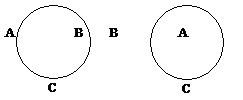
Suppose we have three people named
A size 12{A} {} B size 12{B} {} C size 12{C} {} 3 ! size 12{3!} {}
Figure 6.7 It happens that there are only two ways we can seat three people in a circle. This kind of permutation is called a circular permutation. In such cases, no matter where the first person sits, the permutation is not affected. Each person can shift as many places as they like, and the permutation will not be changed. Imagine the people on a merry-go-round; the rotation of the permutation does not generate a new permutation. So in circular permutations, the first person is considered a place holder, and where he sits does not matter.
Example 25 Circular Permutations
The number of permutations of
n size 12{n} {} ( n − 1 ) ! size 12{ left (n - 1 right )!} {}
Example 26
In how many different ways can five people be seated at a circular table?
We have already determined that the first person is just a place holder. Therefore, there is only one choice for the first spot. We have
So the answer is 24.
Example 27
In how many ways can four couples be seated at a round table if the men and women want to sit alternately?
We again emphasize that the first person can sit anywhere without affecting the permutation.
So there is only one choice for the first spot. Suppose a man sat down first. The chair next to it must belong to a woman, and there are 4 choices. The next chair belongs to a man, so there are three choices and so on. We list the choices below.
So the answer is 144.
Now we address the second problem.
Permutations with Similar Elements
Let us determine the number of distinguishable permutations of the letters ELEMENT.
Suppose we make all the letters different by labeling the letters as follows.
E
1
LE
2
ME
3
NT
size 12{E rSub { size 8{1} } ital "LE" rSub { size 8{2} } ital "ME" rSub { size 8{3} } ital "NT"} {}
Since all the letters are now different, there are
7 ! size 12{7!} {}
Let us now look at one such permutation, say
LE
1
ME
2
NE
3
T
size 12{ ital "LE" rSub { size 8{1} } ital "ME" rSub { size 8{2} } ital "NE" rSub { size 8{3} } T} {}
Suppose we form new permutations from this arrangement by only moving the E's. Clearly, there are
3 ! size 12{3!} {}
LE
1
ME
2
NE
3
T
size 12{ ital "LE" rSub { size 8{1} } ital "ME" rSub { size 8{2} } ital "NE" rSub { size 8{3} } T} {}
LE
1
ME
3
NE
2
T
size 12{ ital "LE" rSub { size 8{1} } ital "ME" rSub { size 8{3} } ital "NE" rSub { size 8{2} } T} {}
LE
2
ME
1
NE
3
T
size 12{ ital "LE" rSub { size 8{2} } ital "ME" rSub { size 8{1} } ital "NE" rSub { size 8{3} } T} {}
LE
3
ME
3
NE
1
T
size 12{ ital "LE" rSub { size 8{3} } ital "ME" rSub { size 8{3} } ital "NE" rSub { size 8{1} } T} {}
LE
3
ME
2
NE
1
T
size 12{ ital "LE" rSub { size 8{3} } ital "ME" rSub { size 8{2} } ital "NE" rSub { size 8{1} } T} {}
LE
3
ME
1
NE
2
T
size 12{ ital "LE" rSub { size 8{3} } ital "ME" rSub { size 8{1} } ital "NE" rSub { size 8{2} } T} {}
Because the
E size 12{E} {} LEMENET size 12{ ital "LEMENET"} {}
Let us suppose there are
n size 12{n} {} ELEMENT size 12{ ital "ELEMENT"} {}
Then there are
n ⋅ 3 ! size 12{n cdot 3!} {} E 1 LE 2 ME 3 NT size 12{E rSub { size 8{1} } ital "LE" rSub { size 8{2} } ital "ME" rSub { size 8{3} } ital "NT"} {}
But we know there are
7 ! size 12{7!} {} E 1 LE 2 ME 3 NT size 12{E rSub { size 8{1} } ital "LE" rSub { size 8{2} } ital "ME" rSub { size 8{3} } ital "NT"} {}
Therefore,
n ⋅ 3 ! = 7 ! size 12{n cdot 3!=7!} {}
Or
n = 7 ! 3 ! size 12{n= { {7!} over {3!} } } {}
This gives us the method we are looking for.
Example 28 Permutations with Similar Elements
The number of permutations of
n size 12{n} {} n size 12{n} {} r 1 size 12{r rSub { size 8{1} } } {} r 2 size 12{r rSub { size 8{2} } } {}
n
!
r
1
!
r
2
!
.
.
.
r
k
!
size 12{ { {n!} over {r rSub { size 8{1} } !r rSub { size 8{2} } ! "." "." "." r rSub { size 8{k} } !} } } {}
Example 29
Find the number of different permutations of the letters of the word MISSISSIPPI.
The word MISSISSIPPI has 11 letters. If the letters were all different there would have been
11 ! size 12{"11"!} {}
So the answer is
11 ! 4 ! 4 ! 2 ! size 12{ { {"11"!} over {4!4!2!} } } {}
Which equals 34,650.
Example 30
If a coin is tossed six times, how many different outcomes consisting of 4 heads and 2 tails are there?
Again, we have permutations with similar elements.
We are looking for permutations for the letters HHHHTT.
The answer is
6 ! 4 ! 2 ! = 15 size 12{ { {6!} over {4!2!} } ="15"} {}
Example 31
In how many different ways can 4 nickels, 3 dimes, and 2 quarters be arranged in a row?
Assuming that all nickels are similar, all dimes are similar, and all quarters are similar, we have permutations with similar elements. Therefore, the answer is
9 ! 4 ! 3 ! 2 ! = 1260 size 12{ { {9!} over {4!3!2!} } ="1260"} {}
Example 32
A stock broker wants to assign 20 new clients equally to 4 of its salespeople. In how many different ways can this be done?
This means that each sales person gets 5 clients. The problem can be thought of as an ordered partitions problem. In that case, using the formula we get
20 ! 5 ! 5 ! 5 ! 5 ! = 11 , 732 , 745 , 024 size 12{ { {"20"!} over {5!5!5!5!} } ="11","732","745","024"} {}
We summarize.
Example 33
Circular Permutations
The number of permutations of
n size 12{n} {}
(
n
−
1
) !
size 12{ left (n - 1 right )!} {}
Permutations with Similar Elements
The number of permutations of
n size 12{n} {} n size 12{n} {} r 1 size 12{r rSub { size 8{1} } } {} r 2 size 12{r rSub { size 8{2} } } {} n = r 1 + r 2 + ⋯ + r k size 12{n=r rSub { size 8{1} } +r rSub { size 8{2} } + dotsaxis +r rSub { size 8{k} } } {}
n
!
r
1
!
r
2
!
⋯
r
k
!
size 12{ { {n!} over {r rSub { size 8{1} } !r rSub { size 8{2} } ! dotsaxis r rSub { size 8{k} } !} } } {}
This is also referred to as ordered partitions .
Combinations Suppose we have a set of three letters
{ A , B , C } size 12{ left lbrace A,B,C right rbrace } {}
AB
size 12{ ital "AB"} {}
BA
size 12{ ital "BA"} {}
BC
size 12{ ital "BC"} {}
CB
size 12{ ital "CB"} {}
AC
size 12{ ital "AC"} {}
CA
size 12{ ital "CA"} {}
Now suppose we have a group of three people
{ A , B , C } size 12{ left lbrace A,B,C right rbrace } {}
AB
size 12{ ital "AB"} {}
BC
size 12{ ital "BC"} {}
AC
size 12{ ital "AC"} {}
When forming committees, the order is not important, because the committee that has Al and Bob is no different than the committee that has Bob and Al. As a result, we have only three committees and not six.
Forming word sequences is an example of permutations, while forming committees is an example of combinations – the topic of this section.
Permutations are those arrangements where order is important, while combinations are those arrangements where order is not significant. From now on, this is how we will tell permutations and combinations apart.
In Example 32 , there were six permutations, but only three combinations.
Just as the symbol
n Pr size 12{n"Pr"} {} n size 12{n} {} r size 12{r} {} nCr size 12{ ital "nCr"} {} n size 12{n} {} r size 12{r} {}
So in Example 32 ,
3 P 2 = 6 size 12{3P2=6} {} 3 C 2 = 3 size 12{3C2=3} {}
Our next goal is to determine the relationship between the number of combinations and the number of permutations in a given situation.
In Example 32 , if we knew that there were three combinations, we could have found the number of permutations by multiplying this number by
2 ! size 12{2!} {} 2 ! size 12{2!} {}
Example 34
Given the set of letters
{ A , B , C , D } size 12{ left lbrace A,B,C,D right rbrace } {}
We have the following four combinations.
ABC BCD CDA BDA
Since every combination has three letters, there are
3 ! size 12{3!} {}
ABC BCD CDA BDA
ACB BDC CAD BAD
BAC CDB DAC DAB
BCA CBD DCA DBA
CAB DCB ACD ADB
CBA DBC ADC ABD
The number of permutations are
3 ! size 12{3!} {}
4 p 3 = 3 ! ⋅ 4 C 3 size 12{4p3=3! cdot 4C3} {}
or
4 C 3 = 4 P 3 3 ! size 12{4C3= { {4P3} over {3!} } } {}
In general,
nCr = n Pr r ! size 12{ ital "nCr"= { {n"Pr"} over {r!} } } {}
Since
n Pr = n ! ( n − r ) ! size 12{n"Pr"= { {n!} over { left (n - r right )!} } } {}
We have,
nCr = n ! ( n − r ) ! r ! size 12{ ital "nCr"= { {n!} over { left (n - r right )!r!} } } {}
Summarizing,
Example 35
Combinations
A combination of a set of elements is an arrangement where each element is used once, and order is not important.
The Number of Combinations of
n
size 12{n} {}
Objects Taken
r
size 12{r} {}
at a Time
nCr
=
n
!
(
n
−
r
) !
r
!
size 12{ ital "nCr"= { {n!} over { left (n - r right )!r!} } } {}
Where
n size 12{n} {} r size 12{r} {}
Example 36
Compute:
5 C 3 size 12{5C3} {}
7 C 3 size 12{7C3} {} We use the above formula.
5 C 3 = 5 ! ( 5 − 3 ) ! 3 ! = 5 ! 2 ! 3 ! = 10 size 12{5C3= { {5!} over { left (5 - 3 right )!3!} } = { {5!} over {2!3!} } ="10"} {}
7 C 3 = 7 ! ( 7 − 3 ) ! 3 ! = 7 ! 4 ! 3 ! = 35 size 12{7C3= { {7!} over { left (7 - 3 right )!3!} } = { {7!} over {4!3!} } ="35"} {} .
Example 37
In how many different ways can a student select to answer five questions from a test that has seven questions, if the order of the selection is not important?
Since the order is not important, it is a combination problem, and the answer is
7 C 5 = 21 size 12{7C5="21"} {}
Example 38
How many line segments can be drawn by connecting any two of the six points that lie on the circumference of a circle?
Since the line that goes from point
A size 12{A} {} B size 12{B} {} B size 12{B} {} A size 12{A} {}
It is a combination of 6 objects taken 2 at a time. Therefore, the answer is
6 C 2 = 6 ! 4 ! 2 ! = 15 size 12{6C2= { {6!} over {4!2!} } ="15"} {}
Example 39
There are ten people at a party. If they all shake hands, how many hand-shakes are possible?
Note that between any two people there is only one hand shake. Therefore, we have
10 C2 = 45 hand-shakes . size 12{"10"C2="45"" hand-shakes" "." } {}
Example 40
The shopping area of a town is in the shape of square that is 5 blocks by 5 blocks. How many different routes can a taxi driver take to go from one corner of the shopping area to the opposite cater-corner?
Let us suppose the taxi driver drives from the point
A size 12{A} {} B size 12{B} {}
Figure 6.8 To reach his destination, he has to travel ten blocks; five horizontal, and five vertical. So if out of the ten blocks he chooses any five horizontal, the other five will have to be the vertical blocks, and vice versa. Therefore, all he has to do is to choose 5 out of ten.
The answer is 10C5, or 252.
Alternately, the problem can be solved by permutations with similar elements.
The taxi driver's route consists of five horizontal and five vertical blocks. If we call a horizontal block
H size 12{H} {} V size 12{V} {}
HHHHHVVVVV size 12{ ital "HHHHHVVVVV"} {}
Clearly there are
10 ! 5 ! 5 ! = 252 permutations size 12{ { {"10"!} over {5!5!} } ="252"" permutations"} {}
Further note that by definition
10 C5 = 10 ! 5 ! 5 ! size 12{"10"C5= { {"10"!} over {5!5!} } } {}
Example 41
If a coin is tossed six times, in how many ways can it fall four heads and two tails?
First we solve this problem using technique–permutations with similar elements.
We need 4 heads and 2 tails, that is
HHHHTT size 12{ ital "HHHHTT"} {}
There are
6 ! 4 ! 2 ! = 15 size 12{ { {6!} over {4!2!} } ="15"} {}
Now we solve this problem using combinations.
Suppose we have six spots to put the coins on. If we choose any four spots for heads, the other two will automatically be tails. So the problem is simply
6 C 4 = 15 size 12{6C4="15"} {}
Incidentally, we could have easily chosen the two tails, instead. In that case, we would have gotten
6 C 2 = 15 size 12{6C2="15"} {}
Further observe that by definition
6 C 4 = 6 ! 2 ! 4 ! size 12{6C4= { {6!} over {2!4!} } } {}
and
6 C 2 = 6 ! 4 ! 2 ! size 12{6C2= { {6!} over {4!2!} } } {}
Which implies
6 C 4 = 6 C 2 size 12{6C4=6C2} {} .
Combinations: Involving Several Sets So far we have solved the basic combination problem of
r size 12{r} {} n size 12{n} {}
Example 42
How many five-people committees consisting of 2 men and 3 women can be chosen from a total of 4 men and 4 women?
We list 4 men and 4 women as follows:
M 1 M 2 M 3 M 4 W 1 W 2 W 3 W 4 size 12{M rSub { size 8{1} } M rSub { size 8{2} } M rSub { size 8{3} } M rSub { size 8{4} } W rSub { size 8{1} } W rSub { size 8{2} } W rSub { size 8{3} } W rSub { size 8{4} } } {}
Since we want 5-people committees consisting of 2 men and 3 women, we'll first form all possible two-man committees and all possible three-woman committees. Clearly there are 4C2 = 6 two-man committees, and 4C3 = 4 three-woman committees, we list them as follows:
For every 2-man committee there are four 3-woman committees that can be chosen to make a 5-person committee. If we choose M 1 M 2 W 1 W 2 W 3 W 1 W 2 W 4 W 1 W 3 W 4 W 2 W 3 W 4
M 1 M 2 , W 1 W 2 W 3 M 1 M 2 , W 1 W 2 W 4 M 1 M 2 ,
W 1 W 3 W 4 M 1 M 2 , W 2 W 3 W 4
Similarly, if we choose M 1 M 3 W 1 W 2 W 3 W 1 W 2 W 4 W 1 W 3 W 4 W 2 W 3 W 4
M 1 M 3 , W 1 W 2 W 3 M 1 M 3 , W 1 W 2 W 4 M 1 M 3 ,
W 1 W 3 W 4
M 1 M 3
,
W 2 W 3 W 4
And so on.
Since there are six 2-man committees, and for every 2-man committee there are four 3- woman committees, there are altogether 6 ⋅ 4 = 24
In essence, we are applying the multiplication axiom to the different combinations.
Example 43
A high school club consists of 4 freshmen, 5 sophomores, 5 juniors, and 6 seniors. How many ways can a committee of 4 people be chosen that includes
One student from each class? All juniors? Two freshmen and 2 seniors? No freshmen? At least three seniors? Applying the multiplication axiom to the combinations involved, we get
4 C 1 ⋅ 5 C 1 ⋅ 5 C 1 ⋅ 6 C 1 = 600 size 12{4C1 cdot 5C1 cdot 5C1 cdot 6C1="600"} {}
We are choosing all 4 members from the 5 juniors, and none from the others.
5 C 4 = 5 size 12{5C4=5} {}
4 C 2 ⋅ 6 C 2 = 90 size 12{4C2 cdot 6C2="90"} {}
Since we don't want any freshmen on the committee, we need to choose all members from the remaining 16. That is
16 C4 = 1820 size 12{"16"C4="1820"} {}
Of the 4 people on the committee, we want at least three seniors. This can be done in two ways. We could have three seniors, and one non-senior, or all four seniors.
6 C 3 ⋅ 14 C1 + 6 C 4 = 295 size 12{6C3 cdot "14"C1+6C4="295"} {}
Example 44
How many five-letter word sequences consisting of 2 vowels and 3 consonants can be formed from the letters of the word INTRODUCE?
First we select a group of five letters consisting of 2 vowels and 3 consonants. Since there are 4 vowels and 5 consonants, we have
4 C 2 ⋅ 5 C 3 size 12{4C2 cdot 5C3} {}
Since our next task is to make word sequences out of these letters, we multiply these by
5 ! size 12{5!} {}
4 C 2 ⋅ 5 C 3 ⋅ 5 ! = 7200 size 12{4C2 cdot 5C3 cdot 5!="7200"} {}
Example 45
A standard deck of playing cards has 52 cards consisting of 4 suits each with 13 cards. In how many different ways can a 5-card hand consisting of four cards of one suit and one of another be drawn?
We will do the problem using the following steps. Step 1. Select a suit. Step 2. Select four cards from this suit. Step 3. Select another suit. Step 4. Select a card from that suit.
Applying the multiplication axiom, we have
4 C 1 ⋅ 13 C 4 ⋅ 3 C 1 ⋅ 13 C 1 = 111,540 .
Binomial Theorem We end this chapter with one more application of combinations. Combinations give the coefficients of a binomial expansion such as ( x + y ) n
( x + y ) 2 = x 2 + 2 x y + y 2
( x + y ) 3 = x 3 + 3 x 2 y + 3 x y 2 + y 3
( x + y ) 4 = x 4 + 4 x 3 y + 6 x 2 y 2 + 4 x y 3 + y 4
( x + y ) 5 = x 5 + 5 x 4 y + 10 x 3 y 2 + 10 x 2 y 3 + 5 x y 4 + y 5
( x + y ) 6 = x 6 + 6 x 5 y + 15 x 4 y 2 + 20 x 3 y 3 + 15 x 2 y 4 + 6 x y 5 + y 6
We make the following observations about the expansion of ( x + y ) n
There are n + 1 In each term, the powers of x y n The powers of x n The powers of y To see where the coefficients come from, consider ( x + y ) 3 x 3 x 2 y x y 2 y 3 ( x + y ) 3 = ( x + y ) ( x + y ) ( x + y )
x x x + x x y + x y x + x y y + y x x + y x y + y y x + y y y
Each product is formed by picking an x y x x y x x y x 2 y x x y x y x y x x x y 3 C 2 = 3 x 2 y
( x + y ) 3 = x 3 + 3 x 2 y + 3 x y 2 + y 3
Example 46
Find the coefficient of the term x 2 y 5 ( x + y ) 7
The expression ( x + y ) 7 ( x + y ) x y
The term x 2 y 5 x y 7 C 2 = 21
Therefore, the coefficient of the term x 2 y 5
Example 47
Without their coefficients, the terms are x 7 x 6 y x 5 y 2 x 4 y 3 x 3 y 4 x 2 y 5 x y 6 y 7 y k y k 7 C k
The coefficient of x 7 7 C 0 = 1 The coefficient of x 6 y 7 C 1 = 7 The coefficient of x 5 y 2 7 C 2 = 21 The coefficient of x 4 y 3 7 C 3 = 35 The remaining coefficients follow the same pattern: 7 C 4 = 35 7 C 5 = 21 7 C 6 = 7 7 C 7 = 1 Substituting, we get
( x + y ) 7 = x 7 + 7 x 6 y + 21 x 5 y 2 + 35 x 4 y 3 + 35 x 3 y 4 + 21 x 2 y 5 + 7 x y 6 + y 7
We generalize the result.
Example 48 Binomial Theorem
( x + y ) n = n C 0 x n + n C 1 x n − 1 y + n C 2 x n − 2 y 2 + ⋯ + n C n y n
Here n k = 0 , 1 , … , n y k n C k x n − k y k k + 1
Example 49
Let x = 3 a y = − 2 b n = 4
( 3 a − 2 b ) 4 = 4 C 0 ( 3 a ) 4 + 4 C 1 ( 3 a ) 3 ( − 2 b ) + 4 C 2 ( 3 a ) 2 ( − 2 b ) 2 + 4 C 3 ( 3 a ) ( − 2 b ) 3 + 4 C 4 ( − 2 b ) 4
= 1 ( 81 a 4 ) + 4 ( 27 a 3 ) ( − 2 b ) + 6 ( 9 a 2 ) ( 4 b 2 ) + 4 ( 3 a ) ( − 8 b 3 ) + 1 ( 16 b 4 )
= 81 a 4 − 216 a 3 b + 216 a 2 b 2 − 96 a b 3 + 16 b 4
Example 50
Find the fifth term of the expansion of ( 3 a − 2 b ) 7
Term number k + 1 y k k = 4 n = 7 x = 3 a y = − 2 b 7 C 4 = 35
7 C 4 ( 3 a ) 3 ( − 2 b ) 4 = 35 ( 27 a 3 ) ( 16 b 4 ) = 15120 a 3 b 4
Note
Attribution
This section is adapted from section 7.7, “Binomial Theorem,” of Applied Finite Mathematics (Sekhon and Bloom) by Rupinder Sekhon and Roberta Bloom (LibreTexts), licensed under CC BY 4.0 . Changes: reworded and reformatted, the general-term rule restated, and three errors in the source corrected (a coefficient in the expansion of ( x + y ) 4
Adapted from Applied Finite Mathematics by Rupinder Sekhon (De Anza College), originally published by OpenStax CNX (cnx.org, collection col10613) under CC BY 3.0 (creativecommons.org/licenses/by/3.0/); that original material remains under CC BY 3.0. Includes material adapted from Applied Finite Mathematics (Sekhon and Bloom), LibreTexts, under CC BY 4.0. Changes were made. This adaptation by XYZ Homework is licensed under CC BY 4.0. License: CC-BY-4.0 .