
1.3 Refraction
You may often notice some odd things when looking into a fish tank. For example, you may see the same fish appearing to be in two different places (Figure 1.12). This happens because light coming from the fish to you changes direction when it leaves the tank, and in this case, it can travel two different paths to get to your eyes. The changing of a light ray’s direction (loosely called bending) when it passes through substances of different refractive indices is called refraction and is related to changes in the speed of light, . Refraction is responsible for a tremendous range of optical phenomena, from the action of lenses to data transmission through optical fibers.
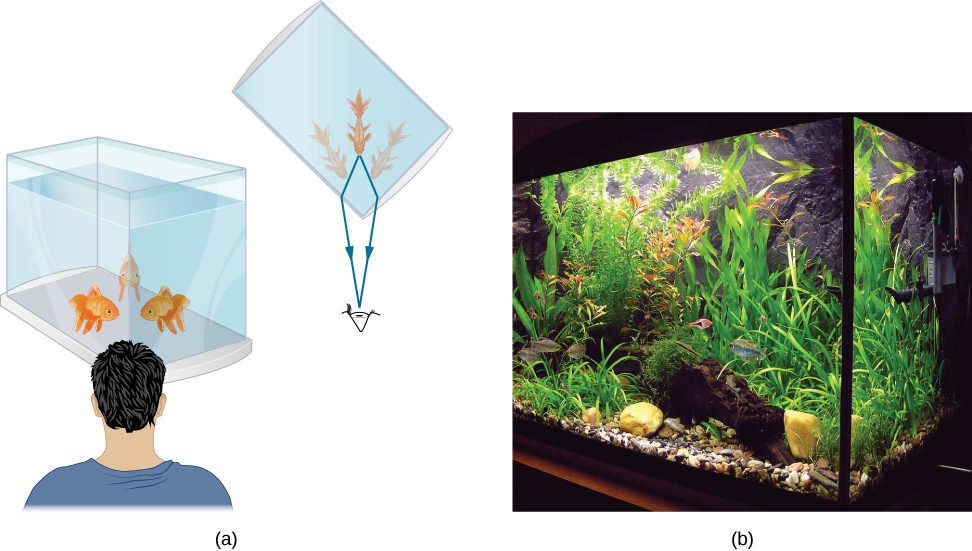
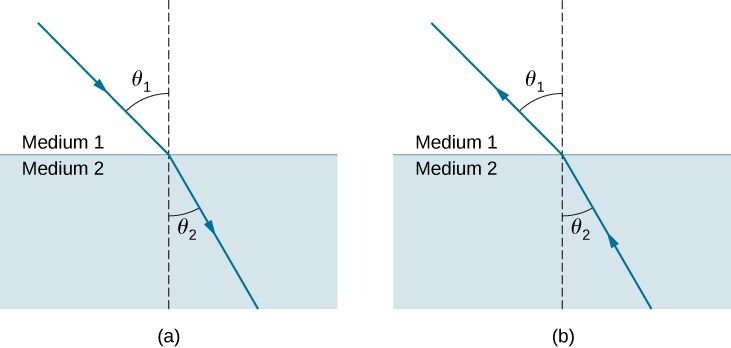
Figure 1.13 shows how a ray of light changes direction when it passes from one medium to another. As before, the angles are measured relative to a perpendicular to the surface at the point where the light ray crosses it. (Some of the incident light is reflected from the surface, but for now we concentrate on the light that is transmitted.) The change in direction of the light ray depends on the relative values of the indices of refraction (The Propagation of Light) of the two media involved. In the situations shown, medium 2 has a greater index of refraction than medium 1. Note that as shown in Figure 1.13(a), the direction of the ray moves closer to the perpendicular when it progresses from a medium with a lower index of refraction to one with a higher index of refraction. Conversely, as shown in Figure 1.13(b), the direction of the ray moves away from the perpendicular when it progresses from a medium with a higher index of refraction to one with a lower index of refraction. The path is exactly reversible.
The amount that a light ray changes its direction depends both on the incident angle and the amount that the speed changes. For a ray at a given incident angle, a large change in speed causes a large change in direction and thus a large change in angle. The exact mathematical relationship is the law of refraction, or Snell’s law, after the Dutch mathematician Willebrord Snell (1591–1626), who discovered it in 1621. While the law has been named after Snell, the Arabian physicist Ibn Sahl found the law of refraction in 984 and used it in his work On Burning Mirrors and Lenses. The law of refraction is stated in equation form as
Here and are the indices of refraction for media 1 and 2, and and are the angles between the rays and the perpendicular in media 1 and 2. The incoming ray is called the incident ray, the outgoing ray is called the refracted ray, and the associated angles are the incident angle and the refracted angle, respectively.
Snell’s experiments showed that the law of refraction is obeyed and that a characteristic index of refraction n could be assigned to a given medium and its value measured. Snell was not aware that the speed of light varied in different media, a key fact used when we derive the law of refraction theoretically using Huygens’s principle in Huygens’s Principle.
Summary
- The change of a light ray’s direction when it passes through variations in matter is called refraction.
- The law of refraction, also called Snell’s law, relates the indices of refraction for two media at an interface to the change in angle of a light ray passing through that interface.
Conceptual Questions
Diffusion by reflection from a rough surface is described in this chapter. Light can also be diffused by refraction. Describe how this occurs in a specific situation, such as light interacting with crushed ice.
Will light change direction toward or away from the perpendicular when it goes from air to water? Water to glass? Glass to air?
“toward” when increasing n (air to water, water to glass); “away” when decreasing n (glass to air)
Explain why an object in water always appears to be at a depth shallower than it actually is?
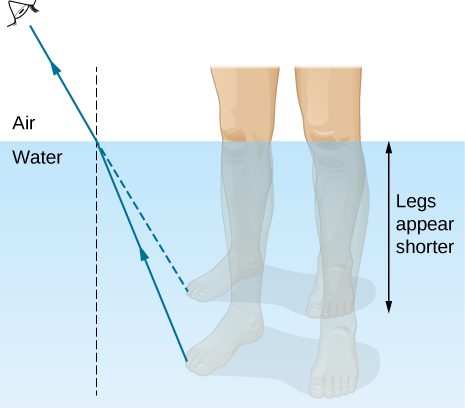
Explain why a person’s legs appear very short when wading in a pool. Justify your explanation with a ray diagram showing the path of rays from the feet to the eye of an observer who is out of the water.
A ray from a leg emerges from water after refraction. The observer in air perceives an apparent location for the source, as if a ray traveled in a straight line. See the dashed ray below.
Explain why an oar that is partially submerged in water appears bent.
Problems
Unless otherwise specified, for the following problems, the indices of refraction of glass and water should be taken to be 1.50 and 1.333, respectively.
A light beam in air has an angle of incidence of at the surface of a glass plate. What are the angles of reflection and refraction?
A light beam in air is incident on the surface of a pond, making an angle of with respect to the surface. What are the angles of reflection and refraction?
reflection, ; refraction,
When a light ray crosses from water into glass, it emerges at an angle of with respect to the normal of the interface. What is its angle of incidence?
A pencil flashlight submerged in water sends a light beam toward the surface at an angle of incidence of . What is the angle of refraction in air?
Light rays from the Sun make a angle to the vertical when seen from below the surface of a body of water. At what angle above the horizon is the Sun?
The path of a light beam in air goes from an angle of incidence of to an angle of refraction of when it enters a rectangular block of plastic. What is the index of refraction of the plastic?
1.53
A scuba diver training in a pool looks at their instructor as shown below. What angle does the ray from the instructor’s face make with the perpendicular to the water at the point where the ray enters? The angle between the ray in the water and the perpendicular to the water is .
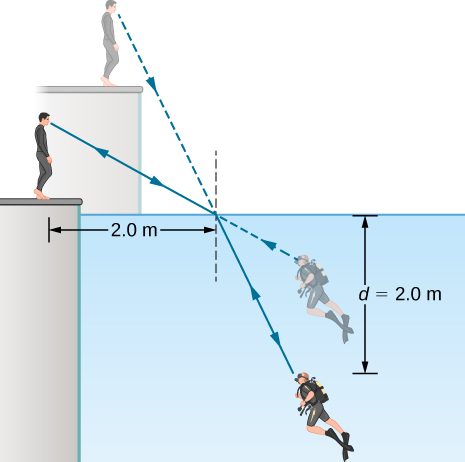
(a) Using information in the preceding problem, find the height of the instructor’s head above the water, noting that you will first have to calculate the angle of incidence. (b) Find the apparent depth of the diver’s head below water as seen by the instructor.
a. 2.9 m; b. 1.4 m
Adapted from University Physics Volume 3 by OpenStax (openstax.org), licensed under CC BY-NC-SA 4.0. Changes were made. License: CC-BY-NC-SA-4.0.