
13.1 The Law of Sines
In this chapter, we showcase how the the tools we've developed in Chapters 11 and 12 can be applied to Geometry. Our first two sections focus specifically on solving oblique (non-right) Triangles.1
Our first example reviews the basics of right triangle trigonometry. The reader is referred to Section B.2 for more details and practice with these concepts.
A few remarks about Example 13.1.1 are in order. First, we adhere to the convention that a lower case Greek letter denotes an angle (as well as the measure of said angle) and the corresponding lowercase English letter represents the side (as well as the length of said side) opposite that angle.
More specifically, is the side opposite , is the side opposite and is the side opposite . Taken together, the pairs , and are called angle-side opposite pairs.
Second, as mentioned earlier, we will strive to solve for quantities using the original data given in the problem whenever possible. While this is not always the easiest or fastest way to proceed, it minimizes the chances of propagated error.2
Third, since many of the applications which require solving triangles `in the wild' rely on degree measure, we shall adopt this convention for the time being.
The Pythagorean Theorem along with Definition B.1 allow us to easily handle any given right triangle problem, but what if the triangle isn't a right triangle? In certain cases, we can use the Law of Sines.
The proof of the Law of Sines can be broken into three cases, and, as we'll see, ultimately relies on what we know about right triangles.
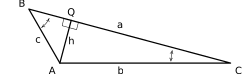
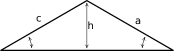
For our first case, consider the triangle below, all of whose angles are acute, with angle-side opposite pairs , and .
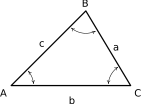
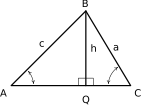
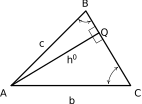
If we drop an altitude from vertex , we divide the triangle into two right triangles: and .
If we call the length of the altitude (for height), we get from Definition B.1 that and so that . Rearranging this last equation, we get .
Dropping an altitude from vertex , we can proceed as above using the triangles and . We find that , so we have shown as required.
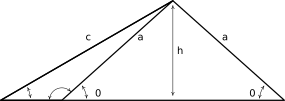
For our next case consider the triangle below with obtuse angle .
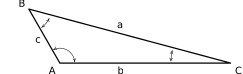
Extending an altitude from vertex gives two right triangles, as in the previous case: and .
Proceeding as before, we get and so that .
Dropping an altitude from vertex B also generates two right triangles, and .
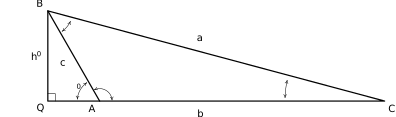
We see so that . Since , , so .
Proceeding to , we get so .
As before, we get , so in this case, too.
The remaining case is when is a right triangle. In this case, the Law of Sines reduces to the formulas given in Definition B.1 and is left to the reader.
In order to use the Law of Sines to solve a triangle, we need at least one angle-side opposite pair. The next example showcases some of the power, and the pitfalls, of the Law of Sines.
Some remarks about Example 13.1.2 are in order. First note that if we are given the measures of two of the angles in a triangle, say and , the measure of the third angle is uniquely determined using the equation . Knowing the measures of all three angles of a triangle completely determines the triangle's shape.
If in addition we are given the length of one of the sides of the triangle, we can then use the Law of Sines to find the lengths of the remaining two sides to determine the size of the triangle. Such is the case in numbers and above.
In number, the given side is adjacent to just one of the angles – this is called the `Angle-Angle-Side' (AAS) case.6 In number, the given side is adjacent to both angles which means we are in the so-called `Angle-Side-Angle' (ASA) case.
If, on the other hand, we are given the measure of just one of the angles in the triangle along with the length of two sides, only one of which is adjacent to the given angle, we are in the `Angle-Side-Side' (ASS) case.7 Such was the case in numbers,,, and above.
In number, the length of the one given side was too short to even form a triangle; in number, the length of was just long enough to form a right triangle; in, was long enough, but not too long, so that two triangles were possible; and in number, side was long enough to form a triangle but too long to swing back and form two. These four cases exemplify all of the possibilities in the Angle-Side-Side case which are summarized in the following theorem.
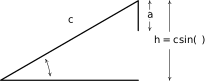
Theorem 13.2 is proved on a case-by-case basis. If , then . If a triangle were to exist, the Law of Sines would have so that , which is impossible.
In the figure below on the left, we see geometrically why this is the case. Simply put, if the side is too short to connect to form a triangle.
This means if , we are always guaranteed to have at least one triangle, and the remaining parts of the theorem tell us what kind and how many triangles to expect in each case.
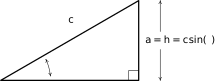
If , then and the Law of Sines gives so that . Here, as required. This situation is sketched below on the right.
, no triangle
,
Moving along, now suppose . As before, the Law of Sines8 gives .
Since , or which means there are two solutions to : an acute angle which we'll call , and its supplement, .
Our job now is to argue that each of these angles `fit' into a triangle with . Since and are angle-side opposite pairs, the assumption in this case gives us . Since is acute, we must have that is acute as well. This means one triangle can contain both and , giving us one of the triangles promised in the theorem.
If we manipulate the inequality a bit, we have . Adding to both sides gives . This proves a triangle can contain both of the angles and , giving us the second triangle predicted in the theorem. We sketch the two triangle case below on the left.
To prove the last case in the theorem, we assume . Then , which forces to be an acute angle. Hence, we get only one triangle in this case, completing the proof.
, two triangles
, one triangle
One last comment regarding the Angle-Side-Side case: if you are given an obtuse angle to begin with then it is impossible to have the two triangle case. Think about this before reading further.
In many of the derivations and arguments in this section, we used the height of a given triangle, , as an intermediate variable to prove equivalences. Since the height of a triangle can be used to determine the area enclosed by said triangle, we can use the methods in this section to reformulate area in terms of side lengths and sines of angles. We state the following theorem and leave its proof as an exercise.
Bearings
Our last example of the section uses the navigation tool known as bearings. Simply put, a bearing is the direction you are heading according to a compass.
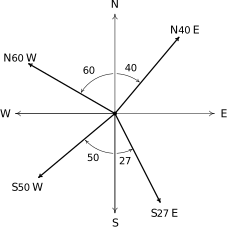
The classic nomenclature for bearings, however, is not given as an angle in standard position, so we must first understand the notation. A bearing is given as an acute angle of rotation (to the east or to the west) away from the north-south (up and down) line of a compass rose.
For example, NE (read “ east of north”) is a bearing which is rotated clockwise from due north. If we imagine standing at the origin in the Cartesian Plane, this bearing would have us heading into Quadrant I along the terminal side of .
Similarly, SW would point into Quadrant III along the terminal side of because we started out pointing due south (along ) and rotated clockwise back to .
Counter-clockwise rotations would be found in the bearings NW (which is on the terminal side of ) and SE (which lies along the terminal side of ).
These four bearings are sketched in the plane below.
The cardinal directions north, south, east and west are usually not given as bearings in the fashion described above, but rather, one just refers to them as `due north', `due south', `due east' and `due west', respectively, and it is assumed that you know which quadrantal angle goes with each cardinal direction.
We make good use of bearings and the Law of Sines in our next example.
Exercises
In Exercises -, solve for the remaining side(s) and angle(s) if possible. As in the text, , and are angle-side opposite pairs.
- Find the area of the triangles given in Exercises, and above.
The Grade of a Road: The grade of a road is much like the pitch of a roof (See Example B.2.3) in that it expresses the ratio of rise/run. In the case of a road, this ratio is always positive because it is measured going uphill and it is usually given as a percentage. For example, a road which rises 7 feet for every 100 feet of (horizontal) forward progress is said to have a 7% grade. However, if we want to apply any Trigonometry to a story problem involving roads going uphill or downhill, we need to view the grade as an angle with respect to the horizontal. In Exercises -, we first have you change road grades into angles and then use the Law of Sines in an application.
- Using a right triangle with a horizontal leg of length 100 and vertical leg with length 7, show that a 7% grade means that the road (hypotenuse) makes about a angle with the horizontal. (It will not be exactly , but it's pretty close.)
- What grade is given by a angle made by the road and the horizontal?11
- Along a long, straight stretch of mountain road with a 7% grade, you see a tall tree standing perfectly plumb alongside the road.12 From a point 500 feet downhill from the tree, the angle of inclination from the road to the top of the tree is . Use the Law of Sines to find the height of the tree. (Hint: First show that the tree makes a angle with the road.)
Exercises - use the concept of bearings as introduced in Section 13.1.1.
Find the angle in standard position with which corresponds to each of the bearings given below.
- due west
- SE
- NE
- due south
- NW
- SW13
- NE
- SW
- The Colonel spots a campfire at a of bearing NE from his current position. Sarge, who is positioned 3000 feet due east of the Colonel, reckons the bearing to the fire to be NW from his current position. Determine the distance from the campfire to each man, rounded to the nearest foot.
- A hiker starts walking due west from Sasquatch Point and gets to the Chupacabra Trailhead before she realizes that she hasn't reset her pedometer. From the Chupacabra Trailhead she hikes for 5 miles along a bearing of NW which brings her to the Muffin Ridge Observatory. From there, she knows a bearing of SE will take her straight back to Sasquatch Point. How far will she have to walk to get from the Muffin Ridge Observatory to Sasquach Point? What is the distance between Sasquatch Point and the Chupacabra Trailhead?
- The captain of the SS Bigfoot sees a signal flare at a bearing of NE from her current location. From his position, the captain of the HMS Sasquatch finds the signal flare to be at a bearing of NW. If the SS Bigfoot is 5 miles from the HMS Sasquatch and the bearing from the SS Bigfoot to the HMS Sasquatch is NE, find the distances from the flare to each vessel, rounded to the nearest tenth of a mile.
- Carl spies a potential Sasquatch nest at a bearing of NE and radios Jeff, who is at a bearing of NE from Carl's position. From Jeff's position, the nest is at a bearing of SW. If Jeff and Carl are 500 feet apart, how far is Jeff from the Sasquatch nest? Round your answer to the nearest foot.
- A hiker determines the bearing to a lodge from her current position is SW. She proceeds to hike 2 miles at a bearing of SE at which point she determines the bearing to the lodge is SW. How far is she from the lodge at this point? Round your answer to the nearest hundredth of a mile.
- A watchtower spots a ship off shore at a bearing of NE. A second tower, which is 50 miles from the first at a bearing of SE from the first tower, determines the bearing to the ship to be NW. How far is the boat from the second tower? Round your answer to the nearest tenth of a mile.
Exercises - use the concepts of `angle of inclination' and `angle of depression' introduced in Section B.2 on page and Exercise, respectively.
- Skippy and Sally decide to hunt UFOs. One night, they position themselves 2 miles apart on an abandoned stretch of desert runway. An hour into their investigation, Skippy spies a UFO hovering over a spot on the runway directly between him and Sally. He records the angle of inclination from the ground to the craft to be and radios Sally immediately to find the angle of inclination from her position to the craft is . How high off the ground is the UFO at this point? Round your answer to the nearest foot. (Recall: 1 mile is 5280 feet.)
- The angle of depression from an observer in an apartment complex to a gargoyle on the building next door is . From a point five stories below the original observer, the angle of inclination to the gargoyle is . Find the distance from each observer to the gargoyle and the distance from the gargoyle to the apartment complex. Round your answers to the nearest foot. (Use the rule of thumb that one story of a building is 9 feet.)
A villainous trio from a copyrighted anime ascends vertically in their hot air balloon from a point on level ground at a constant rate of feet per second. Let be the angle of inclination to the base of the balloon basket from a point on the ground 40 feet away from the launch point.
- Let denote the height of the balloon off of the ground. Show .
- Use the related rate law:14 to help you find the rate of change of with respect to time as increases from to . Remember to give units.
It takes 2 minutes for the 160 foot Ashtabula Bascule Lift Bridge to rotate from its horizontal position to its raised position, as seen below.15
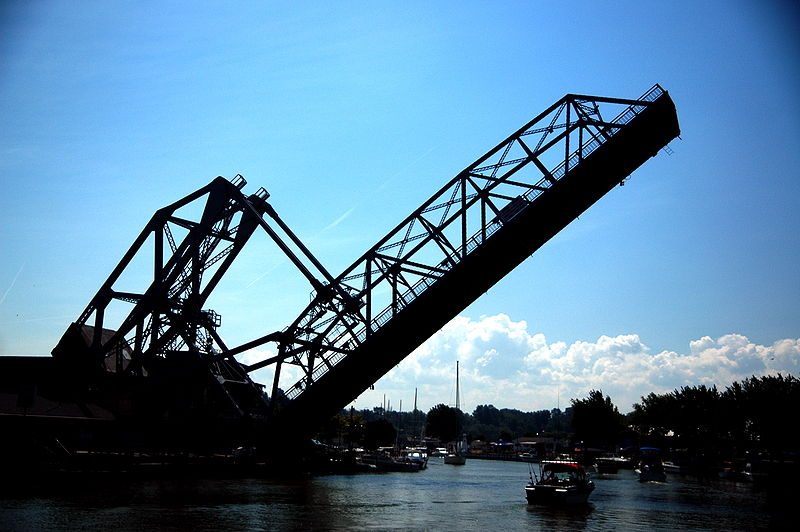
Figure 13.23 Assume the bridge casts a shadow directly below itself the entire time it is being raised,16
- Let denote the length of the shadow of the bridge on the water. Show .
- Assuming the angle of elevation of the bridge changes at a constant rate, use the related rate law:17 to help you find the rate of change of the shadow length with respect to time as increases from to . Remember to give units.
- Prove that the Law of Sines holds when is a right triangle.
- Discuss with your classmates why knowing only the three angles of a triangle is not enough to determine any of the sides.
- Discuss with your classmates why the Law of Sines cannot be used to find the angles in the triangle when only the three sides are given. Also discuss what happens if only two sides and the angle between them are given. (Said another way, explain why the Law of Sines cannot be used in the SSS and SAS cases.)
Given and , choose four different values for so that
- the information yields no triangle
- the information yields exactly one right triangle
- the information yields two distinct triangles
- the information yields exactly one obtuse triangle
Explain why you cannot choose in such a way as to have , and your choice of yield only one triangle where that unique triangle has three acute angles.
- Use the cases and diagrams in the proof of the Law of Sines (Theorem 13.1) to prove the area formulas given in Theorem 13.3. Why do those formulas yield square units when four quantities are being multiplied together?
Answers
Table 13.1 Information does not produce a triangle Table 13.2 Information does not produce a triangle Table 13.3 Information does not produce a triangle Table 13.4 Information does not produce a triangle Table 13.5 Information does not produce a triangle - The area of the triangle from Exercise is about 8.1 square units. The area of the triangle from Exercise is about 377.1 square units. The area of the triangle from Exercise is about 149 square units.
- radians, which is equivalent to
- About 17%
- About 53 feet
- The Colonel is about 3193 feet from the campfire. Sarge is about 2525 feet to the campfire.
- The distance from the Muffin Ridge Observatory to Sasquach Point is about 7.12 miles. The distance from Sasquatch Point to the Chupacabra Trailhead is about 2.46 miles.
- The SS Bigfoot is about 4.1 miles from the flare. The HMS Sasquatch is about 2.9 miles from the flare.
- Jeff is about 371 feet from the nest.
- She is about 3.02 miles from the lodge
- The boat is about 25.1 miles from the second tower.
- The UFO is hovering about 9539 feet above the ground.
- The gargoyle is about 44 feet from the observer on the upper floor. The gargoyle is about 27 feet from the observer on the lower floor. The gargoyle is about 25 feet from the other building.
is given as a constant . .
Hence, .
The angle of elevation is increasing at an average rate of degrees per second.
WARNING: For (good) reasons you'll explore more deeply in Calculus, you'll usually stick with radians when the Calculus version of this problem rolls around …
.
We are told to assume is a constant, so .
We get: .
This means the shadow is receding at a rate of approximately 31.436 feet per minute.
WARNING: For (good) reasons you'll explore more deeply in Calculus, you'll usually stick with radians when the Calculus version of this problem rolls around …
Adapted from Precalculus with Integrated Calculus, edition 4i, by Carl Stitz and Jeff Zeager (stitz-zeager.com), licensed under CC BY-NC-SA 3.0. Changes were made: reformatted as an accessible XYZ web edition. License: CC-BY-NC-SA-3.0.