We begin our study of the conic sections with parabolas, since we have already seen parabolas described as graphs of quadratic functions, (). It turns out that we can also describe parabolas in terms of distances.
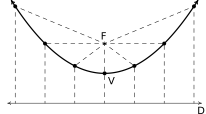
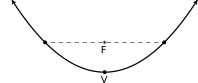
Schematically, we have the following.
Figure 8.16
Each dashed line from the point to a point on the curve has the same length as the dashed line from the point on the curve to the line . The point suggestively labeled is, as you may expect, the vertex. The vertex is the point on the parabola closest to the focus.
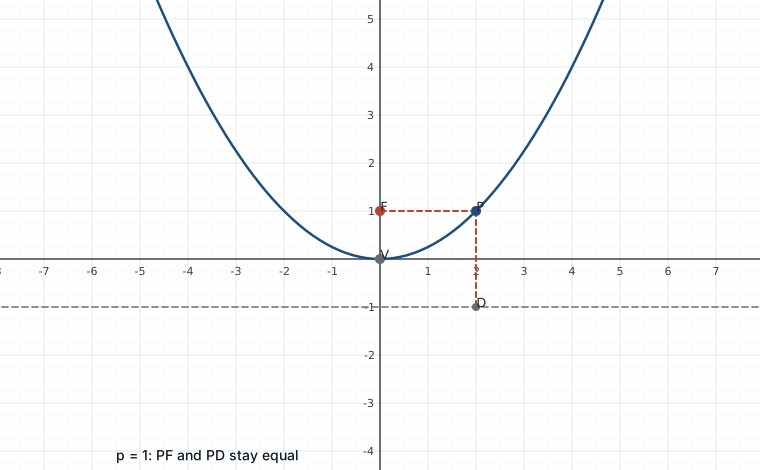
Interactive figureFocus and directrix: the two dashed lengths are always equalDrag V; move the Focal distance p and x-coordinate of P sliders.
A parabola with vertex at the origin, its focus F = (0, p) on a slider, and its directrix y = −p as the dashed line. The point P rides the parabola (its x-coordinate is the second slider); the two dashed segments — from P up to F and from P straight down to the directrix — are the two distances in the definition, and they stay equal however you move P or p. Push p toward zero and the parabola narrows around the axis; pull it larger and the parabola opens wide.
We want to use only the distance definition of parabola to derive the equation of a parabola and, if all is right with the universe, we should get an expression much like those studied in Section 1.4.
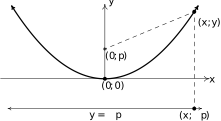
For simplicity, assume that the vertex is and that the parabola opens upwards. Let denote the directed1 distance from the vertex to the focus, which by definition is the same as the distance from the vertex to the directrix. Hence, the focus is and the directrix is the line . Our picture becomes
Figure 8.17
From the definition of parabola, we know the distance from to is the same as the distance from to . Using the Distance Formula, Equation A.1, we get
Solving for yields , which is a quadratic function of the form found in Equation 1.2 with and vertex .
We know from previous experience that if the coefficient of is negative, the parabola opens downwards. In the equation this happens when . In our formulation, we say that is a `directed distance' from the vertex to the focus: if , the focus is above the vertex; if , the focus is below the vertex. The focal length of a parabola, that is, the length from the vertex to the focus, is therefore .
If we choose to place the vertex at an arbitrary point , we arrive at the following formula using either transformations from Section 5.4 or re-deriving the formula from Definition 8.1.
Notice that in the standard equation of the parabola above, only one of the variables, , is squared. As we'll see in the coming sections, this is a quick way to distinguish the equation of a parabola from equations representing the other conic sections.
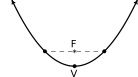
Before embarking on an example, we take a moment to better illustrate the affect of the focal length on the graph of a parabola. Below we sketch three parabolas with focal length , , and . In each case, the focus is denoted by an `.' In general, as the focal length increases, the parabola becomes wider.
Figure 8.18Figure 8.19Figure 8.20
The dashed line segment in each of the illustrations above is called the latus rectum of the parabola. More specifically, the latus rectum of a parabola is the line segment with endpoints on the parabola which contains the focus and is parallel to the directrix.3
We leave it to the reader to show that the length of the latus rectum, called the focal diameter of the parabola is , which appears ever so conveniently in the standard form as stated in Equation 8.1.
Knowing the focus and focal diameter allows to plot two points on the parabola in addition to the vertex, thus producing a more accurate graph.
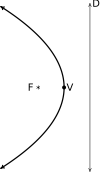
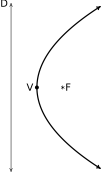
We can produce `horizontal' parabolas in the -plane by reflecting our so-called `vertical' parabolas about the line . As you may recall from Section 5.6, we accomplish this algebraically by interchanging the variables and . Such parabolas necessarily open to the left or to the right, which means that unlike the vertical parabolas, these parabolas do not represent as a function of . As we shall see, however, they can implicitly describe as a function of , provided certain restrictions are in place.
As we saw in Section 5.6, when we reflect a horizontal line across the line , we obtain a vertical line, and, as a result, the directrix of a horizontal parabola is a vertical line. Moreover, the focus of a horizontal parabola is either to the left or right of the directrix. Schematically:
Figure 8.24Figure 8.25
As we have seen, not all equations which describe parabolas will immediately match Equation 8.1 or Equation 8.2. Indeed, completing the square as we did with the equation in number in Example 8.2.2 will be a necessary skill not only in this section, but in the rest of this chapter.
For parabolas, we summarize the procedure for putting an equation of a parabola into standard form below. Of key importance is that in the equation for a parabola, one, and only one, of the variables are squared.
To Write the Equation of a Parabola in Standard Form
Group the variable which is squared on one side of the equation and position the non-squared variable and the constant on the other side.
Complete the square if necessary and divide by the coefficient of the perfect square.
Factor out the coefficient of the non-squared variable from it and the constant.
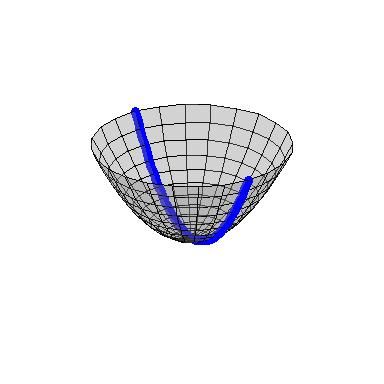
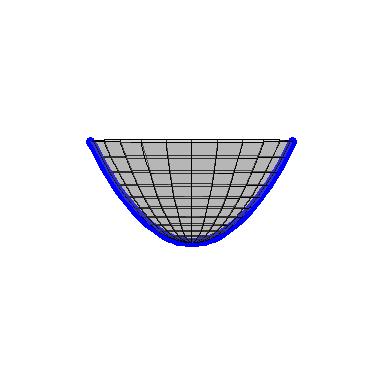
In studying quadratic functions, we have seen parabolas used to model physical phenomena such as the trajectories of projectiles. Other applications of the parabola concern its `reflective property' which necessitates knowing about the focus of a parabola. For example, many satellite dishes are formed in the shape of a paraboloid of revolution as depicted below.
Figure 8.30Figure 8.31
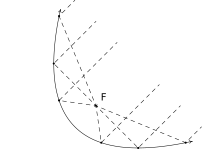
Every cross section through the vertex of the paraboloid is a parabola with the same focus. To see why this is important, imagine the dashed lines below as electromagnetic waves heading towards a parabolic dish. It turns out that the waves reflect off the parabola and concentrate at the focus which then becomes the optimal place for the receiver.
If, on the other hand, we imagine the dashed lines as emanating from the focus, we see that the waves are reflected off the parabola in a coherent fashion as in the case in a flashlight. Here, the bulb is placed at the focus and the light rays are reflected off a parabolic mirror to give directional light.
Figure 8.32
Exercises
In Exercises -, graph of the given equations in the -plane. Find the vertex, focus and directrix. Include the endpoints of the latus rectum in your sketch.
In Exercises -, put the equation into standard form. Find the vertex, focus and directrix.5
For each of the equations given in Exercises - that do not describe as a function of , find two or more explicit functions of represented by each of the equations. (See Example 8.2.2.)
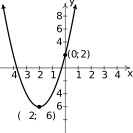
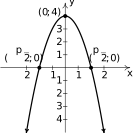
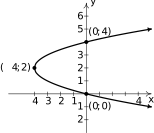
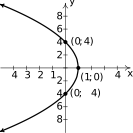
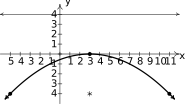
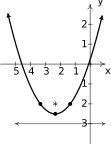
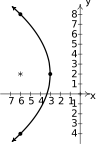
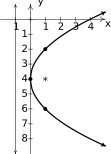
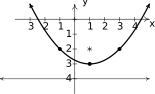
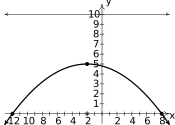
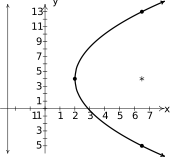
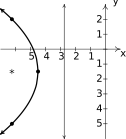
In Exercises -, find an equation for the parabola whose graph is given.
Figure 8.34
Figure 8.35
Figure 8.36,-intercept
Figure 8.37-intercept , -intercept
In Exercises -, find an equation for the parabola which fits the given criteria.
Vertex , focus .
Focus , directrix .
Vertex ; and are points on the curve.
The endpoints of latus rectum are and .
The mirror in Carl's flashlight is a paraboloid of revolution. If the mirror is 5 centimeters in diameter and 2.5 centimeters deep, where should the light bulb be placed so it is at the focus of the mirror?
A parabolic Wi-Fi antenna is constructed by taking a flat sheet of metal and bending it into a parabolic shape.6 If the cross section of the antenna is a parabola which is 45 centimeters wide and 25 centimeters deep, where should the receiver be placed to maximize reception?
A parabolic arch is constructed which is 6 feet wide at the base and 9 feet tall in the middle. Find the height of the arch exactly 1 foot in from the base of the arch.
A popular novelty item is the `mirage bowl.' Follow this link to see another startling application of the reflective property of the parabola.
With the help of your classmates, research spinning liquid mirrors. To get you started, here.
Answers
Vertex Focus Directrix Endpoints of latus rectum ,
Figure 8.38
Vertex Focus Directrix Endpoints of latus rectum ,
Figure 8.39
Vertex Focus Directrix Endpoints of latus rectum ,
Figure 8.40
Vertex Focus Directrix Endpoints of latus rectum ,
Figure 8.41
Vertex Focus Directrix Endpoints of latus rectum ,
Figure 8.42
Vertex Focus Directrix Endpoints of latus rectum ,
Figure 8.43
Vertex Focus Directrix Endpoints of latus rectum ,
Figure 8.44
Vertex Focus Directrix Endpoints of latus rectum ,
Figure 8.45
Vertex Focus Directrix
Vertex Focus Directrix
Vertex Focus Directrix
Vertex Focus Directrix
Vertex Focus Directrix
Vertex Focus Directrix
The equations which do not represent as a function of are:,,,,,,.
For number:
represents the upper half of the parabola.
represents the lower half of the parabola.
For number:
represents the upper half of the parabola.
represents the lower half of the parabola.
For number:
represents the upper half of the parabola.
represents the lower half of the parabola.
For number:
represents the upper half of the parabola.
represents the lower half of the parabola.
For number:
represents the upper half of the parabola.
represents the lower half of the parabola.
For number:
represents the upper half of the parabola.
represents the lower half of the parabola.
For number:
represents the upper half of the parabola.
represents the lower half of the parabola.
or
The bulb should be placed centimeters above the vertex of the mirror.7
The receiver should be placed centimeters from the vertex of the cross section of the antenna.
The arch can be modeled by or . One foot in from the base of the arch corresponds to either , so the height is feet.
Adapted from Precalculus with Integrated Calculus, edition 4i, by Carl Stitz and Jeff Zeager (stitz-zeager.com), licensed under CC BY-NC-SA 3.0. Changes were made: reformatted as an accessible XYZ web edition. License: CC-BY-NC-SA-3.0.
These eBooks are a prerelease and are not yet certified conformant with WCAG 2.1 AA or any other accessibility standard. Every page is built against an automated accessibility gate, and our target for the published editions is WCAG 2.2 Level AA. If something is unusable, please tell us.