
8.3 Solve Equations with Variables and Constants on Both Sides
Solve an Equation with Constants on Both Sides
You may have noticed that in all the equations we have solved so far, all the variable terms were on only one side of the equation with the constants on the other side. This does not happen all the time—so now we’ll see how to solve equations where the variable terms and/or constant terms are on both sides of the equation.
Our strategy will involve choosing one side of the equation to be the variable side, and the other side of the equation to be the constant side. Then, we will use the Subtraction and Addition Properties of Equality, step by step, to get all the variable terms together on one side of the equation and the constant terms together on the other side.
By doing this, we will transform the equation that started with variables and constants on both sides into the form We already know how to solve equations of this form by using the Division or Multiplication Properties of Equality.
Solve an Equation with Variables on Both Sides
What if there are variables on both sides of the equation? We will start like we did above—choosing a variable side and a constant side, and then use the Subtraction and Addition Properties of Equality to collect all variables on one side and all constants on the other side. Remember, what you do to the left side of the equation, you must do to the right side too.
Solve Equations with Variables and Constants on Both Sides
The next example will be the first to have variables and constants on both sides of the equation. As we did before, we’ll collect the variable terms to one side and the constants to the other side.
We’ll summarize the steps we took so you can easily refer to them.
It is a good idea to make the variable side the one in which the variable has the larger coefficient. This usually makes the arithmetic easier.
To solve an equation with fractions, we still follow the same steps to get the solution.
We follow the same steps when the equation has decimals, too.
Solve Equations Using a General Strategy
Each of the first few sections of this chapter has dealt with solving one specific form of a linear equation. It’s time now to lay out an overall strategy that can be used to solve any linear equation. We call this the general strategy. Some equations won’t require all the steps to solve, but many will. Simplifying each side of the equation as much as possible first makes the rest of the steps easier.
In many applications, we will have to solve equations with decimals. The same general strategy will work for these equations.
Key Concepts
- Solve an equation with variables and constants on both sides
- Choose one side to be the variable side and then the other will be the constant side.
- Collect the variable terms to the variable side, using the Addition or Subtraction Property of Equality.
- Collect the constants to the other side, using the Addition or Subtraction Property of Equality.
- Make the coefficient of the variable 1, using the Multiplication or Division Property of Equality.
- Check the solution by substituting into the original equation.
- General strategy for solving linear equations
- Simplify each side of the equation as much as possible. Use the Distributive Property to remove any parentheses. Combine like terms.
- Collect all the variable terms to one side of the equation. Use the Addition or Subtraction Property of Equality.
- Collect all the constant terms to the other side of the equation. Use the Addition or Subtraction Property of Equality.
- Make the coefficient of the variable term to equal to 1. Use the Multiplication or Division Property of Equality. State the solution to the equation.
- Check the solution. Substitute the solution into the original equation to make sure the result is a true statement.
Practice Makes Perfect
Solve an Equation with Constants on Both Sides
In the following exercises, solve the equation for the variable.
x = 6
y = 6
m = −8
b = −8
x = −4
q = −2
Solve an Equation with Variables on Both Sides
In the following exercises, solve the equation for the variable.
k = −11
x = 9
b = −3
z = 3
r = −2
Solve an Equation with Variables and Constants on Both Sides
In the following exercises, solve the equations for the variable.
x = 19
f = 7
q = −5
c = −4
x = 2
y = 4
m = −6
a = 7
a = −40
p = 15
z = 3.46
w = 60
x = 23
Solve an Equation Using the General Strategy
In the following exercises, solve the linear equation using the general strategy.
y = 9
x = 6
y = 3
n = −2
p = −1
x = 5
v = 1
m = 0.25
t = −9
b = 2
m = 6
r = 3
y = −4
n = 2
x = 34
s = 10
Everyday Math
Making a fence Jovani has a fence around the rectangular garden in his backyard. The perimeter of the fence is feet. The length is feet more than the width. Find the width, by solving the equation
30 feet
Concert tickets At a school concert, the total value of tickets sold was Student tickets sold for and adult tickets sold for The number of adult tickets sold was less than times the number of student tickets. Find the number of student tickets sold, by solving the equation
Coins Rhonda has in nickels and dimes. The number of dimes is one less than twice the number of nickels. Find the number of nickels, by solving the equation
8 nickels
Fencing Micah has feet of fencing to make a rectangular dog pen in his yard. He wants the length to be feet more than the width. Find the length, by solving the equation
Writing Exercises
When solving an equation with variables on both sides, why is it usually better to choose the side with the larger coefficient as the variable side?
Answers will vary.
Solve the equation explaining all the steps of your solution.
What is the first step you take when solving the equation Explain why this is your first step.
Answers will vary.
Solve the equation explaining all the steps of your solution as in the examples in this section.
Using your own words, list the steps in the General Strategy for Solving Linear Equations.
Answers will vary.
Explain why you should simplify both sides of an equation as much as possible before collecting the variable terms to one side and the constant terms to the other side.
Self Check
ⓐ After completing the exercises, use this checklist to evaluate your mastery of the objectives of this section.
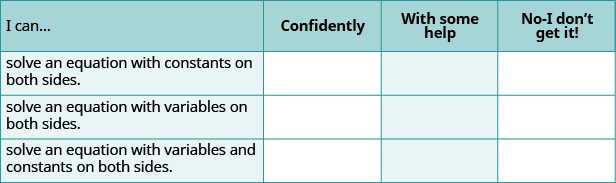
ⓑ What does this checklist tell you about your mastery of this section? What steps will you take to improve?