
7.2 Commutative and Associative Properties
In the next few sections, we will take a look at the properties of real numbers. Many of these properties will describe things you already know, but it will help to give names to the properties and define them formally. This way we’ll be able to refer to them and use them as we solve equations in the next chapter.
Use the Commutative and Associative Properties
Think about adding two numbers, such as and
The results are the same.
Notice, the order in which we add does not matter. The same is true when multiplying and
Again, the results are the same! The order in which we multiply does not matter.
These examples illustrate the commutative properties of addition and multiplication.
The commutative properties have to do with order. If you change the order of the numbers when adding or multiplying, the result is the same.
What about subtraction? Does order matter when we subtract numbers? Does give the same result as
Since changing the order of the subtraction did not give the same result, we can say that subtraction is not commutative.
Let’s see what happens when we divide two numbers. Is division commutative?
Since changing the order of the division did not give the same result, division is not commutative.
Addition and multiplication are commutative. Subtraction and division are not commutative.
Suppose you were asked to simplify this expression.
How would you do it and what would your answer be?
Some people would think and then Others might start with and then
Both ways give the same result, as shown in Figure 7.4. (Remember that parentheses are grouping symbols that indicate which operations should be done first.)
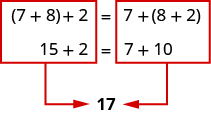
When adding three numbers, changing the grouping of the numbers does not change the result. This is known as the Associative Property of Addition.
The same principle holds true for multiplication as well. Suppose we want to find the value of the following expression:
Changing the grouping of the numbers gives the same result, as shown in Figure 7.5.
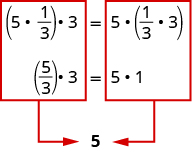
When multiplying three numbers, changing the grouping of the numbers does not change the result. This is known as the Associative Property of Multiplication.
If we multiply three numbers, changing the grouping does not affect the product.
You probably know this, but the terminology may be new to you. These examples illustrate the Associative Properties.
Besides using the associative properties to make calculations easier, we will often use it to simplify expressions with variables.
Evaluate Expressions using the Commutative and Associative Properties
The commutative and associative properties can make it easier to evaluate some algebraic expressions. Since order does not matter when adding or multiplying three or more terms, we can rearrange and re-group terms to make our work easier, as the next several examples illustrate.
Let’s do one more, this time with multiplication.
Simplify Expressions Using the Commutative and Associative Properties
When we have to simplify algebraic expressions, we can often make the work easier by applying the Commutative or Associative Property first instead of automatically following the order of operations. Notice that in Example 4 part ⓑ was easier to simplify than part ⓐ because the opposites were next to each other and their sum is Likewise, part ⓑ in Example 5 was easier, with the reciprocals grouped together, because their product is In the next few examples, we’ll use our number sense to look for ways to apply these properties to make our work easier.
Now we will see how recognizing reciprocals is helpful. Before multiplying left to right, look for reciprocals—their product is
In expressions where we need to add or subtract three or more fractions, combine those with a common denominator first.
When adding and subtracting three or more terms involving decimals, look for terms that combine to give whole numbers.
No matter what you are doing, it is always a good idea to think ahead. When simplifying an expression, think about what your steps will be. The next example will show you how using the Associative Property of Multiplication can make your work easier if you plan ahead.
When simplifying expressions that contain variables, we can use the commutative and associative properties to re-order or regroup terms, as shown in the next pair of examples.
In The Language of Algebra, we learned to combine like terms by rearranging an expression so the like terms were together. We simplified the expression by rewriting it as and then simplified it to We were using the Commutative Property of Addition.
Key Concepts
- Commutative Properties
- Commutative Property of Addition:
- If are real numbers, then
- Commutative Property of Multiplication:
- If are real numbers, then
- Commutative Property of Addition:
- Associative Properties
- Associative Property of Addition:
- If are real numbers then
- Associative Property of Multiplication:
- If are real numbers then
- Associative Property of Addition:
Practice Makes Perfect
Use the Commutative and Associative Properties
In the following exercises, use the commutative properties to rewrite the given expression.
7 + 6 = 6 + 7
7(−13) = (−13)7
(−12)(−18) = (−18)(−12)
−15 + 7 = 7 + (−15)
y + 1 = 1 + y
−3m = m(−3)
In the following exercises, use the associative properties to rewrite the given expression.
(21 + 14) + 9 = 21 + (14 + 9)
(14 · 6) · 9 = 14(6 · 9)
(−2 + 6) + 7 = −2 + (6 + 7)
4(7x) = (4 · 7)x
(17 + y) + 33 = 17 + (y + 33)
Evaluate Expressions using the Commutative and Associative Properties
In the following exercises, evaluate each expression for the given value.
If evaluate:
- ⓐ
- ⓑ
If evaluate:
- ⓐ
- ⓑ
- ⓐ 0.97
- ⓑ 0.97
If evaluate:
- ⓐ
- ⓑ
If evaluate:
- ⓐ
- ⓑ
- ⓐ 2.375
- ⓑ 2.375
If evaluate:
- ⓐ
- ⓑ
If evaluate:
- ⓐ
- ⓑ
- ⓐ 21
- ⓑ 21
If evaluate:
- ⓐ
- ⓑ
If evaluate:
- ⓐ
- ⓑ
- ⓐ 8
- ⓑ 8
Simplify Expressions Using the Commutative and Associative Properties
In the following exercises, simplify.
23
−176
9.89d
36
29.193
72w
−46n
12q
42u + 30v
−57p + (−10q)
7.41m + 6.57n
Everyday Math
Stamps Allie and Loren need to buy stamps. Allie needs four stamps and nine stamps. Loren needs eight stamps and three stamps.
ⓐ How much will Allie’s stamps cost?
ⓑ How much will Loren’s stamps cost?
ⓒ What is the total cost of the girls’ stamps?
ⓓ How many stamps do the girls need altogether? How much will they cost?
ⓔ How many stamps do the girls need altogether? How much will they cost?
Counting Cash Grant is totaling up the cash from a fundraising dinner. In one envelope, he has twenty-three bills, eighteen bills, and thirty-four bills. In another envelope, he has fourteen bills, nine bills, and twenty-seven bills.
ⓐ How much money is in the first envelope?
ⓑ How much money is in the second envelope?
ⓒ What is the total value of all the cash?
ⓓ What is the value of all the bills?
ⓔ What is the value of all bills?
ⓕ What is the value of all bills?
- ⓐ $975
- ⓑ $700
- ⓒ $1675
- ⓓ $185
- ⓔ $270
- ⓕ $1220
Writing Exercises
In your own words, state the Commutative Property of Addition and explain why it is useful.
In your own words, state the Associative Property of Multiplication and explain why it is useful.
Answers will vary.
Self Check
ⓐ After completing the exercises, use this checklist to evaluate your mastery of the objectives of this section.
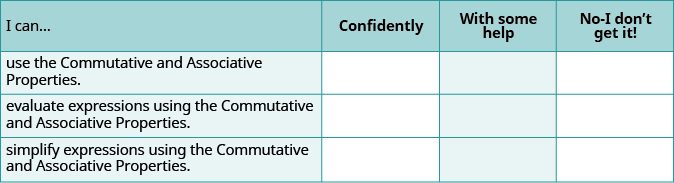
ⓑ After reviewing this checklist, what will you do to become confident for all objectives?
Adapted from Prealgebra 2e by OpenStax (openstax.org), licensed under CC BY-NC-SA 4.0. Changes were made. License: CC-BY-NC-SA-4.0.