
6.1 Understand Percent
Use the Definition of Percent
How many cents are in one dollar? There are cents in a dollar. How many years are in a century? There are years in a century. Does this give you a clue about what the word “percent” means? It is really two words, “per cent,” and means per one hundred. A percent is a ratio whose denominator is We use the percent symbol to show percent.
According to data from the American Association of Community Colleges about of community college students are female. This means out of every community college students are female, as Figure 6.2 shows. Out of the squares on the grid, are shaded, which we write as the ratio
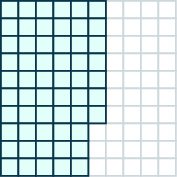
Similarly, means a ratio of means a ratio of and means a ratio of In words, "one hundred percent" means the total is and since we see that means whole.
Convert Percents to Fractions and Decimals
Since percents are ratios, they can easily be expressed as fractions. Remember that percent means per so the denominator of the fraction is
The previous example shows that a percent can be greater than We saw that means or These are improper fractions, and their values are greater than one.
In Decimals, we learned how to convert fractions to decimals. To convert a percent to a decimal, we first convert it to a fraction and then change the fraction to a decimal.
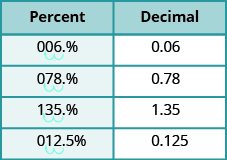
Let's summarize the results from the previous examples in Table 6.1, and look for a pattern we could use to quickly convert a percent number to a decimal number.
| Percent | Decimal |
|---|---|
Do you see the pattern?
To convert a percent number to a decimal number, we move the decimal point two places to the left and remove the sign. (Sometimes the decimal point does not appear in the percent number, but just like we can think of the integer as we can think of as ) Notice that we may need to add zeros in front of the number when moving the decimal to the left.
Figure 6.3 uses the percents in Table 6.1 and shows visually how to convert them to decimals by moving the decimal point two places to the left.
Convert Decimals and Fractions to Percents
To convert a decimal to a percent, remember that percent means per hundred. If we change the decimal to a fraction whose denominator is it is easy to change that fraction to a percent.
To convert a mixed number to a percent, we first write it as an improper fraction.
Let's summarize the results from the previous examples in Table 6.2 so we can look for a pattern.
| Decimal | Percent |
|---|---|
Do you see the pattern? To convert a decimal to a percent, we move the decimal point two places to the right and then add the percent sign.
Figure 6.5 uses the decimal numbers in Table 6.2 and shows visually to convert them to percents by moving the decimal point two places to the right and then writing the sign.
In Decimals, we learned how to convert fractions to decimals. Now we also know how to change decimals to percents. So to convert a fraction to a percent, we first change it to a decimal and then convert that decimal to a percent.
Sometimes when changing a fraction to a decimal, the division continues for many decimal places and we will round off the quotient. The number of decimal places we round to will depend on the situation. If the decimal involves money, we round to the hundredths place. For most other cases in this book we will round the number to the nearest thousandth, so the percent will be rounded to the nearest tenth.
When we first looked at fractions and decimals, we saw that some fractions converted to a repeating decimal. For example, when we converted the fraction to a decimal, we wrote the answer as We will use this same notation, as well as fraction notation, when we convert fractions to percents in the next example.
Key Concepts
- Convert a percent to a fraction.
- Write the percent as a ratio with the denominator 100.
- Simplify the fraction if possible.
-
Convert a percent to a decimal.
- Write the percent as a ratio with the denominator 100.
- Convert the fraction to a decimal by dividing the numerator by the denominator.
-
Convert a decimal to a percent.
- Write the decimal as a fraction.
- If the denominator of the fraction is not 100, rewrite it as an equivalent fraction with denominator 100.
- Write this ratio as a percent.
-
Convert a fraction to a percent.
- Convert the fraction to a decimal.
- Convert the decimal to a percent.
Practice Makes Perfect
Use the Definition of Percents
In the following exercises, write each percent as a ratio.
In the unemployment rate for those with only a high school degree was
In among the unemployed, were long-term unemployed.
The unemployment rate for those with Bachelor's degrees was in
The unemployment rate in Michigan in was
In the following exercises, write as
- ⓐ a ratio and
- ⓑ a percent
out of nursing candidates received their degree at a community college.
- ⓐ
- ⓑ
out of firefighters and law enforcement officers were educated at a community college.
out of first-time freshmen students attend a community college.
- ⓐ
- ⓑ
out of full-time community college faculty have a master's degree.
Convert Percents to Fractions and Decimals
In the following exercises, convert each percent to a fraction and simplify all fractions.
In the following exercises, convert each percent to a decimal.
0.05
0.01
0.63
0.4
1.15
1.5
0.214
0.078
In the following exercises, convert each percent to
- ⓐ a simplified fraction and
- ⓑ a decimal
In of home sales had owner financing. (Source: Bloomberg Businessweek, 5/23–29/2011)
- ⓐ
- ⓑ
In of the United States population was of Asian descent. (Source: www.census.gov)
According to government data, in the number of cell phones in India was of the population.
- ⓐ
- ⓑ
According to the U.S. Census Bureau, among Americans age or older who had doctorate degrees in are women.
A couple plans to have two children. The probability they will have two girls is
- ⓐ
- ⓑ
Javier will choose one digit at random from through The probability he will choose is
According to the local weather report, the probability of thunderstorms in New York City on July is
- ⓐ
- ⓑ
A club sells tickets to a raffle. Osbaldo bought one ticket. The probability he will win the raffle is
Convert Decimals and Fractions to Percents
In the following exercises, convert each decimal to a percent.
1%
18%
135%
300%
0.9%
8.75%
150%
225.4%
In the following exercises, convert each fraction to a percent.
25%
37.5%
175%
680%
42.9%
In the following exercises, convert each fraction to a percent.
of washing machines needed repair.
25%
of dishwashers needed repair.
In the following exercises, convert each fraction to a percent.
According to the National Center for Health Statistics, in of American adults were obese.
35%
The U.S. Census Bureau estimated that in of Americans lived in the same house as they did year before.
In the following exercises, complete the table.
| Fraction | Decimal | Percent |
|---|---|---|
| Fraction | Decimal | Percent |
|---|---|---|
| Fraction | Decimal | Percent |
|---|---|---|
Everyday Math
Sales tax Felipa says she has an easy way to estimate the sales tax when she makes a purchase. The sales tax in her city is She knows this is a little less than
- ⓐ Convert to a fraction.
- ⓑ Use your answer from ⓐ to estimate the sales tax Felipa would pay on a dress.
- ⓐ
- ⓑ
Savings Ryan has of each paycheck automatically deposited in his savings account.
- ⓐ Write as a fraction.
- ⓑ Use your answer from ⓐ to find the amount that goes to savings from Ryan's paycheck.
Amelio is shopping for textbooks online. He found three sellers that are offering a book he needs for the same price, including shipping. To decide which seller to buy from he is comparing their customer satisfaction ratings. The ratings are given in the chart.
Use the chart to answer the following questions
| Seller | Rating |
|---|---|
Write seller rating as a fraction and a decimal.
Write seller rating as a percent and a decimal.
Write seller rating as a percent and a decimal.
80%; 0.8
Which seller should Amelio buy from and why?
Writing Exercises
Convert to fractions. Do you notice a pattern? Explain what the pattern is.
Convert and to percents. Do you notice a pattern? Explain what the pattern is.
When the Szetos sold their home, the selling price was of what they had paid for the house ago. Explain what means in this context.
The Szetos sold their home for five times what they paid 30 years ago.
According to cnn.com, cell phone use in was of what it had been in Explain what means in this context.
Self Check
ⓐ After completing the exercises, use this checklist to evaluate your mastery of the objectives of this section.

ⓑ If most of your checks were:
…confidently. Congratulations! You have achieved the objectives in this section. Reflect on the study skills you used so that you can continue to use them. What did you do to become confident of your ability to do these things? Be specific.
…with some help. This must be addressed quickly because topics you do not master become potholes in your road to success. In math, every topic builds upon previous work. It is important to make sure you have a strong foundation before you move on. Whom can you ask for help? Your fellow classmates and instructor are good resources. Is there a place on campus where math tutors are available? Can your study skills be improved?
…no—I don’t get it! This is a warning sign and you must not ignore it. You should get help right away or you will quickly be overwhelmed. See your instructor as soon as you can to discuss your situation. Together you can come up with a plan to get you the help you need.
Adapted from Prealgebra 2e by OpenStax (openstax.org), licensed under CC BY-NC-SA 4.0. Changes were made. License: CC-BY-NC-SA-4.0.