
14.5 The Mayan Numeral System
Background
As you might imagine, the development of a base system is an important step in making the counting process more efficient. Our own base-ten system probably arose from the fact that we have 10 fingers (including thumbs) on two hands. This is a natural development. However, other civilizations have had a variety of bases other than ten. For example, the Natives of Queensland used a base-two system, counting as follows: “one, two, two and one, two two’s, much.” Some Modern South American Tribes have a base-five system counting in this way: “one, two, three, four, hand, hand and one, hand and two,” and so on. The Babylonians used a base-sixty (sexigesimal) system. In this chapter, we wrap up with a specific example of a civilization that actually used a base system other than 10.
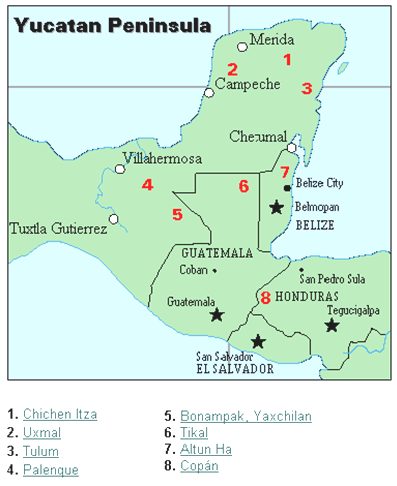 The Mayan civilization is generally dated from 1500 B.C.E to 1700 C.E. The Yucatan Peninsula (see map[i]) in Mexico was the scene for the development of one of the most advanced civilizations of the ancient world. The Mayans had a sophisticated ritual system that was overseen by a priestly class. This class of priests developed a philosophy with time as divine and eternal.[ii] The calendar, and calculations related to it, were thus very important to the ritual life of the priestly class, and hence the Mayan people. In fact, much of what we know about this culture comes from their calendar records and astronomy data. Another important source of information on the Mayans is the writings of Father Diego de Landa, who went to Mexico as a missionary in 1549.
 There were two numeral systems developed by the Mayans - one for the common people and one for the priests. Not only did these two systems use different symbols, they also used different base systems. For the priests, the number system was governed by ritual. The days of the year were thought to be gods, so the formal symbols for the days were decorated heads,[iii] like the sample to the left[iv] Since the basic calendar was based on 360 days, the priestly numeral system used a mixed base system employing multiples of 20 and 360. This makes for a confusing system, the details of which we will skip.
The Mayan Number System
Instead, we will focus on the numeration system of the “common” people, which used a more consistent base system. As we stated earlier, the Mayans used a base-20 system, called the “vigesimal” system. Like our system, it is positional, meaning that the position of a numeric symbol indicates its place value. In the following table you can see the place value in its vertical format.[v]
| Powers | Base-Ten Value | Place Name |
|---|---|---|
| 12,800,000,000 | Hablat | |
| 64,000,000 | Alau | |
| 3,200,000 | Kinchil | |
| 160,000 | Cabal | |
| 8,000 | Pic | |
| 400 | Bak | |
| 20 | Kal | |
| 1 | Hun |
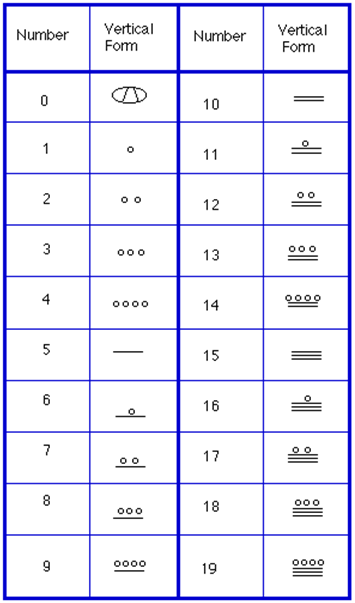
In order to write numbers down, there were only three symbols needed in this system. A horizontal bar represented the quantity 5, a dot represented the quantity 1, and a special symbol (thought to be a shell) represented zero. The Mayan system may have been the first to make use of zero as a placeholder/number. The first 20 numbers are shown in the table to the right.[vi]
# Mayan numerals: base 20, written bottom-up. dot = 1, bar = 5, shell = 0.
NUMBERS = [73, 7211, 3575, 10553, 5617]      # EDIT this list and re-run

def base20(n):
    if n == 0:
        return [0]
    d = []
    while n:
        d.append(n % 20)
        n //= 20
    return d[::-1]

def glyph(d):
    if d == 0:
        return ["  (shell)  "]
    bars, dots = divmod(d, 5)
    rows = []
    if dots:
        rows.append("  " + " ".join("o" * dots))
    rows += ["  -------  "] * bars
    return rows

for n in NUMBERS:
    digits = base20(n)
    print(f"{n} in base 20 is  {','.join(str(d) for d in digits)}  (base 20)")
    for i, d in enumerate(digits):
        power = len(digits) - 1 - i
        rows = glyph(d)
        head = f"   20^{power} = {20 ** power:<7} "
        for j, r in enumerate(rows):
            label = head if j == 0 else " " * len(head)
            print(f"{label}{r:<12}" + (f"  digit {d}, worth {d * 20 ** power}" if j == 0 else ""))
        print()
    back = sum(d * 20 ** (len(digits) - 1 - i) for i, d in enumerate(digits))
    print(f"   total {back}   (the ones place is at the BOTTOM)   correct? {back == n}\n")

print("carrying, Mayan style: five dots become one bar, four bars become one dot one place up")
a, b = 37, 29                                  # EDIT these two
da, db = base20(a)[-1], base20(b)[-1]
dots, bars = (da % 5) + (db % 5), (da // 5) + (db // 5)
print(f"   {a} + {b}: pile the ones places together -> {dots} dots and {bars} bars")
bars2, dots2 = bars + dots // 5, dots % 5
print(f"   five dots make one bar          -> {dots2} dots and {bars2} bars")
carry, bars3 = bars2 // 4, bars2 % 4
print(f"   four bars make one dot one place up -> {dots2} dots and {bars3} bars, carry {carry}")
print(f"   ones place now reads {bars3 * 5 + dots2}, with {carry} extra in the 20s place")
print(f"   result {a + b} = {','.join(str(d) for d in base20(a + b))} (base 20)")
Unlike our system, where the ones place starts on the right and then moves to the left, the Mayan systems places the ones on the bottom of a vertical orientation and moves up as the place value increases.
When numbers are written in vertical form, there should never be more than four dots in a single place. When writing Mayan numbers, every group of five dots becomes one bar. Also, there should never be more than three bars in a single place…four bars would be converted to one dot in the next place up. It’s the same as 10 getting converted to a 1 in the next place up when we carry during addition.
Note that in the previous example a new notation was used when we wrote . The commas between the three numbers 8, 18, and 15 are now separating place values for us so that we can keep them separate from each other. This use of the comma is slightly different than how they’re used in the decimal system. When we write a number in base 10, such as 7,567,323, the commas are used primarily as an aide to read the number easily but they do not separate single place values from each other. We will need this notation whenever the base we use is larger than 10.
Adding Mayan Numbers
When adding Mayan numbers together, we’ll adopt a scheme that the Mayans probably did not use but which will make life a little easier for us.
Conclusion
In this chapter, we have briefly sketched the development of numbers and our counting system, with the emphasis on the “brief” part. There are numerous sources of information and research that fill many volumes of books on this topic. Unfortunately, we cannot begin to come close to covering all of the information that is out there.
We have only scratched the surface of the wealth of research and information that exists on the development of numbers and counting throughout human history. What is important to note is that the system that we use every day is a product of thousands of years of progress and development. It represents contributions by many civilizations and cultures. It does not come down to us from the sky, a gift from the gods. It is not the creation of a textbook publisher. It is indeed as human as we are, as is the rest of mathematics. Behind every symbol, formula and rule there is a human face to be found, or at least sought.
Furthermore, we hope that you now have a basic appreciation for just how interesting and diverse number systems can get. Also, we’re pretty sure that you have also begun to recognize that we take our own number system for granted so much that when we try to adapt to other systems or bases, we find ourselves truly having to concentrate and think about what is going on.
[i] www.gorp.com/gorp/location/latamer/map_maya.htm
[ii] Bidwell, James; Mayan Arithmetic in Mathematics Teacher, Issue 74 (Nov., 1967), p. 762-68.
[iii] www.ukans.edu/~lctls/Mayan/numbers.html
[iv] www.ukans.edu/~lctls/Mayan/numbers.html
[v] Bidwell
[vi] www.vpds.wsu.edu/fair_95/gym/UM001.html
[vii] forum.swarthmore.edu/k12/mayan.math/mayan2.html
Adapted from Math in Society by David Lippman, hosted on LibreTexts (math.libretexts.org) and licensed under CC BY-SA 3.0. Changes were made. License: CC-BY-SA-3.0.