Math in SocietyXYZ Homework Edition

⇩ Download ▾

13.5 Exercises

1. List out the elements of the set “The letters of the word Mississipi”

2. List out the elements of the set “Months of the year”

3. Write a verbal description of the set {3,6,9}\{3,6,9\}

4. Write a verbal description of the set {a,i,e,0,u}\{a, i, e, 0, u\}

5. Is {1,3,5}\{1,3,5\} a subset of the set of odd integers?

6. Is {A,B,C}\{A, B, C\}a subset of the set of letters of the alphabet?

For problems 7-12, consider the sets below, and indicate if each statement is true or false.

A = { 1 , 2 , 3 , 4 , 5 } B = { 1 , 3 , 5 } C = { 4 , 6 } U = {  numbers from  0  to  10 } A=\{1,2,3,4,5\} \quad B=\{1,3,5\} \quad C=\{4,6\} \quad U=\{\text { numbers from } 0 \text { to } 10\}

7. 3∈B3 \in B

8. 5∈C5 \in C

9. B⊂AB \subset A

10. C⊂AC \subset A

11. C⊂BC \subset B

12. C⊂UC \subset U

Using the sets from above, and treating UU as the Universal set, find each of the following:

13. A∪BA \cup B

14. A∪CA \cup C

15. A∩CA \cap C

16. B∩CB \cap C

17. AcA^{c}

18. BcB^{c}

Let D={b,a,c,k},E={t,a,s,k},F={b,a,t,h}D=\{b, a, c, k\}, \quad E=\{t, a, s, k\}, \quad F=\{b, a, t, h\}. Using these sets, find the following:

19. Dc∩ED^{c} \cap E

20. Fc∩DF^{c} \cap D

21. (D∩E)∪F(D \cap E) \cup F

22. D∩(E∪P)D \cap(E \cup P)

23. (F∩E)c∩D(F \cap E)^{c} \cap D

24. (D∪E)c∩F(D \cup E)^{c} \cap F

Create a Venn diagram to illustrate each of the following:

25. (F∩E)∪D(F \cap E) \cup D

26. (D∪E)c∩F(D \cup E)^{c} \cap F

27. (Fc∩E′)∩D\left(F^{c} \cap E^{\prime}\right) \cap D

28. (D∪E)∪F(D \cup E) \cup F

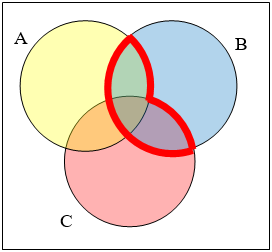
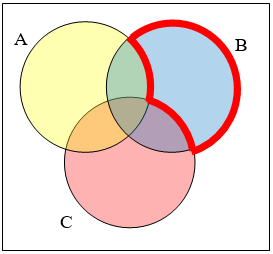
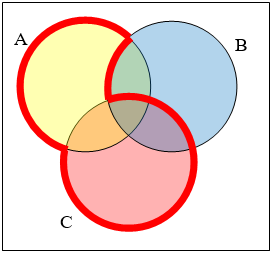
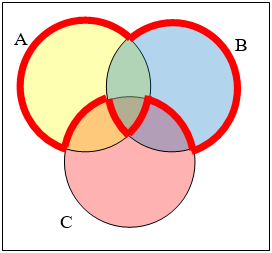
Write an expression for the shaded region.

29.

Venn diagram of three overlapping circles, A in yellow at the upper left, B in blue at the upper right and C in pink at the bottom, with a heavy red outline around the part of B that meets the other circles: the A-and-B lens, the B-and-C lens, and the central piece common to all three.

30.

Venn diagram of three overlapping circles, A in yellow at the upper left, B in blue at the upper right and C in pink at the bottom, with a heavy red outline around only the part of circle B that lies outside both A and C.

31.

Venn diagram of three overlapping circles, A in yellow at the upper left, B in blue at the upper right and C in pink at the bottom. A heavy red outline encloses the whole of circle C together with the part of A lying outside B, so the only piece of A left out is the A-and-B lens that sits above C.

32.

Venn diagram of three overlapping circles, A in yellow at the upper left, B in blue at the upper right and C in pink at the bottom. A heavy red outline encloses everything in A or B that lies outside C, and dips down to take in the central piece common to all three, leaving out the A-and-C-only sliver, the B-and-C-only sliver and the rest of C.

Let A={1,2,3,4,5}B={1,3,5}C={4,6}A=\{1,2,3,4,5\} \quad B=\{1,3,5\} \quad C=\{4,6\}. Find the cardinality of the given set.

33. n(A)\mathrm{n}(A)

34. n(B)\mathrm{n}(B)

35. n(A∪C)\mathrm{n}(A \cup C)

36. n(A∩C)\mathrm{n}(A \cap C)

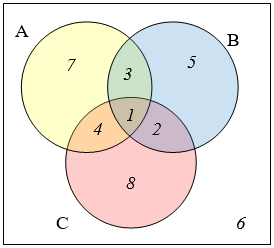
The Venn diagram here shows the cardinality of each set. Use this in 37-40 to find the cardinality of given set.

Venn diagram of three overlapping circles labelled A, B and C inside a rectangle, with the cardinality written in each region: A alone 7, A and B only 3, B alone 5, A and C only 4, all three 1, B and C only 2, C alone 8, and 6 outside all three circles.

37. n(A∩C)\mathrm{n}(A \cap C)

38. n(B∪C)\mathrm{n}(B \cup C)

39. n(A∩B∩C2)\mathrm{n}\left(A \cap B \cap C^{2}\right)

40. n(A∩Bc∩C)\mathrm{n}\left(A \cap B^{c} \cap C\right)

41. If n(G)=20,n(H)=30,n(G∩H)=5,n(G)=20, n(H)=30, n(G \cap H)=5, find n(G∪H)n(G \cup H)

42. If n(G)=5,n(H)=8,n(G∩H)=4,n(G)=5, n(H)=8, n(G \cap H)=4, find n(G∪H)n(G \cup H)

43. A survey was given asking whether they watch movies at home from Netflix, Redbox, or a video store. Use the results to determine how many people use Redbox.

52 only use Netflix 62 only use Redbox 24 only use a video store 16 use only a video store and Redbox 48 use only Netflix and Redbox 30 use only a video store and Netflix 10 use all three 25 use none of these \begin{array}{ll} \text{52 only use Netflix} & \text{62 only use Redbox} \\ \text{24 only use a video store} & \text{16 use only a video store and Redbox} \\ \text{48 use only Netflix and Redbox} & \text{30 use only a video store and Netflix} \\ \text{10 use all three} & \text{25 use none of these} \end{array}

44. A survey asked buyers whether color, size, or brand influenced their choice of cell phone. The results are below. How many people were influenced by brand?

5 only said color 8 only said size 16 only said brand 20 said only color and size 42 said only color and brand 53 said only size and brand 102 said all three 20 said none of these \begin{array}{ll} \text{5 only said color} & \text{8 only said size} \\ \text{16 only said brand} & \text{20 said only color and size} \\ \text{42 said only color and brand} & \text{53 said only size and brand} \\ \text{102 said all three} & \text{20 said none of these} \end{array}

45. Use the given information to complete a Venn diagram, then determine: a) how many students have seen exactly one of these movies, and b) how many had seen only Star Wars.

18 had seen The Matrix (M) 24 had seen Star Wars (SW) 20 had seen Lord of the Rings (LotR) 10 had seen M and SW 14 had seen LotR and SW  12 had seen M and LotR \begin{array}{ll} \text{18 had seen The Matrix (M)} & \text{24 had seen Star Wars (SW)} \\ \text{20 had seen Lord of the Rings (LotR)} & \text{10 had seen M and SW} \\ \text{14 had seen LotR and SW } & \text{12 had seen M and LotR} \\ \text{6 had seen all three} & \text{} \end{array}

46. A survey asked people what alternative transportation modes they use. Using the data to complete a Venn diagram, then determine: a) what percent of people only ride the bus, and b) how many people don’t use any alternate transportation.

30% use the bus 20% ride a bicycle 25% walk 5% use the bus and ride a bicycle 10% ride a bicycle and walk 12% use the bus and walk \begin{array}{ll} \text{30% use the bus} & \text{20% ride a bicycle} \\ \text{25% walk} & \text{5% use the bus and ride a bicycle} \\ \text{10% ride a bicycle and walk} & \text{12% use the bus and walk} \\ \text{2% use all three} & \text{} \end{array}

Adapted from Math in Society by David Lippman, hosted on LibreTexts (math.libretexts.org) and licensed under CC BY-SA 3.0. Changes were made. License: CC-BY-SA-3.0.

These eBooks are a prerelease and are not yet certified conformant with WCAG 2.1 AA or any other accessibility standard. Every page is built against an automated accessibility gate, and our target for the published editions is WCAG 2.2 Level AA. If something is unusable, please tell us.