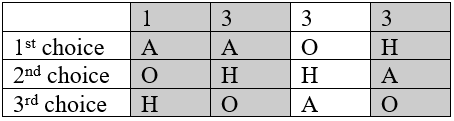
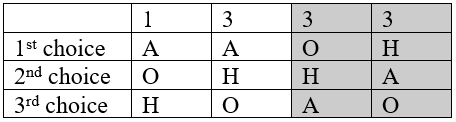
The election from Example 2 may seem totally clean, but there is a problem lurking that arises whenever there are three or more choices. Looking back at our preference table, how would our members vote if they only had two choices?
Anaheim vs Orlando: 7 out of the 10 would prefer Anaheim over Orlando
Anaheim vs Hawaii: 6 out of 10 would prefer Hawaii over Anaheim
This doesn’t seem right, does it? Anaheim just won the election, yet 6 out of 10 voters, 60% of them, would have preferred Hawaii! That hardly seems fair. Marquis de Condorcet, a French philosopher, mathematician, and political scientist wrote about how this could happen in 1785, and for him we name our first fairness criterion.
Since Hawaii is preferred in a one-to-one comparison to both other choices, Hawaii is the Condorcet Winner.
Adapted from Math in Society by David Lippman, hosted on LibreTexts (math.libretexts.org) and licensed under CC BY-SA 3.0. Changes were made. License: CC-BY-SA-3.0.
These eBooks are a prerelease and are not yet certified conformant with WCAG 2.1 AA or any other accessibility standard. Every page is built against an automated accessibility gate, and our target for the published editions is WCAG 2.2 Level AA. If something is unusable, please tell us.