
7.2 Add and Subtract Rational Expressions
Add and Subtract Rational Expressions with a Common Denominator
What is the first step you take when you add numerical fractions? You check if they have a common denominator. If they do, you add the numerators and place the sum over the common denominator. If they do not have a common denominator, you find one before you add.
It is the same with rational expressions. To add rational expressions, they must have a common denominator. When the denominators are the same, you add the numerators and place the sum over the common denominator.
To add or subtract rational expressions with a common denominator, add or subtract the numerators and place the result over the common denominator.
We always simplify rational expressions. Be sure to factor, if possible, after you subtract the numerators so you can identify any common factors.
Remember, too, we do not allow values that would make the denominator zero. What value of x should be excluded in the next example?
To subtract rational expressions, they must also have a common denominator. When the denominators are the same, you subtract the numerators and place the difference over the common denominator. Be careful of the signs when you subtract a binomial or trinomial.
Add and Subtract Rational Expressions Whose Denominators are Opposites
When the denominators of two rational expressions are opposites, it is easy to get a common denominator. We just have to multiply one of the fractions by
Let’s see how this works.
 | |
|---|---|
| Multiply the second fraction by |  |
| The denominators are the same. |  |
| Simplify. |  |
Be careful with the signs as you work with the opposites when the fractions are being subtracted.
Find the Least Common Denominator of Rational Expressions
When we add or subtract rational expressions with unlike denominators, we will need to get common denominators. If we review the procedure we used with numerical fractions, we will know what to do with rational expressions.
Let’s look at this example: Since the denominators are not the same, the first step was to find the least common denominator (LCD).
To find the LCD of the fractions, we factored 12 and 18 into primes, lining up any common primes in columns. Then we “brought down” one prime from each column. Finally, we multiplied the factors to find the LCD.
When we add numerical fractions, once we found the LCD, we rewrote each fraction as an equivalent fraction with the LCD by multiplying the numerator and denominator by the same number. We are now ready to add.
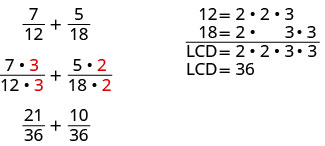
We do the same thing for rational expressions. However, we leave the LCD in factored form.
Remember, we always exclude values that would make the denominator zero. What values of should we exclude in this next example?
Add and Subtract Rational Expressions with Unlike Denominators
Now we have all the steps we need to add or subtract rational expressions with unlike denominators.
The steps used to add rational expressions are summarized here.
Avoid the temptation to simplify too soon. In the example above, we must leave the first rational expression as to be able to add it to Simplify only after you have combined the numerators.
The process we use to subtract rational expressions with different denominators is the same as for addition. We just have to be very careful of the signs when subtracting the numerators.
There are lots of negative signs in the next example. Be extra careful.
Things can get very messy when both fractions must be multiplied by a binomial to get the common denominator.
We follow the same steps as before to find the LCD when we have more than two rational expressions. In the next example, we will start by factoring all three denominators to find their LCD.
Add and subtract rational functions
To add or subtract rational functions, we use the same techniques we used to add or subtract polynomial functions.
Key Concepts
- Rational Expression Addition and Subtraction
If p, q, and r are polynomials where then
and - How to find the least common denominator of rational expressions.
- Factor each expression completely.
- List the factors of each expression. Match factors vertically when possible.
- Bring down the columns.
- Write the LCD as the product of the factors.
- How to add or subtract rational expressions.
- Determine if the expressions have a common denominator.
- Yes – go to step 2.
- No – Rewrite each rational expression with the LCD.
- Find the LCD.
- Rewrite each rational expression as an equivalent rational expression with the LCD.
- Add or subtract the rational expressions.
- Simplify, if possible.
- Determine if the expressions have a common denominator.
Practice Makes Perfect
Add and Subtract Rational Expressions with a Common Denominator
In the following exercises, add.
In the following exercises, subtract.
Add and Subtract Rational Expressions whose Denominators are Opposites
In the following exercises, add or subtract.
Find the Least Common Denominator of Rational Expressions
In the following exercises, ⓐ find the LCD for the given rational expressions ⓑ rewrite them as equivalent rational expressions with the lowest common denominator.
ⓐ
ⓑ ,
ⓐ
ⓑ ,
ⓐ
ⓑ ,
ⓐ
ⓑ ,
Add and Subtract Rational Expressions with Unlike Denominators
In the following exercises, perform the indicated operations.
Add and Subtract Rational Functions
In the following exercises, find ⓐ ⓑ
and
ⓐ ⓑ
and
and
ⓐ
ⓑ
and
Writing Exercises
Donald thinks that is Is Donald correct? Explain.
Answers will vary.
Explain how you find the Least Common Denominator of and
Felipe thinks is ⓐ Choose numerical values for x and y and evaluate ⓑ Evaluate for the same values of x and y you used in part ⓐ. ⓒ Explain why Felipe is wrong. ⓓ Find the correct expression for
ⓐ Answers will vary.
ⓑ Answers will vary.
ⓒ Answers will vary.
ⓓ
Simplify the expression and explain all your steps.
Self Check
ⓐ After completing the exercises, use this checklist to evaluate your mastery of the objectives of this section.
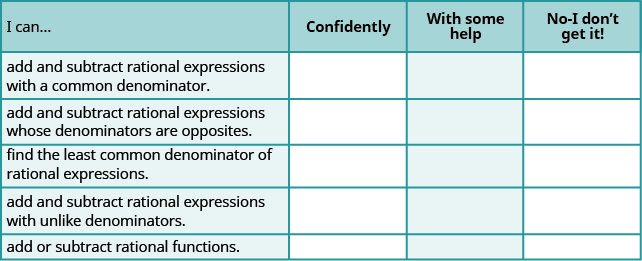
ⓑ After reviewing this checklist, what will you do to become confident for all objectives?
Adapted from Intermediate Algebra 2e by OpenStax (openstax.org), licensed under CC BY-NC-SA 4.0. Changes were made. License: CC-BY-NC-SA-4.0.