
5.4 Dividing Polynomials
Dividing Monomials
We are now familiar with all the properties of exponents and used them to multiply polynomials. Next, we’ll use these properties to divide monomials and polynomials.
Once you become familiar with the process and have practiced it step by step several times, you may be able to simplify a fraction in one step.
Divide a Polynomial by a Monomial
Now that we know how to divide a monomial by a monomial, the next procedure is to divide a polynomial of two or more terms by a monomial.
The method we’ll use to divide a polynomial by a monomial is based on the properties of fraction addition. So we’ll start with an example to review fraction addition. The sum simplifies to
Now we will do this in reverse to split a single fraction into separate fractions. For example, can be written
This is the “reverse” of fraction addition and it states that if a, b, and c are numbers where then We will use this to divide polynomials by monomials.
Divide Polynomials Using Long Division
Divide a polynomial by a binomial, we follow a procedure very similar to long division of numbers. So let’s look carefully the steps we take when we divide a 3-digit number, 875, by a 2-digit number, 25.
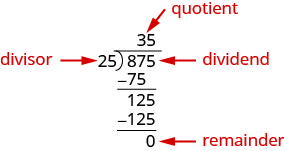
We check division by multiplying the quotient by the divisor.
If we did the division correctly, the product should equal the dividend.
Now we will divide a trinomial by a binomial. As you read through the example, notice how similar the steps are to the numerical example above.
When we divided 875 by 25, we had no remainder. But sometimes division of numbers does leave a remainder. The same is true when we divide polynomials. In the next example, we’ll have a division that leaves a remainder. We write the remainder as a fraction with the divisor as the denominator.
Look back at the dividends in previous examples. The terms were written in descending order of degrees, and there were no missing degrees. The dividend in this example will be It is missing an term. We will add in as a placeholder.
In the next example, we will divide by As we divide, we will have to consider the constants as well as the variables.
Divide Polynomials using Synthetic Division
As we have mentioned before, mathematicians like to find patterns to make their work easier. Since long division can be tedious, let’s look back at the long division we did in Example 4 and look for some patterns. We will use this as a basis for what is called synthetic division. The same problem in the synthetic division format is shown next.
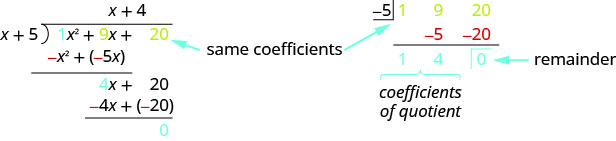
Synthetic division basically just removes unnecessary repeated variables and numbers. Here all the and are removed. as well as the and as they are opposite the term above.
The first row of the synthetic division is the coefficients of the dividend. The is the opposite of the 5 in the divisor.
The second row of the synthetic division are the numbers shown in red in the division problem.
The third row of the synthetic division are the numbers shown in blue in the division problem.
Notice the quotient and remainder are shown in the third row.
The following example will explain the process.
In the next example, we will do all the steps together.
Divide Polynomial Functions
Just as polynomials can be divided, polynomial functions can also be divided.
Use the Remainder and Factor Theorem
Let’s look at the division problems we have just worked that ended up with a remainder. They are summarized in the chart below. If we take the dividend from each division problem and use it to define a function, we get the functions shown in the chart. When the divisor is written as the value of the function at is the same as the remainder from the division problem.
| Dividend | Divisor | Remainder | Function | |
|---|---|---|---|---|
| 4 | 4 | |||
| 3 | 3 |
To see this more generally, we realize we can check a division problem by multiplying the quotient times the divisor and add the remainder. In function notation we could say, to get the dividend we multiply the quotient, times the divisor, and add the remainder, r.
 | |
|---|---|
| If we evaluate this at we get: |  |
 | |
 |
This leads us to the Remainder Theorem.
When we divided by in Example 6 the result was To check our work, we multiply by to get .
Written this way, we can see that and are factors of When we did the division, the remainder was zero.
Whenever a divisor, divides a polynomial function, and resulting in a remainder of zero, we say is a factor of
The reverse is also true. If is a factor of then will divide the polynomial function resulting in a remainder of zero.
We will state this in the Factor Theorem.
Key Concepts
- Division of a Polynomial by a Monomial
- To divide a polynomial by a monomial, divide each term of the polynomial by the monomial.
- Division of Polynomial Functions
- For functions and where
- For functions and where
- Remainder Theorem
- If the polynomial function is divided by then the remainder is
- Factor Theorem: For any polynomial function
- if is a factor of then
- if then is a factor of
Section Exercises
Practice Makes Perfect
Divide Monomials
In the following exercises, divide the monomials.
Divide a Polynomial by a Monomial
In the following exercises, divide each polynomial by the monomial.
Divide Polynomials using Long Division
In the following exercises, divide each polynomial by the binomial.
Divide Polynomials using Synthetic Division
In the following exercises, use synthetic Division to find the quotient and remainder.
is divided by
is divided by
is divided by
is divided by
is divided by
is divided by
is divided by
is divided by
Divide Polynomial Functions
In the following exercises, divide.
For functions and find ⓐ ⓑ
For functions and find ⓐ ⓑ
ⓐ
ⓑ
For functions and find ⓐ ⓑ
For functions and find ⓐ ⓑ
ⓐ
ⓑ
For functions and find ⓐ ⓑ
For functions and find ⓐ ⓑ
ⓐ ⓑ
Use the Remainder and Factor Theorem
In the following exercises, use the Remainder Theorem to find the remainder.
is divided by
is divided by
divided by
divided by
−6
In the following exercises, use the Factor Theorem to determine if is a factor of the polynomial function.
Determine whether a factor of
Determine whether a factor of
no
Determine whether a factor of
Determine whether a factor of
yes
Writing Exercises
James divides by 6 this way: What is wrong with his reasoning?
Divide and explain with words how you get each term of the quotient.
answer will vary
Explain when you can use synthetic division.
In your own words, write the steps for synthetic division for divided by
Answers will vary.
Self Check
ⓐ After completing the exercises, use this checklist to evaluate your mastery of the objectives of this section
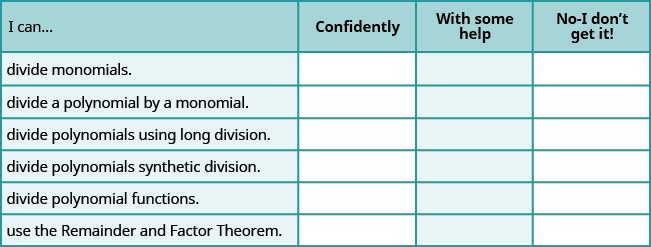
ⓑ On a scale of 1-10, how would you rate your mastery of this section in light of your responses on the checklist? How can you improve this?
Chapter Review Exercises
Add and Subtract Polynomials
Types of Polynomials
In the following exercises, determine the type of polynomial.
binomial
trinomial
Add and Subtract Polynomials
In the following exercises, add or subtract the polynomials.
Find the sum of and
Find the difference of and
In the following exercises, simplify.
Subtract from
Find the difference of and
Evaluate a Polynomial Function for a Given Value of the Variable
In the following exercises, find the function values for each polynomial function.
For the function find:
ⓐ ⓑ ⓒ
ⓐ 165 ⓑ 39 ⓒ 5
For the function find:
ⓐ ⓑ ⓒ
A pair of glasses is dropped off a bridge 640 feet above a river. The polynomial function gives the height of the glasses t seconds after they were dropped. Find the height of the glasses when
The height is .
A manufacturer of the latest soccer shoes has found that the revenue received from selling the shoes at a cost of dollars each is given by the polynomial Find the revenue received when dollars.
Add and Subtract Polynomial Functions
In the following exercises, find ⓐ (f + g)(x) ⓑ (f + g)(3) ⓒ (f − g)(x) ⓓ (f − g)(−2)
and
ⓐ ⓑ
ⓒ
ⓓ
and
Properties of Exponents and Scientific Notation
Simplify Expressions Using the Properties for Exponents
In the following exercises, simplify each expression using the properties for exponents.
1
Use the Definition of a Negative Exponent
In the following exercises, simplify each expression.
36
In the following exercises, simplify each expression using the Product Property.
In the following exercises, simplify each expression using the Power Property.
In the following exercises, simplify each expression using the Product to a Power Property.
1
In the following exercises, simplify each expression using the Quotient to a Power Property.
In the following exercises, simplify each expression by applying several properties.
In the following exercises, write each number in scientific notation.
5,300,000
In the following exercises, convert each number to decimal form.
In the following exercises, multiply or divide as indicated. Write your answer in decimal form.
Multiply Polynomials
Multiply Monomials
In the following exercises, multiply the monomials.
Multiply a Polynomial by a Monomial
In the following exercises, multiply.
Multiply a Binomial by a Binomial
In the following exercises, multiply the binomials using:
ⓐ the Distributive Property ⓑ the FOIL method ⓒ the Vertical Method.
In the following exercises, multiply the binomials. Use any method.
Multiply a Polynomial by a Polynomial
In the following exercises, multiply using ⓐ the Distributive Property ⓑ the Vertical Method.
In the following exercises, multiply. Use either method.
Multiply Special Products
In the following exercises, square each binomial using the Binomial Squares Pattern.
In the following exercises, multiply each pair of conjugates using the Product of Conjugates.
Divide Monomials
Divide Monomials
In the following exercises, divide the monomials.
Divide a Polynomial by a Monomial
In the following exercises, divide each polynomial by the monomial
Divide Polynomials using Long Division
In the following exercises, divide each polynomial by the binomial.
Divide Polynomials using Synthetic Division
In the following exercises, use synthetic Division to find the quotient and remainder.
is divided by
is divided by
is divided by
Divide Polynomial Functions
In the following exercises, divide.
For functions and find ⓐ
ⓑ
ⓐ
ⓑ
For functions and find ⓐ
ⓑ
Use the Remainder and Factor Theorem
In the following exercises, use the Remainder Theorem to find the remainder.
is divided by
divided by
In the following exercises, use the Factor Theorem to determine if is a factor of the polynomial function.
Determine whether is a factor of .
no
Determine whether is a factor of .
Chapter Practice Test
For the polynomial
ⓐ Is it a monomial, binomial, or trinomial? ⓑ What is its degree?
ⓐ trinomial ⓑ 4
Use the Factor Theorem to determine if a factor of
yes
ⓐ Convert 112,000 to scientific notation. ⓑ Convert to decimal form.
In the following exercises, simplify and write your answer in exponential notation.
For the function find:
ⓐ ⓑ ⓒ
ⓐ ⓑ ⓒ
For and find
ⓐ ⓑ
ⓒ ⓓ
For functions
and
find
ⓐ ⓑ
ⓐ
ⓑ
A hiker drops a pebble from a bridge 240 feet above a canyon. The function gives the height of the pebble seconds after it was dropped. Find the height when
Adapted from Intermediate Algebra 2e by OpenStax (openstax.org), licensed under CC BY-NC-SA 4.0. Changes were made. License: CC-BY-NC-SA-4.0.