
4.6 Solve Systems of Equations Using Determinants
In this section we will learn of another method to solve systems of linear equations called Cramer’s rule. Before we can begin to use the rule, we need to learn some new definitions and notation.
Evaluate the Determinant of a Matrix
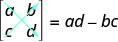
If a matrix has the same number of rows and columns, we call it a square matrix. Each square matrix has a real number associated with it called its determinant. To find the determinant of the square matrix we first write it as To get the real number value of the determinant we subtract the products of the diagonals, as shown.
Evaluate the Determinant of a Matrix
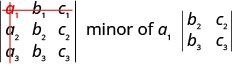
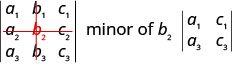
To evaluate the determinant of a matrix, we have to be able to evaluate the minor of an entry in the determinant. The minor of an entry is the determinant found by eliminating the row and column in the determinant that contains the entry.
To find the minor of entry we eliminate the row and column which contain it. So we eliminate the first row and first column. Then we write the determinant that remains.
To find the minor of entry we eliminate the row and column that contain it. So we eliminate the 2nd row and 2nd column. Then we write the determinant that remains.
We are now ready to evaluate a determinant. To do this we expand by minors, which allows us to evaluate the determinant using determinants—which we already know how to evaluate!
To evaluate a determinant by expanding by minors along the first row, we use the following pattern:
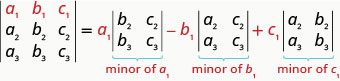
Remember, to find the minor of an entry we eliminate the row and column that contains the entry.
To evaluate a determinant we can expand by minors using any row or column. Choosing a row or column other than the first row sometimes makes the work easier.
When we expand by any row or column, we must be careful about the sign of the terms in the expansion. To determine the sign of the terms, we use the following sign pattern chart.
Notice that the sign pattern in the first row matches the signs between the terms in the expansion by the first row.
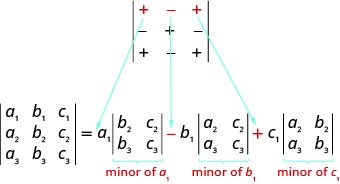
Since we can expand by any row or column, how do we decide which row or column to use? Usually we try to pick a row or column that will make our calculation easier. If the determinant contains a 0, using the row or column that contains the 0 will make the calculations easier.
Use Cramer’s Rule to Solve Systems of Equations
Cramer’s Rule is a method of solving systems of equations using determinants. It can be derived by solving the general form of the systems of equations by elimination. Here we will demonstrate the rule for both systems of two equations with two variables and for systems of three equations with three variables.
Let’s start with the systems of two equations with two variables.
Notice that to form the determinant D, we use take the coefficients of the variables.
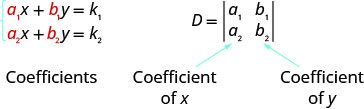
Notice that to form the determinant and we substitute the constants for the coefficients of the variable we are finding.

To solve a system of three equations with three variables with Cramer’s Rule, we basically do what we did for a system of two equations. However, we now have to solve for three variables to get the solution. The determinants are also going to be which will make our work more interesting!
Cramer’s rule does not work when the value of the D determinant is 0, as this would mean we would be dividing by 0. But when the system is either inconsistent or dependent.
When the value of and and are all zero, the system is consistent and dependent and there are infinitely many solutions.
When the value of and and are not all zero, the system is inconsistent and there is no solution.
In the next example, we will use the values of the determinants to find the solution of the system.
Solve Applications using Determinants
An interesting application of determinants allows us to test if points are collinear. Three points and are collinear if and only if the determinant below is zero.
We will use this property in the next example.
Key Concepts
- Determinant: The determinant of any square matrix where a, b, c, and d are real numbers, is
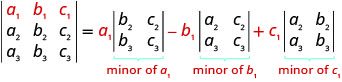
- Expanding by Minors along the First Row to Evaluate a 3 × 3 Determinant: To evaluate a determinant by expanding by minors along the first row, the following pattern:
- Sign Pattern: When expanding by minors using a row or column, the sign of the terms in the expansion follow the following pattern.
- Cramer’s Rule: For the system of equations the solution can be determined by
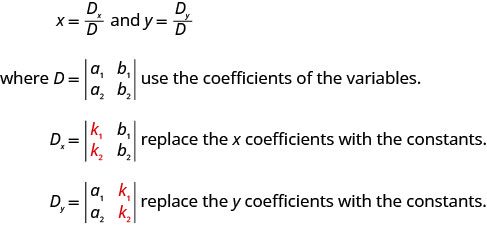
Notice that to form the determinant D, we use take the coefficients of the variables. - How to solve a system of two equations using Cramer’s rule.
- Evaluate the determinant D, using the coefficients of the variables.
- Evaluate the determinant Use the constants in place of the x coefficients.
- Evaluate the determinant Use the constants in place of the y coefficients.
- Find x and y.
- Write the solution as an ordered pair.
- Check that the ordered pair is a solution to both original equations.
- Dependent and Inconsistent Systems of Equations: For any system of equations, where the value of the determinant
- Test for Collinear Points: Three points and are collinear if and only if
Practice Makes Perfect
Evaluate the Determinant of a 2 × 2 Matrix
In the following exercises, evaluate the determinant of each square matrix.
4
10
Evaluate the Determinant of a 3 × 3 Matrix
In the following exercises, find and then evaluate the indicated minors.
Find the minor ⓐ ⓑ ⓒ
Find the minor ⓐ ⓑ ⓒ
ⓐ 6 ⓑ ⓒ
Find the minor ⓐ ⓑ ⓒ
Find the minor ⓐ ⓑ ⓒ
ⓐ 9 ⓑ ⓒ 8
In the following exercises, evaluate each determinant by expanding by minors along the first row.
49
In the following exercises, evaluate each determinant by expanding by minors.
25
Use Cramer’s Rule to Solve Systems of Equations
In the following exercises, solve each system of equations using Cramer’s Rule.
infinitely many solutions
inconsistent
inconsistent
infinitely many solutions
Solve Applications Using Determinants
In the following exercises, determine whether the given points are collinear.
and
and
yes
and
and
yes
Writing Exercises
Explain the difference between a square matrix and its determinant. Give an example of each.
Explain what is meant by the minor of an entry in a square matrix.
Answers will vary.
Explain how to decide which row or column you will use to expand a determinant.
Explain the steps for solving a system of equations using Cramer’s rule.
Answers will vary.
Self Check
ⓐ After completing the exercises, use this checklist to evaluate your mastery of the objectives of this section.
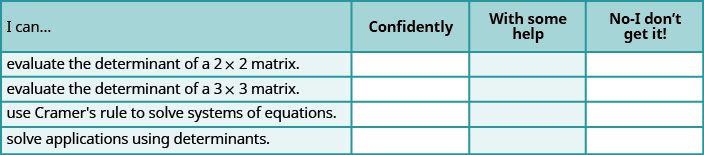
ⓑ After reviewing this checklist, what will you do to become confident for all objectives?
Adapted from Intermediate Algebra 2e by OpenStax (openstax.org), licensed under CC BY-NC-SA 4.0. Changes were made. License: CC-BY-NC-SA-4.0.