
1.2 Integers
Simplify Expressions with Absolute Value
A negative number is a number less than 0. The negative numbers are to the left of zero on the number line. See Figure 1.2.
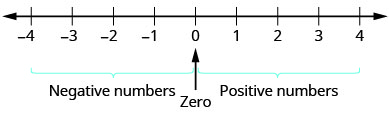
You may have noticed that, on the number line, the negative numbers are a mirror image of the positive numbers, with zero in the middle. Because the numbers and are the same distance from zero, each one is called the opposite of the other. The opposite of is and the opposite of is
Figure 1.3 illustrates the definition.

We saw that numbers such as 3 and are opposites because they are the same distance from 0 on the number line. They are both three units from 0. The distance between 0 and any number on the number line is called the absolute value of that number.
For example,
Figure 1.4 illustrates this idea.
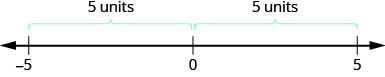
The absolute value of a number is never negative because distance cannot be negative. The only number with absolute value equal to zero is the number zero itself because the distance from 0 to 0 on the number line is zero units.
In the next example, we’ll order expressions with absolute values.
We now add absolute value bars to our list of grouping symbols. When we use the order of operations, first we simplify inside the absolute value bars as much as possible, then we take the absolute value of the resulting number.
In the next example, we simplify the expressions inside absolute value bars first just as we do with parentheses.
Add and Subtract Integers
So far, we have only used the counting numbers and the whole numbers.
Our work with opposites gives us a way to define the integers. The whole numbers and their opposites are called the integers. The integers are the numbers
Most students are comfortable with the addition and subtraction facts for positive numbers. But doing addition or subtraction with both positive and negative numbers may be more challenging.
We will use two color counters to model addition and subtraction of negatives so that you can visualize the procedures instead of memorizing the rules.
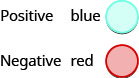
We let one color (blue) represent positive. The other color (red) will represent the negatives.
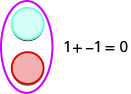
If we have one positive counter and one negative counter, the value of the pair is zero. They form a neutral pair. The value of this neutral pair is zero.
We will use the counters to show how to add:
The first example, adds 5 positives and 3 positives—both positives.
The second example, adds 5 negatives and 3 negatives—both negatives.
When the signs are the same, the counters are all the same color, and so we add them. In each case we get 8—either 8 positives or 8 negatives.

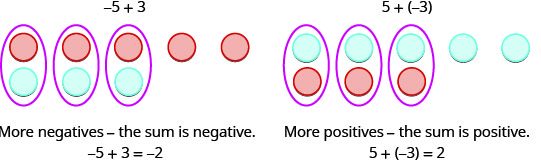
So what happens when the signs are different? Let’s add and
When we use counters to model addition of positive and negative integers, it is easy to see whether there are more positive or more negative counters. So we know whether the sum will be positive or negative.
We will continue to use counters to model the subtraction. Perhaps when you were younger, you read as “5 take away 3.” When you use counters, you can think of subtraction the same way!
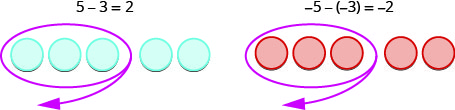
We will use the counters to show to subtract:
The first example, we subtract 3 positives from 5 positives and end up with 2 positives.
In the second example, we subtract 3 negatives from 5 negatives and end up with 2 negatives.
Each example used counters of only one color, and the “take away” model of subtraction was easy to apply.
What happens when we have to subtract one positive and one negative number? We’ll need to use both blue and red counters as well as some neutral pairs. If we don’t have the number of counters needed to take away, we add neutral pairs. Adding a neutral pair does not change the value. It is like changing quarters to nickels—the value is the same, but it looks different.
Let’s look at and
 |  | |
|---|---|---|
| Model the first number. |  |  |
| We now add the needed neutral pairs. |  |  |
| We remove the number of counters modeled by the second number. | 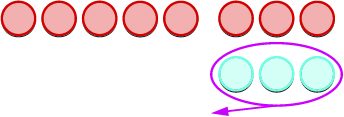 |  |
| Count what is left. |  |  |
 |  | |
 |  |
Have you noticed that subtraction of signed numbers can be done by adding the opposite? In the last example, is the same as and is the same as You will often see this idea, the Subtraction Property, written as follows:
What happens when there are more than three integers? We just use the order of operations as usual.
Multiply and Divide Integers
Since multiplication is mathematical shorthand for repeated addition, our model can easily be applied to show multiplication of integers. Let’s look at this concrete model to see what patterns we notice. We will use the same examples that we used for addition and subtraction. Here, we are using the model just to help us discover the pattern.
We remember that means add a, b times.
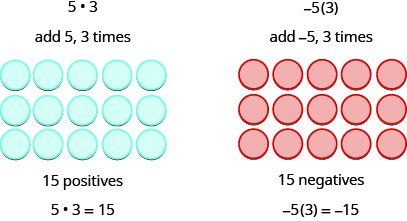
The next two examples are more interesting. What does it mean to multiply 5 by It means subtract times. Looking at subtraction as “taking away”, it means to take away 5, 3 times. But there is nothing to take away, so we start by adding neutral pairs on the workspace.
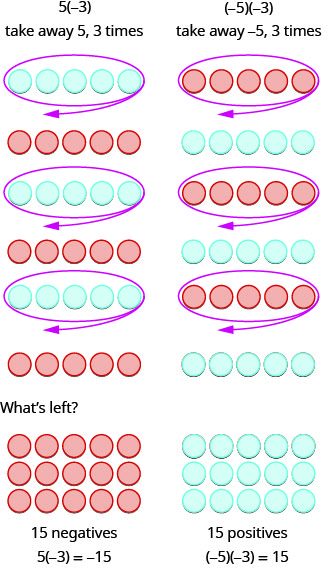
In summary:
Notice that for multiplication of two signed numbers, when the
What about division? Division is the inverse operation of multiplication. So, because In words, this expression says that 15 can be divided into 3 groups of 5 each because adding five three times gives 15. If you look at some examples of multiplying integers, you might figure out the rules for dividing integers.
Division follows the same rules as multiplication with regard to signs.
When we multiply a number by 1, the result is the same number. Each time we multiply a number by we get its opposite!
Simplify Expressions with Integers
What happens when there are more than two numbers in an expression? The order of operations still applies when negatives are included. Remember Please Excuse My Dear Aunt Sally?
Let’s try some examples. We’ll simplify expressions that use all four operations with integers—addition, subtraction, multiplication, and division. Remember to follow the order of operations.
The last example showed us the difference between and This distinction is important to prevent future errors. The next example reminds us to multiply and divide in order left to right.
Evaluate Variable Expressions with Integers
Remember that to evaluate an expression means to substitute a number for the variable in the expression. Now we can use negative numbers as well as positive numbers.
Translate Phrases to Expressions with Integers
Our earlier work translating English to algebra also applies to phrases that include both positive and negative numbers.
Use Integers in Applications
We’ll outline a plan to solve applications. It’s hard to find something if we don’t know what we’re looking for or what to call it! So when we solve an application, we first need to determine what the problem is asking us to find. Then we’ll write a phrase that gives the information to find it. We’ll translate the phrase into an expression and then simplify the expression to get the answer. Finally, we summarize the answer in a sentence to make sure it makes sense.
Key Concepts
- Opposite Notation
- Absolute Value
The absolute value of a number is its distance from 0 on the number line.
The absolute value of a number n is written as and for all numbers.
Absolute values are always greater than or equal to zero. - Grouping Symbols
- Subtraction Property
Subtracting a number is the same as adding its opposite. - Multiplication and Division of Signed Numbers
For multiplication and division of two signed numbers:
Same signs Result ⋅ Two positives Positive ⋅ Two negatives Positive
If the signs are the same, the result is positive.
Different signs Result ⋅ Positive and negative Negative ⋅ Negative and positive Negative
If the signs are different, the result is negative. - Multiplication by
Multiplying a number by gives its opposite. - How to Use Integers in Applications.
- Read the problem. Make sure all the words and ideas are understood
- Identify what we are asked to find.
- Write a phrase that gives the information to find it.
- Translate the phrase to an expression.
- Simplify the expression.
- Answer the question with a complete sentence.
Practice Makes Perfect
Simplify Expressions with Absolute Value
In the following exercises, fill in or for each of the following pairs of numbers.
ⓐ
ⓑ
ⓒ
ⓓ
ⓐ ⓑ ⓒ ⓓ
ⓐ
ⓑ
ⓒ
ⓓ
ⓐ
ⓑ
ⓒ
ⓓ
ⓐ ⓑ ⓒ ⓓ
ⓐ
ⓑ
ⓒ
ⓓ
In the following exercises, simplify.
0
8
15
1
Add and Subtract Integers
In the following exercises, simplify each expression.
ⓐ
ⓑ
ⓒ
ⓐ ⓑ ⓒ
ⓐ
ⓑ
ⓒ
32
ⓐ
ⓑ
ⓒ
ⓓ
ⓐ 6 ⓑ ⓒ ⓓ
ⓐ
ⓑ
ⓒ
ⓓ
22
ⓐ ⓑ
ⓐ 16 ⓑ 16
ⓐ ⓑ
ⓐ ⓑ
ⓐ 45 ⓑ 45
ⓐ ⓑ
0
4
6
Multiply and Divide Integers
In the following exercises, multiply or divide.
ⓐ
ⓑ
ⓒ
ⓓ
ⓐ ⓑ ⓒ
ⓓ
ⓐ
ⓑ
ⓒ
ⓓ
ⓐ
ⓑ
ⓒ
ⓓ
ⓐ ⓑ ⓒ
ⓓ
ⓐ
ⓑ
ⓒ
ⓓ
Simplify and Evaluate Expressions with Integers
In the following exercises, simplify each expression.
ⓐ ⓑ
ⓐ ⓑ
ⓐ ⓑ
In the following exercises, evaluate each expression.
when
ⓐ ⓑ
ⓐ ⓑ
when
ⓐ
ⓑ
when
when
when
and
when
and
when
when
Translate English Phrases to Algebraic Expressions
In the following exercises, translate to an algebraic expression and simplify if possible.
the sum of 3 and increased by 7
the sum of and increased by
ⓐ the difference of and
ⓑ subtract from
ⓐ
ⓑ
ⓐ the difference of and
ⓑ subtract from
the quotient of and the sum of and
the product of and the difference of and
Use Integers in Applications
In the following exercises, solve.
Temperature On January 15, the high temperature in Anaheim, California, was 84°. That same day, the high temperature in Embarrass, Minnesota, was What was the difference between the temperature in Anaheim and the temperature in Embarrass?
Temperature On January 21, the high temperature in Palm Springs, California, was and the high temperature in Whitefield, New Hampshire, was What was the difference between the temperature in Palm Springs and the temperature in Whitefield?
Football On the first down, the Chargers had the ball on their 25-yard line. They lost 6 yards on the first-down play, gained 10 yards on the second-down play, and lost 8 yards on the third-down play. What was the yard line at the end of the third-down play?
21 yards
Football On first down, the Steelers had the ball on their 30-yard line. They gained 9 yards on the first-down play, lost 14 yards on the second-down play, and lost 2 yards on the third-down play. What was the yard line at the end of the third-down play?
Checking Account Mayra has $124 in her checking account. She writes a check for $152. What is the new balance in her checking account?
Checking Account Reymonte has a balance of in his checking account. He deposits $281 to the account. What is the new balance?
Writing Exercises
Explain why the sum of and 2 is negative, but the sum of 8 and is positive.
Answers will vary.
Give an example from your life experience of adding two negative numbers.
In your own words, state the rules for multiplying and dividing integers.
Answers will vary.
Why is
Self Check
ⓐ After completing the exercises, use this checklist to evaluate your mastery of the objectives of this section.
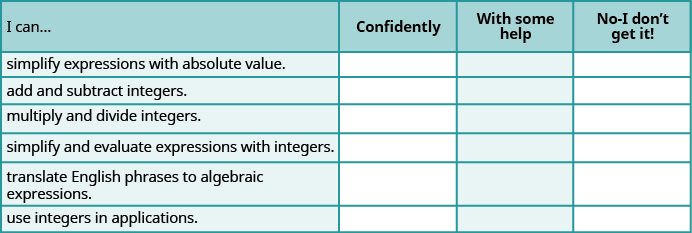
ⓑ After reviewing this checklist, what will you do to become confident for all objectives?
Adapted from Intermediate Algebra 2e by OpenStax (openstax.org), licensed under CC BY-NC-SA 4.0. Changes were made. License: CC-BY-NC-SA-4.0.