
3.1 Step Forcing
A furnace, a relay, a charging circuit — real inputs are switched. The cleanest model of a switch is the Heaviside step function , equal to for and to for : nothing, then suddenly something. (The figure below builds it arithmetically as , which is before the switch and after it.) An input with a jump defeats any method that wants one smooth formula for all time, so this section adopts a tool that ingests the whole history at once.
The Laplace transform trades a function of time for a function of a new variable ,
and its worth rests on three dictionary entries. Differentiation becomes multiplication: and . The constant becomes . And a delayed copy of a signal becomes an exponential tag — the shifting rule
whose right side is the transform of multiplied by a factor that says "start this at instead of ." In particular .
Now the model problem. Take a damped spring from the family of Chapter 2 — damping , frequency , characteristic roots — sitting at rest until a constant force switches on:
Transforming every term (the initial conditions contribute nothing, being zero) gives , so
The three pieces inside the parentheses are standard: is the constant , and the two shifted fractions are the transforms of and . So without its tag the response would be , and the tag delays it wholesale:
Nothing happens until ; then the mass climbs toward the new equilibrium , overshoots it, and rings its way down onto it at the free-vibration frequency .
The one algebraic step between and the answer, and the step the section names in its own objective. The engine decomposes independently and confirms the three pieces above are that fraction.
Read the two forms side by side, because they do not look alike. The engine returns the canonical decomposition, — two terms, no completed square. The text splits that second term in two and shifts both halves, giving three terms once the untouched is counted back in, because that form is the one you can read a transform off: over a shifted denominator is , and what is left over is . Algebra prefers the first form; a table lookup needs the second. The certificate says they are the same fraction, which is what makes the rewrite legitimate rather than merely traditional.
The decomposition is also self-verifying at the engine boundary: it reassembles the pieces and requires the difference from the input to normalize to zero before returning anything at all.
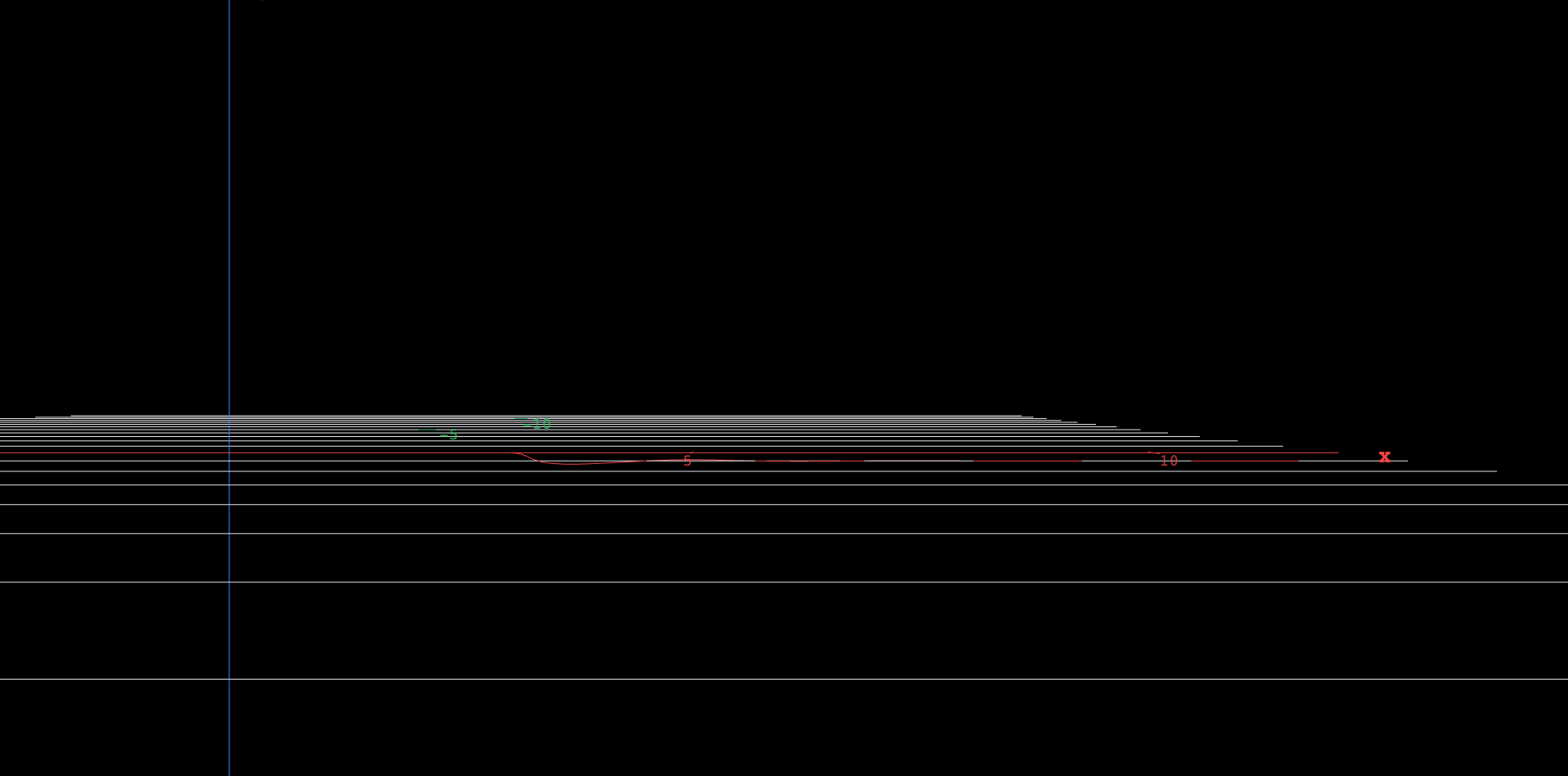 Explore in 3D (opens in a new tab)
Explore
- Observe. With , the curve before the switch is not merely small — it is exactly zero. Explain from the equation why rest plus zero forcing means zero, identically. Then count how many times the curve visibly crosses the dashed line before settling onto it.
- Predict. You are about to drag from to . Commit first: will the response change its shape, its height, or only its starting point?
- Verify. Drag. The whole pattern translates rigidly — the climb, the first peak, and each ring sit at the same distances after the switch, wherever the switch is. That rigidity is the factor made visible: a delay in time and nothing else.
- Observe. Read the first peak at any : height about , reached about after switch-on. The second peak is barely above the dashed line, near . The overshoot has collapsed to roughly an eighth of its first value in a single ring.
- Predict, then verify. Push to . Which features of the response still fit in the window , and which have fallen off the right edge? What would a switch at show?
Connect
The response has two personalities, and the partial fractions found them mechanically. The term inverts to the steady state , where the new constant force exactly balances the spring force . The remaining terms invert to the transient — a free damped vibration straight out of Chapter 2, born at the switching instant and dying like . No new behavior was invented at the switch: the denominator is the characteristic polynomial wearing its roots on its sleeve, so the ringing frequency and decay rate after the jump are the ones the free system always had.
The characteristic polynomial the denominator was wearing, solved exactly: one conjugate pair, decay rate , ringing frequency — certified against the roots the prose reads off its sleeve.
The shifting rule also handles switching off. A force applied only for is , and by linearity the response is : turn on the response, then turn on its negative. A whole chain of switches — on, off, on, off — costs one tagged term per switch, bookkeeping that the next section compresses into a geometric series.
The overshoot argument's one computation, certified. The engine shows its derivative in raw, uncollapsed form — and the check proves that expression equal to the the example states, which is exactly the claim that the cosine terms cancel. (Written in here; the example's shift changes nothing, as the example itself notes.)
An original work of XYZ Homework, built around interactive XYZ 3D figures, following the standard first-course sequence (first-order equations through systems and the phase plane). Distinct from the LibreTexts-sourced Differential Equations for Engineers (Lebl) edition, which has its own attribution. License: CC-BY-NC-SA-4.0.