
2.1 The Three Damping Regimes
A mass on a spring, slowed by friction and pushed by nothing, obeys
The coefficients are written in this particular way because of what happens next. Guessing and substituting turns the differential equation into an ordinary algebraic one — the characteristic equation
whose roots are . The guess pays off because differentiating an exponential returns the same exponential times a constant, so the whole equation collapses to a polynomial. The roots then tell you everything: the general solution is built from and , a decaying amplitude multiplying an oscillation of frequency . The real part is the decay rate; the imaginary part is the ringing.
One particular solution, with and a specific starting velocity, is
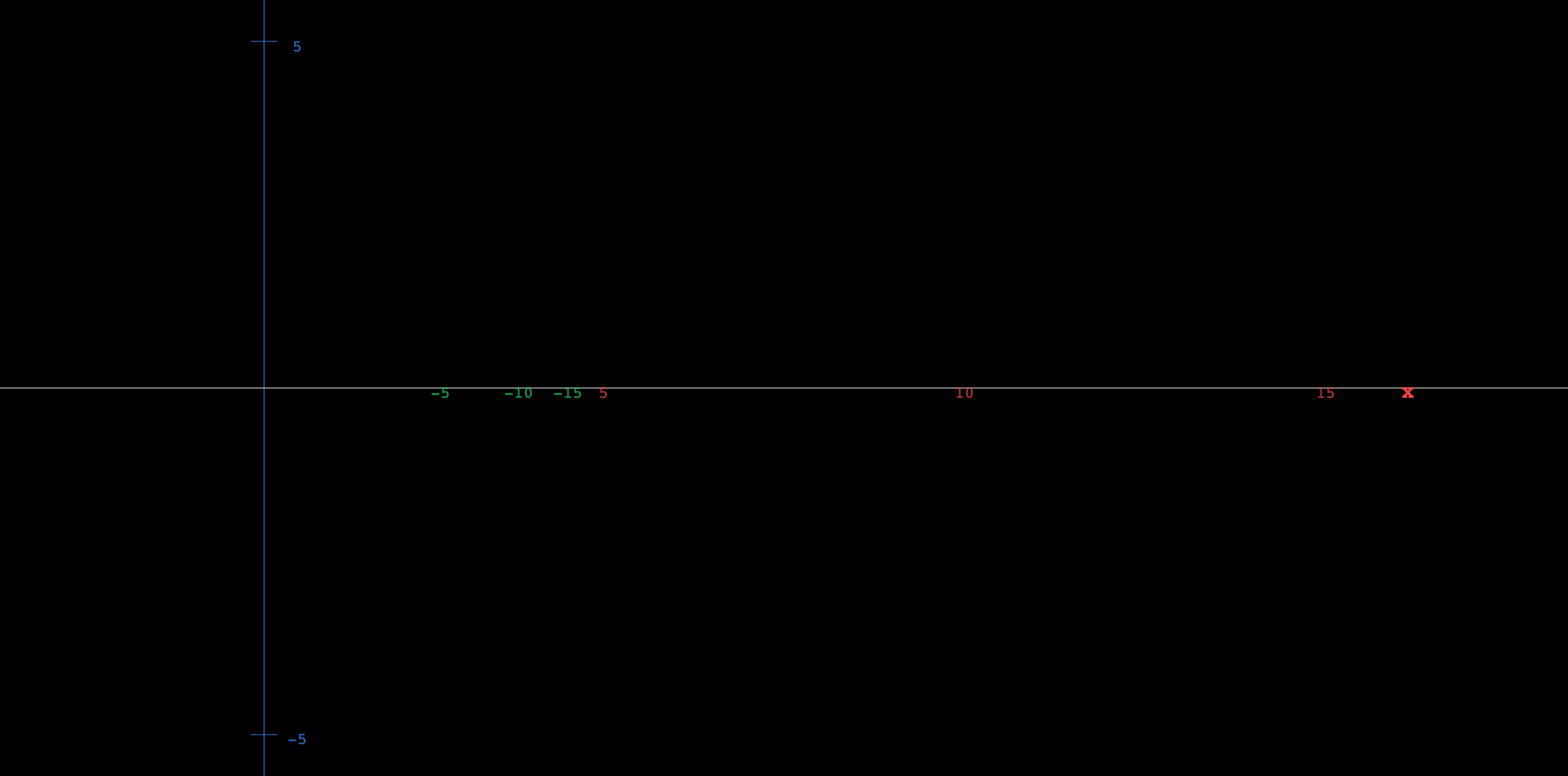
and that is what the figure below plots. Both parameters are live.
 Explore in 3D (opens in a new tab)
Explore
- Observe. Set , . With no damping the motion repeats forever at constant amplitude. Count how many complete oscillations fit in the window, and predict what setting will do to that count before you try it.
- Predict. Keeping , what changes as grows from to — the height of the wiggles, the spacing of the wiggles, or both? Commit to an answer.
- Verify. Drag to and check. The curve stays inside an invisible envelope ; the wiggle spacing is set by alone. Confirm the two sliders act independently.
- Observe. Now push to with still at . How many times does the curve cross zero before it becomes indistinguishable from the axis? Compare with the count at .
- Predict, then verify. Set and drag down to . The curve barely completes a single swing. What would mean for the characteristic roots, and what shape would the motion have?
Connect
Written in the standard form , the roots are , and the sign of the discriminant splits behavior into three cases. When the roots are complex, with : underdamped motion, oscillating inside a decaying envelope, everything the figure shows with positive. When both roots are real and negative: overdamped motion, a sum of two decaying exponentials that crosses zero at most once and never oscillates. The boundary case gives a repeated real root and is called critically damped; its solutions are , and among all damping choices it returns the mass to rest fastest without overshoot.
That last fact is engineering, not trivia. A screen door closer, a car's shock absorber, and an instrument needle are all deliberately tuned near critical damping — enough resistance to kill the ringing, not so much that the return crawls. In the figure, dragging upward with fixed walks you toward that tuning: the oscillations you have to eliminate are visible right up to the point where the last one disappears.
The overdamped contrast case is worth pinning down, because its roots are the one place in this section where an arithmetic slip is invisible to the eye — there is no picture to check them against. Both halves are computed here rather than typed.
The companion matrix of has equal to the polynomial shown — the characteristic equation the exponential guess produces, obtained here from the system rather than by hand. ( stands for .)
A root is a number the polynomial sends to zero, so the honest check is to substitute it back. The CAS returns exactly — no rounding, no decimal approximation — confirming , and the same substitution works for its partner . Their sum is and their product is , matching the equation's coefficients.
An original work of XYZ Homework, built around interactive XYZ 3D figures, following the standard first-course sequence (first-order equations through systems and the phase plane). Distinct from the LibreTexts-sourced Differential Equations for Engineers (Lebl) edition, which has its own attribution. License: CC-BY-NC-SA-4.0.