
31.6 Binding Energy
Learning Objectives
By the end of this section, you will be able to:
- Define and discuss binding energy.
- Calculate the binding energy per nucleon of a particle.
The more tightly bound a system is, the stronger the forces that hold it together and the greater the energy required to pull it apart. We can therefore learn about nuclear forces by examining how tightly bound the nuclei are. We define the binding energy (BE) of a nucleus to be the energy required to completely disassemble it into separate protons and neutrons. We can determine the BE of a nucleus from its rest mass. The two are connected through Einstein’s famous relationship . A bound system has a smaller mass than its separate constituents; the more tightly the nucleons are bound together, the smaller the mass of the nucleus.
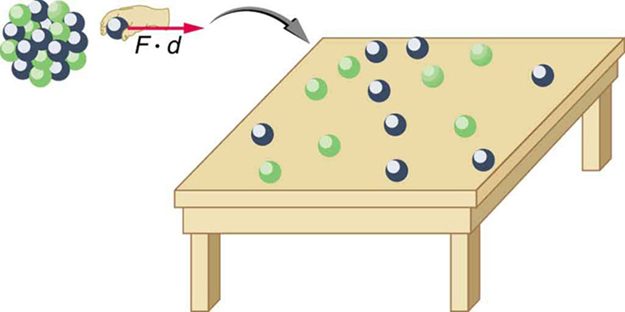
Imagine pulling a nuclide apart as illustrated in Figure 31.22. Work done to overcome the nuclear forces holding the nucleus together puts energy into the system. By definition, the energy input equals the binding energy BE. The pieces are at rest when separated, and so the energy put into them increases their total rest mass compared with what it was when they were glued together as a nucleus. That mass increase is thus . This difference in mass is known as mass defect. It implies that the mass of the nucleus is less than the sum of the masses of its constituent protons and neutrons. A nuclide has protons and neutrons, so that the difference in mass is
Thus,
where is the mass of the nuclide , is the mass of a proton, and is the mass of a neutron. Traditionally, we deal with the masses of neutral atoms. To get atomic masses into the last equation, we first add electrons to , which gives , the atomic mass of the nuclide. We then add electrons to the protons, which gives , or times the mass of a hydrogen atom. Thus the binding energy of a nuclide is
The atomic masses can be found in Appendix A, most conveniently expressed in unified atomic mass units u (). BE is thus calculated from known atomic masses.
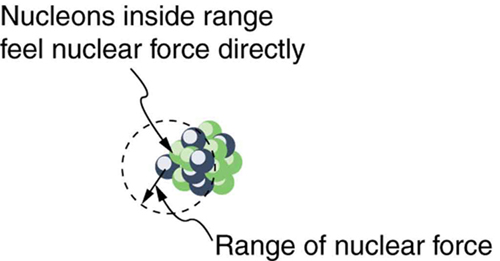
What patterns and insights are gained from an examination of the binding energy of various nuclides? First, we find that BE is approximately proportional to the number of nucleons in any nucleus. About twice as much energy is needed to pull apart a nucleus like compared with pulling apart , for example. To help us look at other effects, we divide BE by and consider the binding energy per nucleon, . The graph of in Figure 31.24 reveals some very interesting aspects of nuclei. We see that the binding energy per nucleon averages about 8 MeV, but is lower for both the lightest and heaviest nuclei. This overall trend, in which nuclei with equal to about 60 have the greatest and are thus the most tightly bound, is due to the combined characteristics of the attractive nuclear forces and the repulsive Coulomb force. It is especially important to note two things—the strong nuclear force is about 100 times stronger than the Coulomb force, and the nuclear forces are shorter in range compared to the Coulomb force. So, for low-mass nuclei, the nuclear attraction dominates and each added nucleon forms bonds with all others, causing progressively heavier nuclei to have progressively greater values of . This continues up to , roughly corresponding to the mass number of iron. Beyond that, new nucleons added to a nucleus will be too far from some others to feel their nuclear attraction. Added protons, however, feel the repulsion of all other protons, since the Coulomb force is longer in range. Coulomb repulsion grows for progressively heavier nuclei, but nuclear attraction remains about the same, and so becomes smaller. This is why stable nuclei heavier than have more neutrons than protons. Coulomb repulsion is reduced by having more neutrons to keep the protons farther apart (see Figure 31.25).
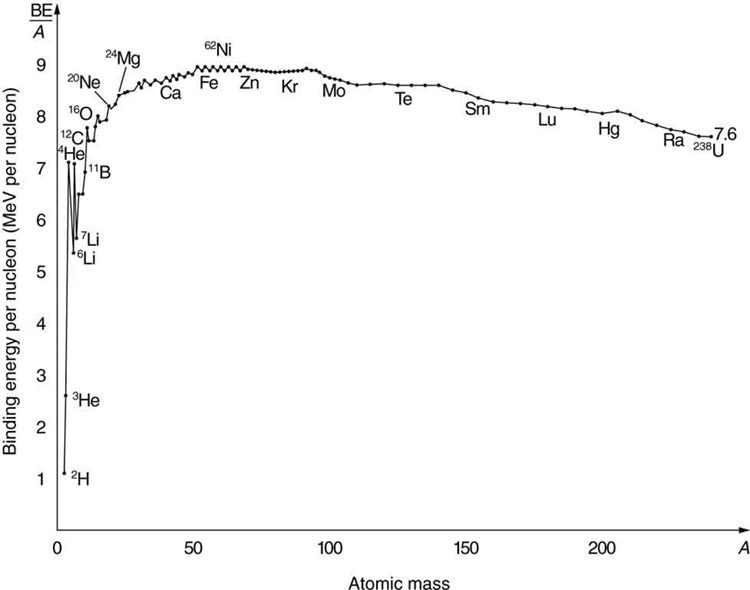
There are some noticeable spikes on the graph, which represent particularly tightly bound nuclei. These spikes reveal further details of nuclear forces, such as confirming that closed-shell nuclei (those with magic numbers of protons or neutrons or both) are more tightly bound. The spikes also indicate that some nuclei with even numbers for and , and with , are exceptionally tightly bound. This finding can be correlated with some of the cosmic abundances of the elements. The most common elements in the universe, as determined by observations of atomic spectra from outer space, are hydrogen, followed by , with much smaller amounts of and other elements. It should be noted that the heavier elements are created in supernova explosions, while the lighter ones are produced by nuclear fusion during the normal life cycles of stars, as will be discussed in subsequent chapters. The most common elements have the most tightly bound nuclei. It is also no accident that one of the most tightly bound light nuclei is , emitted in decay.
There is more to be learned from nuclear binding energies. The general trend in is fundamental to energy production in stars, and to fusion and fission energy sources on Earth, for example. This is one of the applications of nuclear physics covered in Medical Applications of Nuclear Physics. The abundance of elements on Earth, in stars, and in the universe as a whole is related to the binding energy of nuclei and has implications for the continued expansion of the universe.
Problem-Solving Strategies
For Reaction And Binding Energies and Activity Calculations in Nuclear Physics
- Identify exactly what needs to be determined in the problem (identify the unknowns). This will allow you to decide whether the energy of a decay or nuclear reaction is involved, for example, or whether the problem is primarily concerned with activity (rate of decay).
- Make a list of what is given or can be inferred from the problem as stated (identify the knowns).
- For reaction and binding-energy problems, we use atomic rather than nuclear masses. Since the masses of neutral atoms are used, you must count the number of electrons involved. If these do not balance (such as in decay), then an energy adjustment of 0.511 MeV per electron must be made. Also note that atomic masses may not be given in a problem; they can be found in tables.
- For problems involving activity, the relationship of activity to half-life, and the number of nuclei given in the equation can be very useful. Owing to the fact that number of nuclei is involved, you will also need to be familiar with moles and Avogadro’s number.
- Perform the desired calculation; keep careful track of plus and minus signs as well as powers of 10.
- Check the answer to see if it is reasonable: Does it make sense? Compare your results with worked examples and other information in the text. (Heeding the advice in Step 5 will also help you to be certain of your result.) You must understand the problem conceptually to be able to determine whether the numerical result is reasonable.
Test Prep for AP Courses
Binding energy is a measure of how much work must be done against nuclear forces in order to disassemble a nucleus into its constituent parts. For example, the amount of energy in order to disassemble into 2 protons and 2 neutrons requires 28.3 MeV of work to be done on the nuclear particles. Describe the force that makes it so difficult to pull a nucleus apart. Would it be accurate to say that the electric force plays a role in the forces within a nucleus? Explain why or why not.
Section Summary
- The binding energy (BE) of a nucleus is the energy needed to separate it into individual protons and neutrons. In terms of atomic masses, where is the mass of a hydrogen atom, is the atomic mass of the nuclide, and is the mass of a neutron. Patterns in the binding energy per nucleon, , reveal details of the nuclear force. The larger the , the more stable the nucleus.
Conceptual Questions
Why is the number of neutrons greater than the number of protons in stable nuclei having greater than about 40, and why is this effect more pronounced for the heaviest nuclei?
Problems & Exercises
is a loosely bound isotope of hydrogen. Called deuterium or heavy hydrogen, it is stable but relatively rare—it is 0.015% of natural hydrogen. Note that deuterium has , which should tend to make it more tightly bound, but both are odd numbers. Calculate , the binding energy per nucleon, for and compare it with the approximate value obtained from the graph in Figure 31.24.
1.112 MeV, consistent with graph
is among the most tightly bound of all nuclides. It is more than 90% of natural iron. Note that has even numbers of both protons and neutrons. Calculate , the binding energy per nucleon, for and compare it with the approximate value obtained from the graph in Figure 31.24.
is the heaviest stable nuclide, and its is low compared with medium-mass nuclides. Calculate , the binding energy per nucleon, for and compare it with the approximate value obtained from the graph in Figure 31.24.
7.848 MeV, consistent with graph
(a) Calculate for , the rarer of the two most common uranium isotopes. (b) Calculate for . (Most of uranium is .) Note that has even numbers of both protons and neutrons. Is the of significantly different from that of ?
(a) Calculate for . Stable and relatively tightly bound, this nuclide is most of natural carbon. (b) Calculate for . Is the difference in between and significant? One is stable and common, and the other is unstable and rare.
(a) 7.680 MeV, consistent with graph
(b) 7.520 MeV, consistent with graph. Not significantly different from value for , but sufficiently lower to allow decay into another nuclide that is more tightly bound.
The fact that is greatest for near 60 implies that the range of the nuclear force is about the diameter of such nuclides. (a) Calculate the diameter of an nucleus. (b) Compare for and . The first is one of the most tightly bound nuclides, while the second is larger and less tightly bound.
The purpose of this problem is to show in three ways that the binding energy of the electron in a hydrogen atom is negligible compared with the masses of the proton and electron. (a) Calculate the mass equivalent in u of the 13.6-eV binding energy of an electron in a hydrogen atom, and compare this with the mass of the hydrogen atom obtained from Appendix A. (b) Subtract the mass of the proton given in Table 31.2 from the mass of the hydrogen atom given in Appendix A. You will find the difference is equal to the electron’s mass to three digits, implying the binding energy is small in comparison. (c) Take the ratio of the binding energy of the electron (13.6 eV) to the energy equivalent of the electron’s mass (0.511 MeV). (d) Discuss how your answers confirm the stated purpose of this problem.
(a) vs. 1.007825 u for
(b) 0.000549 u
(c)
Unreasonable Results
A particle physicist discovers a neutral particle with a mass of 2.02733 u that he assumes is two neutrons bound together. (a) Find the binding energy. (b) What is unreasonable about this result? (c) What assumptions are unreasonable or inconsistent?
(a)
(b) The negative binding energy implies an unbound system.
(c) This assumption that it is two bound neutrons is incorrect.
Adapted from College Physics 2e by OpenStax (openstax.org), licensed under CC BY-NC-SA 4.0. Changes were made. License: CC-BY-NC-SA-4.0.