
30.8 Quantum Numbers and Rules
Learning Objectives
By the end of this section, you will be able to:
- Define quantum number.
- Calculate angle of angular momentum vector with an axis.
- Define spin quantum number.
Physical characteristics that are quantized—such as energy, charge, and angular momentum—are of such importance that names and symbols are given to them. The values of quantized entities are expressed in terms of quantum numbers, and the rules governing them are of the utmost importance in determining what nature is and does. This section covers some of the more important quantum numbers and rules—all of which apply in chemistry, material science, and far beyond the realm of atomic physics, where they were first discovered. Once again, we see how physics makes discoveries which enable other fields to grow.
The energy states of bound systems are quantized, because the particle wavelength can fit into the bounds of the system in only certain ways. This was elaborated for the hydrogen atom, for which the allowed energies are expressed as , where . We define to be the principal quantum number that labels the basic states of a system. The lowest-energy state has , the first excited state has , and so on. Thus the allowed values for the principal quantum number are
This is more than just a numbering scheme, since the energy of the system, such as the hydrogen atom, can be expressed as some function of , as can other characteristics (such as the orbital radii of the hydrogen atom).
The fact that the magnitude of angular momentum is quantized was first recognized by Bohr in relation to the hydrogen atom; it is now known to be true in general. With the development of quantum mechanics, it was found that the magnitude of angular momentum can have only the values
where is defined to be the angular momentum quantum number. The rule for in atoms is given in the parentheses. Given , the value of can be any integer from zero up to . For example, if , then can be 0, 1, 2, or 3.
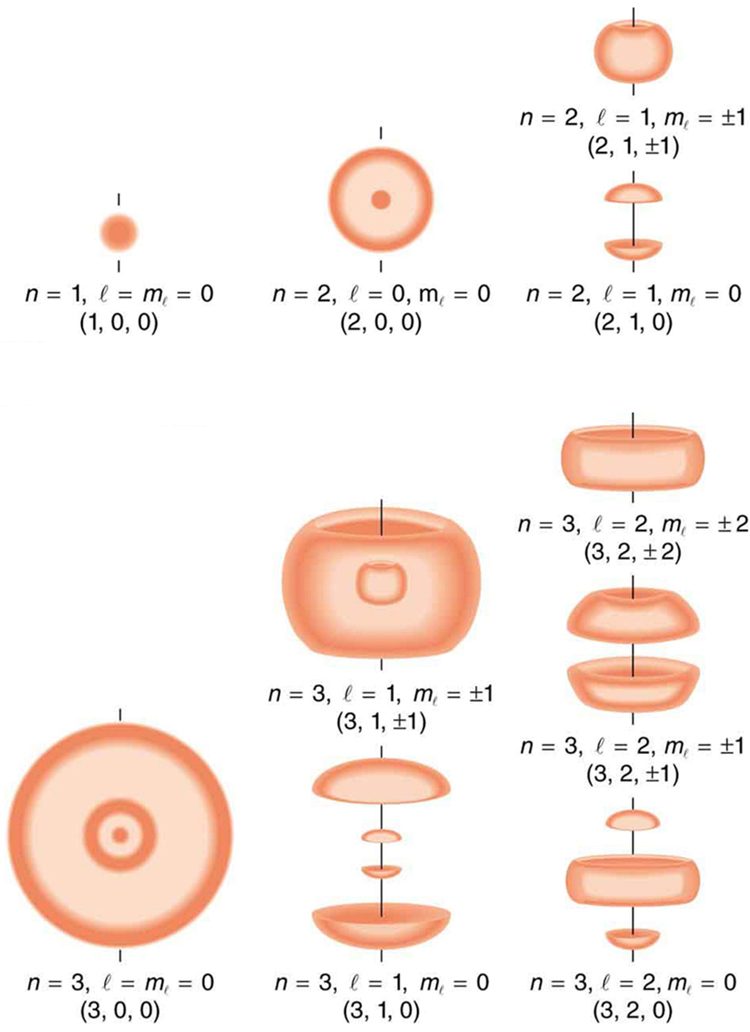
Note that for , can only be zero. This means that the ground-state angular momentum for hydrogen is actually zero, not as Bohr proposed. The picture of circular orbits is not valid, because there would be angular momentum for any circular orbit. A more valid picture is the cloud of probability shown for the ground state of hydrogen in Figure 30.48. The electron actually spends time in and near the nucleus. The reason the electron does not remain in the nucleus is related to Heisenberg’s uncertainty principle—the electron’s energy would have to be much too large to be confined to the small space of the nucleus. Now the first excited state of hydrogen has , so that can be either 0 or 1, according to the rule in . Similarly, for , can be 0, 1, or 2. It is often most convenient to state the value of , a simple integer, rather than calculating the value of from . For example, for , we see that
It is much simpler to state .
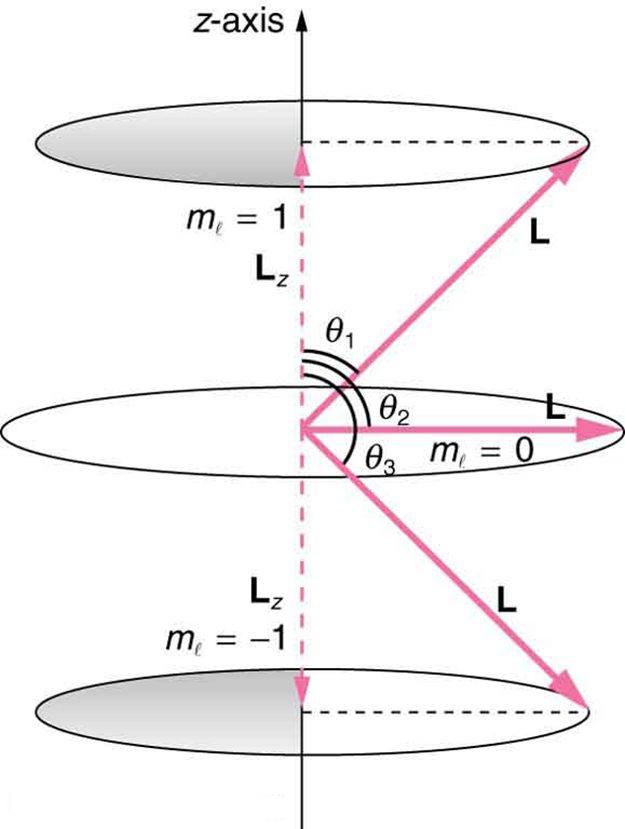
As recognized in the Zeeman effect, the direction of angular momentum is quantized. We now know this is true in all circumstances. It is found that the component of angular momentum along one direction in space, usually called the -axis, can have only certain values of . The direction in space must be related to something physical, such as the direction of the magnetic field at that location. This is an aspect of relativity. Direction has no meaning if there is nothing that varies with direction, as does magnetic force. The allowed values of are
where is the -component of the angular momentum and is the angular momentum projection quantum number. The rule in parentheses for the values of is that it can range from to in steps of one. For example, if , then can have the five values –2, –1, 0, 1, and 2. Each corresponds to a different energy in the presence of a magnetic field, so that they are related to the splitting of spectral lines into discrete parts, as discussed in the preceding section. If the -component of angular momentum can have only certain values, then the angular momentum can have only certain directions, as illustrated in Figure 30.55.
Intrinsic Spin Angular Momentum Is Quantized in Magnitude and Direction
There are two more quantum numbers of immediate concern. Both were first discovered for electrons in conjunction with fine structure in atomic spectra. It is now well established that electrons and other fundamental particles have intrinsic spin, roughly analogous to a planet spinning on its axis. This spin is a fundamental characteristic of particles, and only one magnitude of intrinsic spin is allowed for a given type of particle. Intrinsic angular momentum is quantized independently of orbital angular momentum. Additionally, the direction of the spin is also quantized. It has been found that the magnitude of the intrinsic (internal) spin angular momentum, , of an electron is given by
where is defined to be the spin quantum number. This is very similar to the quantization of given in , except that the only value allowed for for electrons is 1/2.
The direction of intrinsic spin is quantized, just as is the direction of orbital angular momentum. The direction of spin angular momentum along one direction in space, again called the -axis, can have only the values
for electrons. is the -component of spin angular momentum and is the spin projection quantum number. For electrons, can only be 1/2, and can be either +1/2 or –1/2. Spin projection is referred to as spin up, whereas is called spin down. These are illustrated in Figure 30.54.
To summarize, the state of a system, such as the precise nature of an electron in an atom, is determined by its particular quantum numbers. These are expressed in the form —see Table 30.1 For electrons in atoms, the principal quantum number can have the values . Once is known, the values of the angular momentum quantum number are limited to . For a given value of , the angular momentum projection quantum number can have only the values . Electron spin is independent of and , always having . The spin projection quantum number can have two values, .
| Name | Symbol | Allowed values |
|---|---|---|
| Principal quantum number | ||
| Angular momentum | ||
| Angular momentum projection | ||
| Spin1 | ||
| Spin projection |
Figure 30.56 shows several hydrogen states corresponding to different sets of quantum numbers. Note that these clouds of probability are the locations of electrons as determined by making repeated measurements—each measurement finds the electron in a definite location, with a greater chance of finding the electron in some places rather than others. With repeated measurements, the pattern of probability shown in the figure emerges. The clouds of probability do not look like nor do they correspond to classical orbits. The uncertainty principle actually prevents us and nature from knowing how the electron gets from one place to another, and so an orbit really does not exist as such. Nature on a small scale is again much different from that on the large scale.
We will see that the quantum numbers discussed in this section are valid for a broad range of particles and other systems, such as nuclei. Some quantum numbers, such as intrinsic spin, are related to fundamental classifications of subatomic particles, and they obey laws that will give us further insight into the substructure of matter and its interactions.
Section Summary
- Quantum numbers are used to express the allowed values of quantized entities. The principal quantum number labels the basic states of a system and is given by
- The magnitude of angular momentum is given by where is the angular momentum quantum number. The direction of angular momentum is quantized, in that its component along an axis defined by a magnetic field, called the -axis is given by is the -component of the angular momentum and is the angular momentum projection quantum number. Similarly, the electron’s intrinsic spin angular momentum is given by is defined to be the spin quantum number. Finally, the direction of the electron’s spin along the -axis is given by where is the -component of spin angular momentum and is the spin projection quantum number. Spin projection is referred to as spin up, whereas is called spin down. Table 30.1 summarizes the atomic quantum numbers and their allowed values.
Conceptual Questions
Define the quantum numbers , and .
For a given value of , what are the allowed values of ?
For a given value of , what are the allowed values of ? What are the allowed values of for a given value of ? Give an example in each case.
List all the possible values of and for an electron. Are there particles for which these values are different? The same?
Problem Exercises
If an atom has an electron in the state with , what are the possible values of ?
are possible since and .
An atom has an electron with . What is the smallest value of for this electron?
What are the possible values of for an electron in the state?
are possible.
What, if any, constraints does a value of place on the other quantum numbers for an electron in an atom?
(a) Calculate the magnitude of the angular momentum for an electron. (b) Compare your answer to the value Bohr proposed for the state.
(a)
(b)
Exercise 30.40
(a) What is the magnitude of the angular momentum for an electron? (b) Calculate the magnitude of the electron’s spin angular momentum. (c) What is the ratio of these angular momenta?
Repeat Exercise 30.40 for .
(a)
(b)
(c)
(a) How many angles can make with the -axis for an electron? (b) Calculate the value of the smallest angle.
What angles can the spin of an electron make with the -axis?
Adapted from College Physics 2e by OpenStax (openstax.org), licensed under CC BY-NC-SA 4.0. Changes were made. License: CC-BY-NC-SA-4.0.