Observe heat transfer and change in temperature and mass.
Calculate final temperature after heat transfer between two objects.
One of the major effects of heat transfer is temperature change: heating increases the temperature while cooling decreases it. We assume that there is no phase change and that no work is done on or by the system. Experiments show that the transferred heat depends on three factors—the change in temperature, the mass of the system, and the substance and phase of the substance.
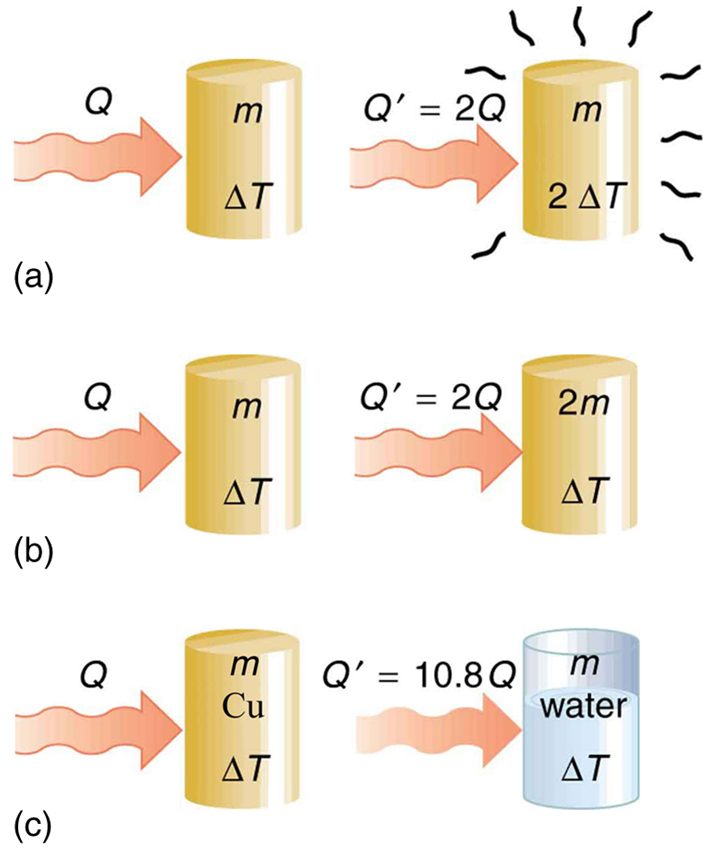
Figure 14.4The heat transferred to cause a temperature change depends on the magnitude of the temperature change, the mass of the system, and the substance and phase involved. (a) The amount of heat transferred is directly proportional to the temperature change. To double the temperature change of a mass , you need to add twice the heat. (b) The amount of heat transferred is also directly proportional to the mass. To cause an equivalent temperature change in a doubled mass, you need to add twice the heat. (c) The amount of heat transferred depends on the substance and its phase. If it takes an amount of heat to cause a temperature change in a given mass of copper, it will take 10.8 times that amount of heat to cause the equivalent temperature change in the same mass of water assuming no phase change in either substance.
The dependence on temperature change and mass are easily understood. Owing to the fact that the (average) kinetic energy of an atom or molecule is proportional to the absolute temperature, the internal energy of a system is proportional to the absolute temperature and the number of atoms or molecules. Owing to the fact that the transferred heat is equal to the change in the internal energy, the heat is proportional to the mass of the substance and the temperature change. The transferred heat also depends on the substance so that, for example, the heat necessary to raise the temperature is less for alcohol than for water. For the same substance, the transferred heat also depends on the phase (gas, liquid, or solid).
Values of specific heat must generally be looked up in tables, because there is no simple way to calculate them. In general, the specific heat also depends on the temperature. Table 14.1 lists representative values of specific heat for various substances. Except for gases, the temperature and volume dependence of the specific heat of most substances is weak. We see from this table that the specific heat of water is five times that of glass and ten times that of iron, which means that it takes five times as much heat to raise the temperature of water the same amount as for glass and ten times as much heat to raise the temperature of water as for iron. In fact, water has one of the largest specific heats of any material, which is important for sustaining life on Earth.
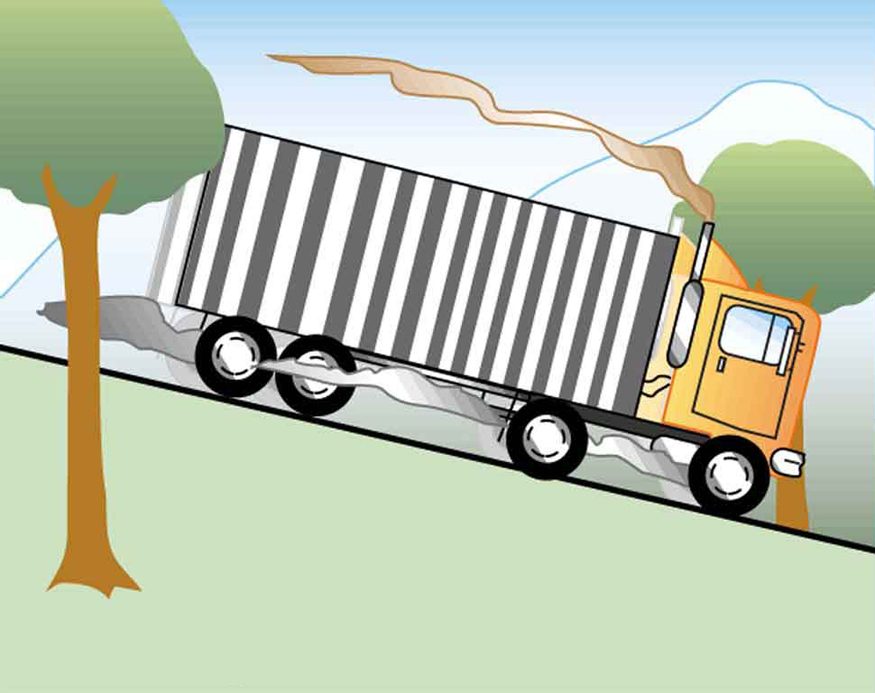
Figure 14.5The smoking brakes on this truck are a visible evidence of the mechanical equivalent of heat.
Note that Example 2 is an illustration of the mechanical equivalent of heat. Alternatively, the temperature increase could be produced by a blow torch instead of mechanically.
If 25 kJ is necessary to raise the temperature of a block from to , how much heat is necessary to heat the block from to ?
The heat transfer depends only on the temperature difference. Since the temperature differences are the same in both cases, the same 25 kJ is necessary in the second case.
Summary
The transfer of heat that leads to a change in the temperature of a body with mass is , where is the specific heat of the material. This relationship can also be considered as the definition of specific heat.
Conceptual Questions
What three factors affect the heat transfer that is necessary to change an object’s temperature?
The brakes in a car increase in temperature by when bringing the car to rest from a speed . How much greater would be if the car initially had twice the speed? You may assume the car to stop sufficiently fast so that no heat transfers out of the brakes.
Problems & Exercises
On a hot day, the temperature of an 80,000-L swimming pool increases by . What is the net heat transfer during this heating? Ignore any complications, such as loss of water by evaporation.
Show that .
To sterilize a 50.0-g glass baby bottle, we must raise its temperature from to . How much heat transfer is required?
The same heat transfer into identical masses of different substances produces different temperature changes. Calculate the final temperature when 1.00 kcal of heat transfers into 1.00 kg of the following, originally at : (a) water; (b) concrete; (c) steel; and (d) mercury.
Rubbing your hands together warms them by converting work into thermal energy. If a woman rubs her hands back and forth for a total of 20 rubs, at a distance of 7.50 cm per rub, and with an average frictional force of 40.0 N, what is the temperature increase? The mass of tissues warmed is only 0.100 kg, mostly in the palms and fingers.
A 0.250-kg block of a pure material is heated from to by the addition of 4.35 kJ of energy. Calculate its specific heat and identify the substance of which it is most likely composed.
Suppose identical amounts of heat transfer into different masses of copper and water, causing identical changes in temperature. What is the ratio of the mass of copper to water?
10.8
(a) The number of kilocalories in food is determined by calorimetry techniques in which the food is burned and the amount of heat transfer is measured. How many kilocalories per gram are there in a 5.00-g peanut if the energy from burning it is transferred to 0.500 kg of water held in a 0.100-kg aluminum cup, causing a temperature increase? (b) Compare your answer to labeling information found on a package of peanuts and comment on whether the values are consistent.
Following vigorous exercise, the body temperature of an 80.0-kg person is . At what rate in watts must the person transfer thermal energy to reduce the the body temperature to in 30.0 min, assuming the body continues to produce energy at the rate of 150 W? .
617 W
Even when shut down after a period of normal use, a large commercial nuclear reactor transfers thermal energy at the rate of 150 MW by the radioactive decay of fission products. This heat transfer causes a rapid increase in temperature if the cooling system fails (1 watt = 1 joule/second or 1 W = 1 J/s and 1 MW = 1 megawatt). (a) Calculate the rate of temperature increase in degrees Celsius per second
if the mass of the reactor core is
and it has an average specific heat of
. (b) How long would it take to obtain a temperature increase of
, which could cause some metals holding the radioactive materials to melt? (The initial rate of temperature increase would be greater than that calculated here because the heat transfer is concentrated in a smaller mass. Later, however, the temperature increase would slow down because the
steel containment vessel would also begin to heat up.)
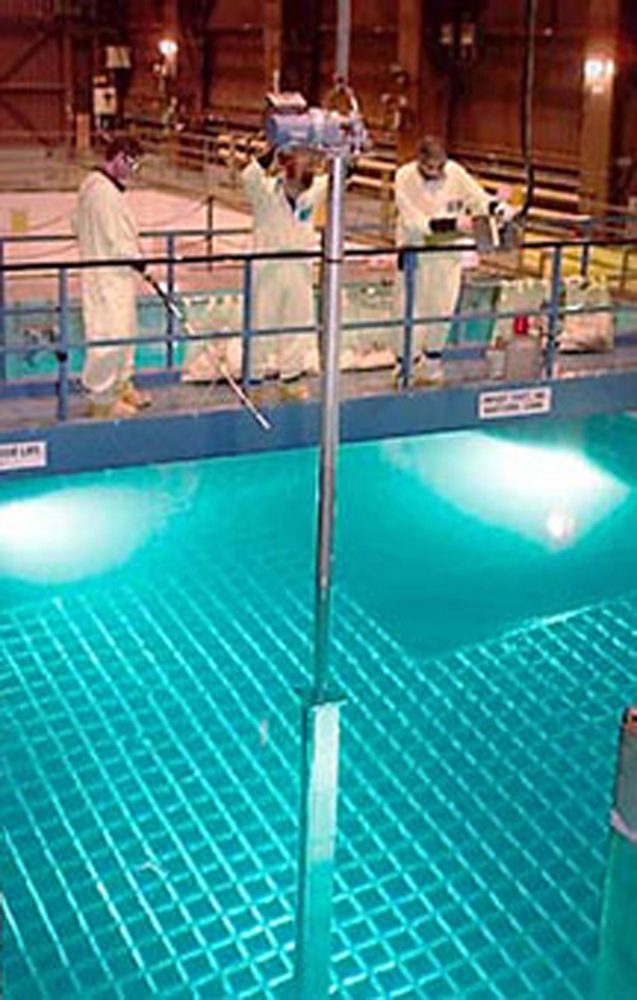
Figure 14.6Radioactive spent-fuel pool at a nuclear power plant. Spent fuel stays hot for a long time.Radioactive spent-fuel pool at a nuclear power plant. Spent fuel stays hot for a long time. (credit: U.S. Department of Energy)
Adapted from College Physics 2e by OpenStax (openstax.org), licensed under CC BY-NC-SA 4.0. Changes were made. License: CC-BY-NC-SA-4.0.
These eBooks are a prerelease and are not yet certified conformant with WCAG 2.1 AA or ADA Title II. Every page is built against an automated accessibility gate, and the published editions will meet ADA Title II requirements when they release in late September 2026. If something is unusable, please tell us.