
9.4 Applications of Statics, Including Problem-Solving Strategies
Learning Objectives
By the end of this section, you will be able to:
- Discuss the applications of Statics in real life.
- State and discuss various problem-solving strategies in Statics.
Statics can be applied to a variety of situations, ranging from raising a drawbridge to bad posture and back strain. We begin with a discussion of problem-solving strategies specifically used for statics. Since statics is a special case of Newton’s laws, both the general problem-solving strategies and the special strategies for Newton’s laws, discussed in Problem-Solving Strategies, still apply.
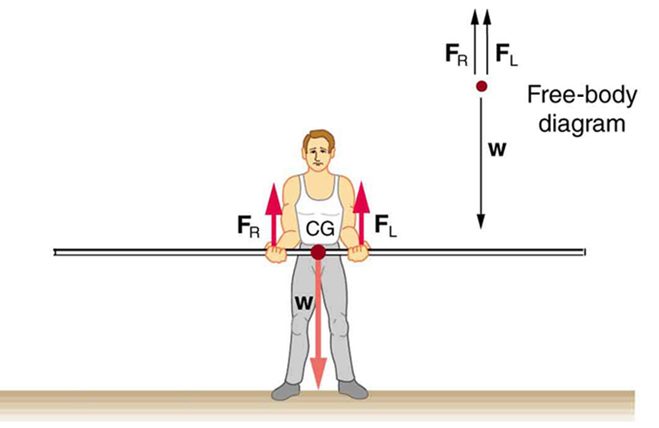
Now let us apply this problem-solving strategy for the pole vaulter shown in the three figures below. The pole is uniform and has a mass of 5.00 kg. In Figure 9.25, the pole’s cg lies halfway between the vaulter’s hands. It seems reasonable that the force exerted by each hand is equal to half the weight of the pole, or 24.5 N. This obviously satisfies the first condition for equilibrium . The second condition is also satisfied, as we can see by choosing the cg to be the pivot point. The weight exerts no torque about a pivot point located at the cg, since it is applied at that point and its lever arm is zero. The equal forces exerted by the hands are equidistant from the chosen pivot, and so they exert equal and opposite torques. Similar arguments hold for other systems where supporting forces are exerted symmetrically about the cg. For example, the four legs of a uniform table each support one-fourth of its weight.
In Figure 9.25, a pole vaulter holding a pole with its cg halfway between his hands is shown. Each hand exerts a force equal to half the weight of the pole, . (b) The pole vaulter moves the pole to his left, and the forces that the hands exert are no longer equal. See Figure 9.25. If the pole is held with its cg to the left of the person, then he must push down with his right hand and up with his left. The forces he exerts are larger here because they are in opposite directions and the cg is at a long distance from either hand.
Similar observations can be made using a meter stick held at different locations along its length.
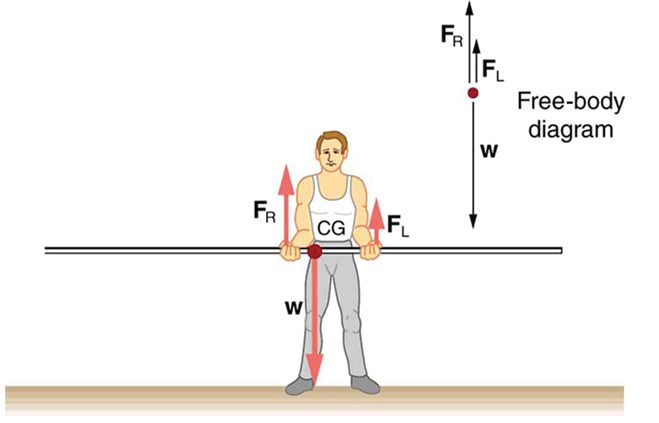
If the pole vaulter holds the pole as shown in Figure 9.26, the situation is not as simple. The total force he exerts is still equal to the weight of the pole, but it is not evenly divided between his hands. (If , then the torques about the cg would not be equal since the lever arms are different.) Logically, the right hand should support more weight, since it is closer to the cg. In fact, if the right hand is moved directly under the cg, it will support all the weight. This situation is exactly analogous to two people carrying a load; the one closer to the cg carries more of its weight. Finding the forces and is straightforward, as the next example shows.
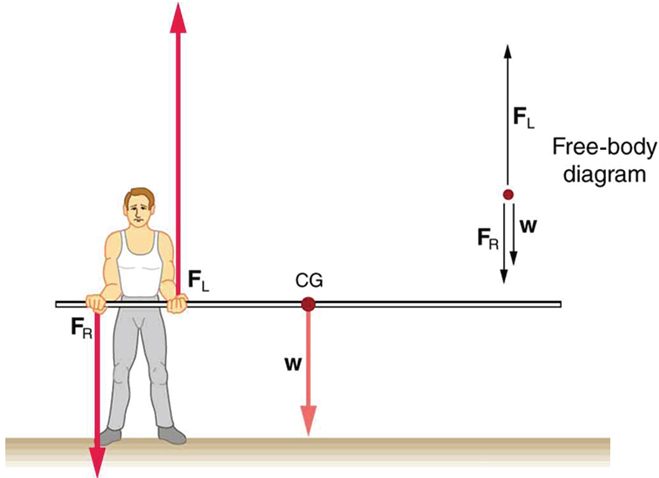
If the pole vaulter holds the pole from near the end of the pole (Figure 9.27), the direction of the force applied by the right hand of the vaulter reverses its direction.
If the pole vaulter holds the pole as he might at the start of a run, shown in Figure 9.27, the forces change again. Both are considerably greater, and one force reverses direction.
Test Prep for AP Courses
A child sits on the end of a playground see-saw. Which of the following values is the most appropriate estimate of the torque created by the child?
- 6 N⋅m
- 60 N⋅m
- 600 N⋅m
- 6000 N⋅m
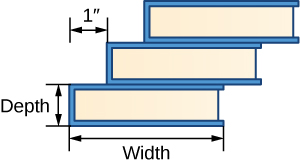
A group of students is stacking a set of identical books, each one overhanging the one below it by 1 inch. They would like to estimate how many books they could place on top of each other before the stack tipped. What information below would they need to know to make this calculation?
- The mass of each book
- The width of each book
- The depth of each book
- I only
- I and II only
- I and III only
- II only
- I, II, and III
(d)
A 10 N board of uniform density is 5 meters long. It is supported on the left by a string bearing a 3 N upward force. In order to prevent the string from breaking, a person must place an upward force of 7 N at a position along the bottom surface of the board. At what distance from its left edge would they need to place this force in order for the board to be in static equilibrium?
- m
- m
- m
- m
- 5 m
A bridge is supported by two piers located 20 meters apart. Both the left and right piers provide an upward force on the bridge, labeled FL and FR respectively.
- If a 1000 kg car comes to rest at a point 5 meters from the left pier, how much force will the bridge provide to the left and right piers?
- How will FL and FR change as the car drives to the right side of the bridge?
- FL = 7350 N, FR = 2450 N
- As the car moves to the right side of the bridge, FL will decrease and FR will increase. (At exactly halfway across the bridge, FL and FR will both be 4900 N.)
An object of unknown mass is provided to a student. Without using a scale, design an experimental procedure detailing how the magnitude of this mass could be experimentally found. Your explanation must include the concept of torque and all steps should be provided in an orderly sequence. You may include a labeled diagram of your setup to help in your description. Include enough detail so that another student could carry out your procedure.
Summary
- Statics can be applied to a variety of situations, ranging from raising a drawbridge to bad posture and back strain. We have discussed the problem-solving strategies specifically useful for statics. Statics is a special case of Newton’s laws, both the general problem-solving strategies and the special strategies for Newton’s laws, discussed in Problem-Solving Strategies, still apply.
Conceptual Questions
When visiting some countries, you may see a person balancing a load on the head. Explain why the center of mass of the load needs to be directly above the person’s neck vertebrae.
Problems & Exercises
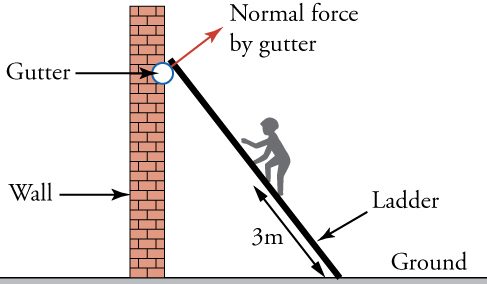
To get up on the roof, a person (mass 70.0 kg) places a 6.00-m aluminum ladder (mass 10.0 kg) against the house on a concrete pad with the base of the ladder 2.00 m from the house. The ladder rests against a plastic rain gutter, which we can assume to be frictionless. Because the gutter is round, the ladder is tangent to it and therefore the normal force by the gutter is perpendicular to the ladder. The center of mass of the ladder is 2.00 m from the bottom, measured parallel to the ladder. The person is standing 3.00 m from the bottom, again measured parallel to the ladder. What are the magnitudes of the forces on the ladder at the top and bottom?
In Figure 9.27, the cg of the pole held by the pole vaulter is 2.00 m from the left hand, and the hands are 0.700 m apart. Calculate the force exerted by (a) his right hand and (b) his left hand. (c) If each hand supports half the weight of the pole in Figure 9.25, show that the second condition for equilibrium is satisfied for a pivot other than the one located at the center of gravity of the pole. Explicitly show how you follow the steps in the Problem-Solving Strategy for static equilibrium described above.
Adapted from College Physics 2e by OpenStax (openstax.org), licensed under CC BY-NC-SA 4.0. Changes were made. License: CC-BY-NC-SA-4.0.